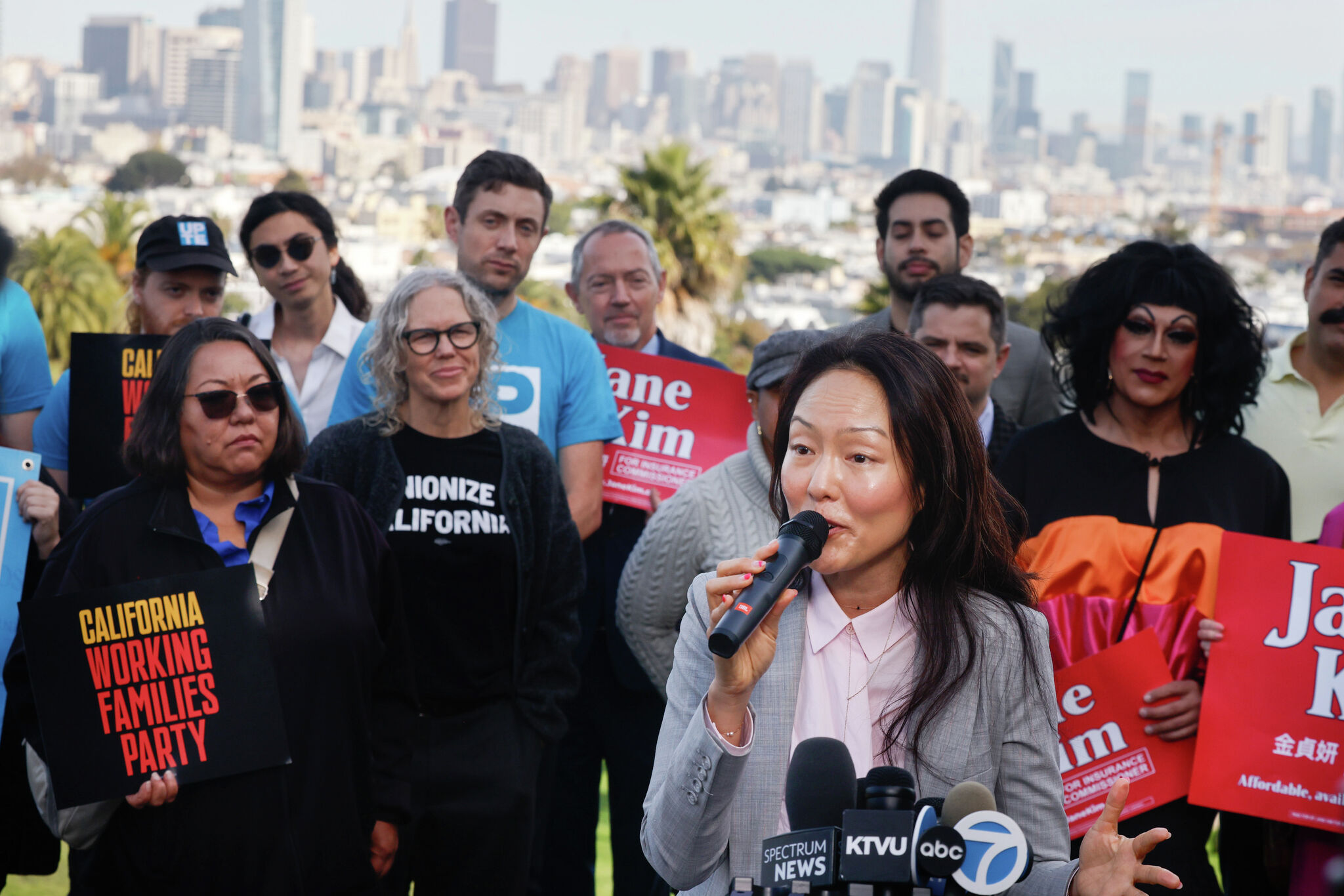
Jane Kim Claims Victory in California Insurance Commissioner Race
Standing before the historic fire hydrant that famously saved the Mission District during the 1906 earthquake and fire, Jane Kim declared victory on Friday in the race to become California’s next insurance commissioner. The announcement, reported by the San Francisco Chronicle, comes as the state grapples with an insurance market in flux, characterized by rising premiums and the increasing reality of climate-driven disaster risks.
While the race has not yet been formally called by election officials, Kim holds a commanding lead of roughly 400,000 votes, capturing 52.7% of the vote with about 65% of ballots counted as of midday Friday. Her opponent, state Sen. Ben Allen of Santa Monica, confirmed he spoke with Kim on Friday morning to offer his congratulations, though his campaign has stopped short of a formal concession.
The stakes for the incoming commissioner are high. The position, recently described by Bloomberg as “the worst job in California politics,” requires navigating a complex, $3 trillion industry while balancing the needs of homeowners facing coverage cancellations and the financial solvency of the state’s insurance market. Kim, a former San Francisco supervisor and regional director for Bernie Sanders’ 2020 presidential campaign, would become the first Working Families Party candidate to hold statewide office in the United States.
A Shift in Regulatory Philosophy
The election offered voters two distinct visions for the future of California’s insurance landscape. Kim centered her platform on a proposal to establish a state-run, nonprofit disaster insurer—a model drawing inspiration from the California Earthquake Authority. She argues that shifting disaster coverage out of the private market is the only sustainable path forward as climate risks intensify. Conversely, Allen advocated for decreasing the state’s reliance on the FAIR Plan—the state’s insurer of last resort—by focusing on risk reduction and streamlining the claims process to restore private market competition.
The ideological divide was underscored by the backing each candidate received. Allen secured support from prominent figures in Southern California real estate, including Rick Caruso and Jason Oppenheim. Kim, meanwhile, leaned into a progressive coalition, garnering endorsements from high-profile figures such as U.S. Rep. Ro Khanna and U.S. Rep. Pramila Jayapal. The absence of a Republican candidate in the race created a unique dynamic, leading to a significant drop-off in voter participation for the commissioner’s seat compared to the gubernatorial contest.
Market Fragility and the Path Forward
The American Property Casualty Insurance Association (APCIA) acknowledged the election results in a statement on Friday, signaling a willingness to work with the incoming commissioner while simultaneously warning against radical policy shifts. Denni Ritter, the organization’s department vice president for state government relations, emphasized that the market is only just beginning to stabilize following recent legislative reforms. The industry group cautioned that “costly new mandates or regulatory actions” could inadvertently worsen the crisis by limiting coverage options.

Kim acknowledged the difficulty of the task ahead, noting that she enters the role with no illusions about the intensity of the fight. The practical reality for millions of Californians remains unchanged for now: the state continues to see insurers pull back from high-fire-risk zones, and residents in areas like Pacific Palisades and Altadena remain hyper-aware of the industry’s limitations after the 2025 wildfires.
As the final ballots are processed, the focus shifts toward the transition. Ricardo Lara, the outgoing commissioner who has held the office since 2019, will hand over the reins at the beginning of next year. Whether Kim’s proposal for a state-run disaster insurer can navigate the legislative and financial hurdles required to become reality remains the defining question of her incoming term. For now, the victory represents a clear mandate from voters who, in the absence of a traditional partisan choice, opted for a candidate promising to aggressively challenge the status quo of the insurance industry.
Keep reading
- Delaware Police Issue Alerts for Wanted and Homeless Sex Offenders
- Sen. Chris Murphy Discharged From Hospital After Suffering Hemorrhagic Stroke
- Newsom Commutes All California Death Sentences to Life Without Parole (newsarchyuk.com)
- Sergey Brin’s Campaign Led to Likely Defeat of California Wealth Tax (world-today-news.com)

Delaware Police Issue Alerts for Wanted and Homeless Sex Offenders
Delaware State Police Update Registry for Homeless and Wanted Sex Offenders On Friday, November 6, 2026, the Delaware...
Sen. Chris Murphy Discharged From Hospital After Suffering Hemorrhagic Stroke
Senator Chris Murphy’s Path to Recovery Following Hemorrhagic Stroke Democratic Senator Chris Murphy of Connecticut has been discharged...

Earn Girl Scout Badges at Zoo Badge Day 2026
Spring Badge Season at the Sacramento Zoo For Girl Scout troops planning their spring itinerary, the Sacramento Zoo...

Catalyst NEA Forum Highlights Arkansas Partnerships for Economic Growth and Workforce Development
Arkansas Leaders Map Future of Workforce and Innovation at Catalyst NEA Business, education, and government leaders converged at...