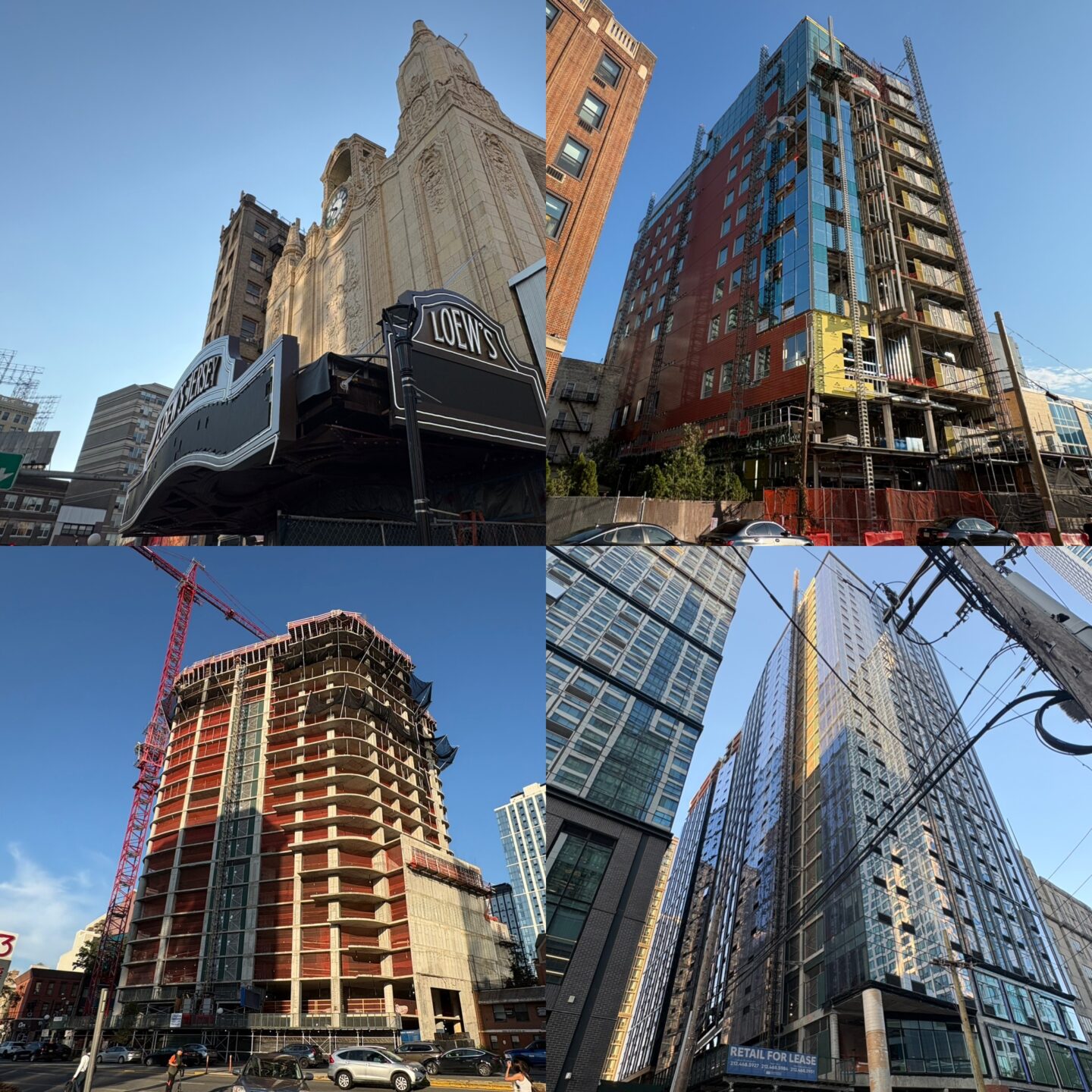
For years, the skyline of Jersey City’s Journal Square has been defined by the silhouette of construction cranes. While the sheer density of high-rise development has dominated local conversation, the neighborhood is now pivoting from a period of pure vertical growth to one of institutional and cultural activation. According to reporting from Jersey Digs, the next chapter of this transformation is marked by the return of historic entertainment, the infusion of academic infrastructure, and a calculated increase in affordable housing units that aim to balance the neighborhood’s rapid residential expansion.
The Loews’ Jersey Reclaims Its Stage
The most immediate shift in the neighborhood’s identity occurs on November 9, when the historic Loews’ Jersey theater hosts its grand re-opening ribbon cutting. Originally opened in 1927 just before the onset of the Great Depression, the venue is a hallmark of Baroque Revival architecture, complete with ornate marble and gilded detailing. The $130 million restoration, led by Devils Arena Entertainment, represents more than a renovation; it serves as a cultural anchor for a district that has spent the better part of a decade becoming a residential hub. The theater is already securing its place in the modern entertainment circuit, with comedian Chelsea Handler scheduled to film a Netflix special there later this year.

Residential Density Meets Affordability Mandates
While the theater brings a historic touch, the surrounding streets are undergoing a radical physical change. Construction at the Imperial Tower, located at 2966 John F. Kennedy Boulevard, has officially restarted following a $220 million financing deal. The project, helmed by developers Kuldeep “Sunny” Kumar and Mohan Myneni, faced a temporary pause while the team sought to increase the building’s height. The revised 56-story tower will eventually house 542 residential units, with 57 designated as affordable housing—a necessary concession in a market where luxury development has frequently outpaced the needs of long-term residents. The project also signals the continued integration of hospitality and commerce, incorporating a 154-key Marriott-flagged hotel and over 34,000 square feet of retail space, with completion slated for 2028.
The Namdar Group, a major player in the area’s transformation, is also hitting significant milestones. Two of its high-rises—612 Pavonia Avenue and 29 Van Reipen Street—are topped out and expected to wrap construction next year. These 27-story structures are positioned to capitalize on their proximity to the Journal Square PATH station, emphasizing a transit-oriented lifestyle. Meanwhile, at 16 Lott Street, the company is preparing its tallest Jersey City development to date. The 47-story tower is set to integrate a historic structure at 629 Newark Avenue into a glass-heavy design, adding 1,049 residential units to the local inventory, including a 105-unit affordable housing component.
Hudson County Community College Expands Its Local Footprint
The transformation is not limited to private residential investment. Hudson County Community College is expanding its footprint with a new 11-story academic tower at 14 Enos Place. Designed by NK Architects, the facility is a direct investment in the neighborhood’s human capital. It will house 24 state-of-the-art classrooms, a black box theater, and an NCAA-regulation gymnasium, alongside a healthcare lab and a University Center for sister colleges. By embedding these services in the heart of the square, the college is attempting to solidify the area as a destination for students and workers, rather than just a dormitory for commuters.
The scale of these projects varies significantly, from massive towers to infill developments that aim to maintain the neighborhood’s street-level activity. At 42-46 Cottage Street, for instance, a smaller 8-story mixed-use building is nearing completion. Designed by GRO Architects, it features 45 smaller residences and ground-floor retail stretching from the cellar to the third floor, a strategy intended to keep the pedestrian experience active. Similarly, the redevelopment of the former FilStop site at 683 Newark Avenue—a beloved Filipino market that closed in 2020 after 46 years—is nearing completion. The new five-story complex, developed by Cottage Realty Development, aims to replace the lost retail tradition with 40 residential units and 4,500 square feet of commercial space.

Tax Exemptions Drive Large-Scale Development Projects
The scale of this development is not without friction. Projects like 701 Newark Avenue, a 35-story tower, have relied on long-term tax exemptions to move forward, a common but often debated tool in Jersey City’s fiscal policy. While these incentives accelerate construction, they also raise questions about the long-term tax burden on current residents. The neighborhood is still bracing for major projects yet to break ground. A 55-story tower at 2859 Kennedy Boulevard, backed by Nasser Freres, has already secured a commitment from Whole Foods to anchor its retail space, signaling that developers are confident in the neighborhood’s evolving demographic profile.
The sheer velocity of this growth forces a difficult question: can the existing infrastructure, from transit capacity to public services, keep pace with the thousands of new units coming online? The current wave of development suggests that the city is betting on a “build it and they will come” model, where the density itself becomes the engine for future retail and cultural demand. As the Loews’ Jersey prepares to open its doors, the contrast between the city’s 1927 roots and its 2028 future has never been more visible.

Keep reading

BYU Women’s Basketball Beats Portland 74-64 After Dominant Third Quarter
Cougars erase halftime deficit with dominant third quarter to defeat Portland 74-64 The BYU women's basketball team turned...

Tramell Jones Jr. to Make Second Career Start for Florida
Tramell Jones Jr. Earns First Swamp Start Against Oklahoma Sophomore quarterback Tramell Jones Jr. will lead the Florida...

College student held hostage by brother sues Albany officers who shot him 5 times – KPTV
When a 911 Call for Help Ends in Five Bullets and a Federal Lawsuit David Lyon thought he...

Bismarck Demons Defeat Williston Coyotes 3-0 in Finale
Williston Falls to Bismarck Demons on Senior Night The Williston Coyotes wrapped up their regular season with a...