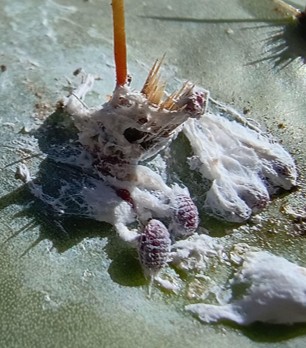
Roughly 70,000 cochineal scale insects are required to produce just 450 grams of the brilliant red dye harvested from prickly pear cacti.
The process is labor intensive, requiring insects to be scraped from the cactus pads, killed, dried, and ground into a fine powder to facilitate pigment extraction.
- Female cochineal bugs live between 40 and 180 days from egg to adulthood.
- Adult males typically survive for only 35 to 52 days depending on seasonal conditions.
- The Journal of Integrated Pest Management published a study detailing the ecology and management of cochineal insects in 2025.
Fluffy white waxy secretions coat the pads of prickly pear cacti across yards and sidewalks, hiding small parasitic insects known as cochineal scale bugs. Touching this waxy substance reveals a vivid red liquid called carminic acid, which accounts for about 24% of the dry weight of all life stages and eggs. These insects belong to the order Hemiptera, sharing a biological classification with cicadas, aphids, and leafhoppers.
This natural colorant, often listed as carmine, Red 4, Crimson Lake, or natural flavorings, has been utilized for millennia in cosmetics, foods, and fabrics. According to the Journal of Integrated Pest Management study authored by Timothy D. Schowalter, an entomologist at the Louisiana State University Agricultural Center, the bright red pigment became the second most valuable export from the New World during the Colonial Period after early domestication by Aztec, Maya, and Inca cultures.
Evidence of textiles colored with the pigment has been recovered from ancient Peruvian burials dating to at least 600 CE, and the Aztecs historically required the insects as tribute from conquered communities.

Fabrics dyed with cochineal served as a symbol of wealth, coloring manuscripts, the robes of Catholic cardinals, British redcoats, and the early flags of the United States. While synthetic alternatives largely replaced natural pigments today, commercial production continues in countries including Peru, China, Mexico, and Spain.
Life cycles feature twice as many females as males, allowing a single male to mate with multiple partners. Crawlers hatch quickly from surface-laid eggs, and female crawlers move toward the cactus spines where they settle permanently, losing their legs entirely when molting. Both sexes produce long filament strands that assist wind dispersal and predator concealment, while male insects form cocoons before emerging as adults with long white wings.

Natural predators such as beetles, flies, parasitic wasps, and lacewings keep native populations in check. Some predators even repurpose the carminic acid for personal defense by excreting it when disturbed, though introduced populations can become agricultural pests managed through physical removal.
The 2025 Journal of Integrated Pest Management study was authored by Timothy D. Schowalter, an entomologist at the Louisiana State University Agricultural Center. Schowalter holds a Ph.D. in Entomology from the University of Georgia, earned in 1979, and previously served as a Professor of Entomology and Interim Head at Oregon State University between 1981 and 2003.
His academic expertise centers on forest entomology and insect ecology, with a focus on how arthropods respond to natural and anthropogenic disturbances. Beyond his research, Schowalter has authored the textbook Insect Ecology: an Ecosystem Approach and served as the Program Director for Ecosystem Studies at the National Science Foundation from 1992 to 1993, providing a deep scientific foundation for his analysis of cochineal insect management.
Cochineal insects are also utilized for the biocontrol of invasive prickly pear cacti. Commercial producers initiate colonies by transferring bugs directly onto new prickly pear pads or by placing uninfested pads in contact with infested ones. The insects are then allowed to grow and reproduce before harvest.
Byline: Chief Editor

Louis Vuitton 38th America’s Cup: Will Sensors Decide the Winner?
Sensors are invisibly transforming the AC75 as teams push the boundaries of aerodynamic and hydrodynamic performance on a...

New York Judge Declines to Block Kalshi Operations, Orders Expedited Briefing
Judge Melissa Crane declined to shut down prediction market platform Kalshi in New York on Monday, allowing operations...

A Celtic Christmas Brings Irish Holiday Show to Wichita’s Orpheum Theatre
Traditional Irish tunes and Celtic twists on Christmas favorites arrive on Wednesday, November 25 at The Orpheum Theatre...

Milwaukee Nonprofit Sees Demand Double; Hunger Task Force Supplies 70% of Food
Hunger Task Force supplies 70% of food as demand doubles at Milwaukee nonprofit, Lyn Hildenbrand says. "We try...