
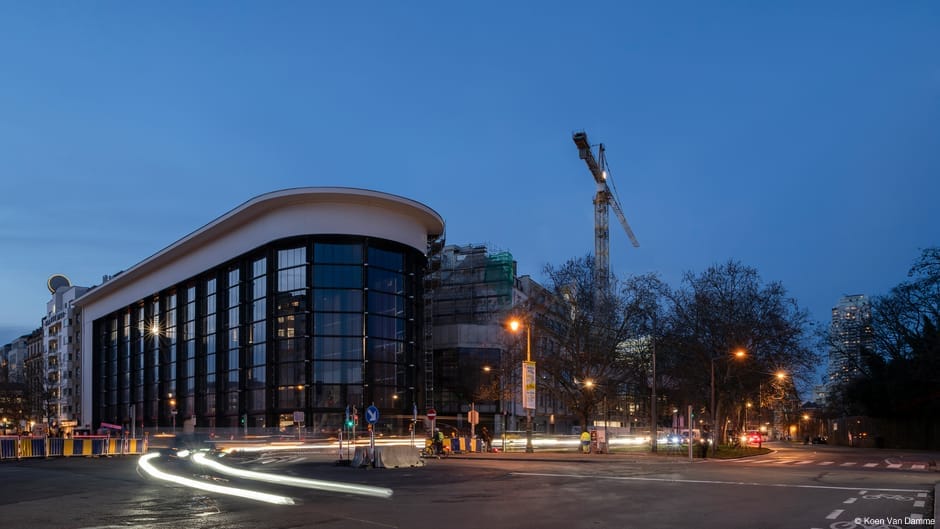
Kanal-Centre Pompidou opens its doors to the public on Saturday in a former Citroën garage on the Charleroi–Brussels Canal, ending a twelve-year project marked by budget overruns, leadership turbulence and political friction.
The 40,000-square-metre complex, billed as Europe’s largest museum development, spans half its footprint as freely accessible public space — library, cinema, rooftop terrace, bakery, an indoor playground designed by Assemble and a “speaker's corner” for civic debate. The Brussels-Capital Region acquired the 1934 modernist landmark in 2015 and funded the conversion, which rose from an initial €150 million budget to around €230 million ($252 million).
“Kanal reveals how architecture can reinvent the museum typology, not only as a place for art, but as a stage for the city and its citizens,” said Atelier Kanal, the consortium of EM2N, noAarchitecten and Sergison Bates Architects that led the design, emphasizing an approach “renewed without being erased, made precise without being overdetermined and open to continued transformation.”
All 30,000 free tickets for the opening weekend were claimed within 24 hours, according to DW. The programme centres on a five-year partnership with the Centre Pompidou in Paris — itself closed for renovation until 2030 — lending works by Matisse, Picasso, Giacometti and major contemporary artists for rotating exhibitions. The inaugural show, A Truly Immense Journey, mixes more than 350 loans from Paris with Belgian collections and new commissions.
Funding cuts and a departing director
The run-up to opening has been shadowed by financial retrenchment. The annual operating subsidy, originally projected at €35 million, was cut to €28 million in 2026 after a change of control in the Brussels government in February and is projected to fall to €10 million by 2029, The Brussels Times reported.
Managing director Yves Goldstein is due to step down on Monday, 30 November, following what the region acknowledged as a “difference of opinion regarding the future of Kanal”. His replacement is expected to be announced mid-December.
Artistic director Kasia Redzisz, appointed in 2021 after the board initially tried to overrule her selection, has framed the museum’s mission around accessibility. “Inclusivity is the best way for the public to make the place their own,” she told The Art Newspaper in January.
The opening programme includes An Infinite Woman: Black Archives in Two Acts, examining colonial imagery of Mangbetu women through works by Carrie Mae Weems, Frida Orupabo, Simone Leigh and Faith Ringgold, and a collective weaving installation by Otobong Nkanga.
From car cathedral to civic living room
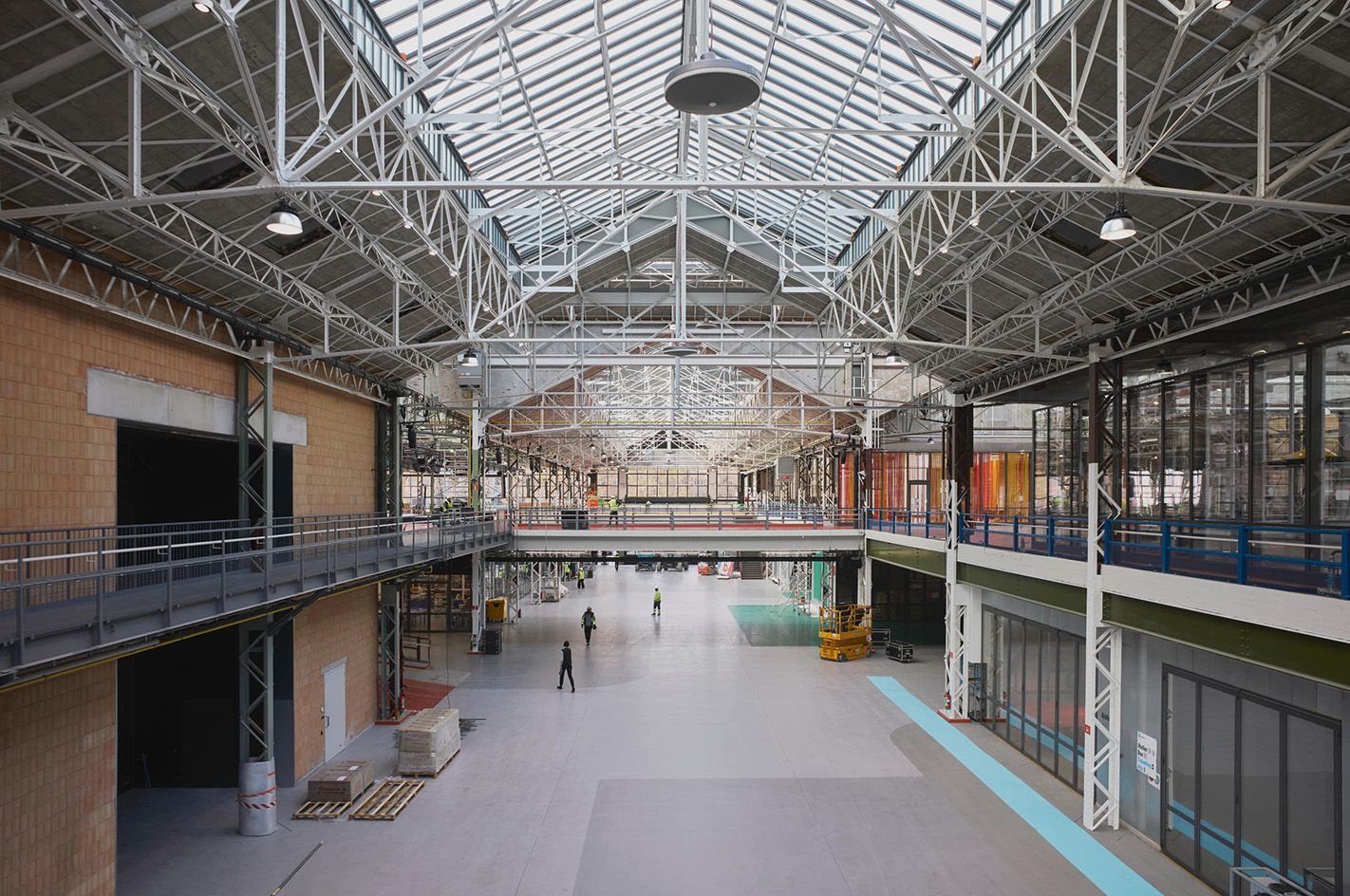
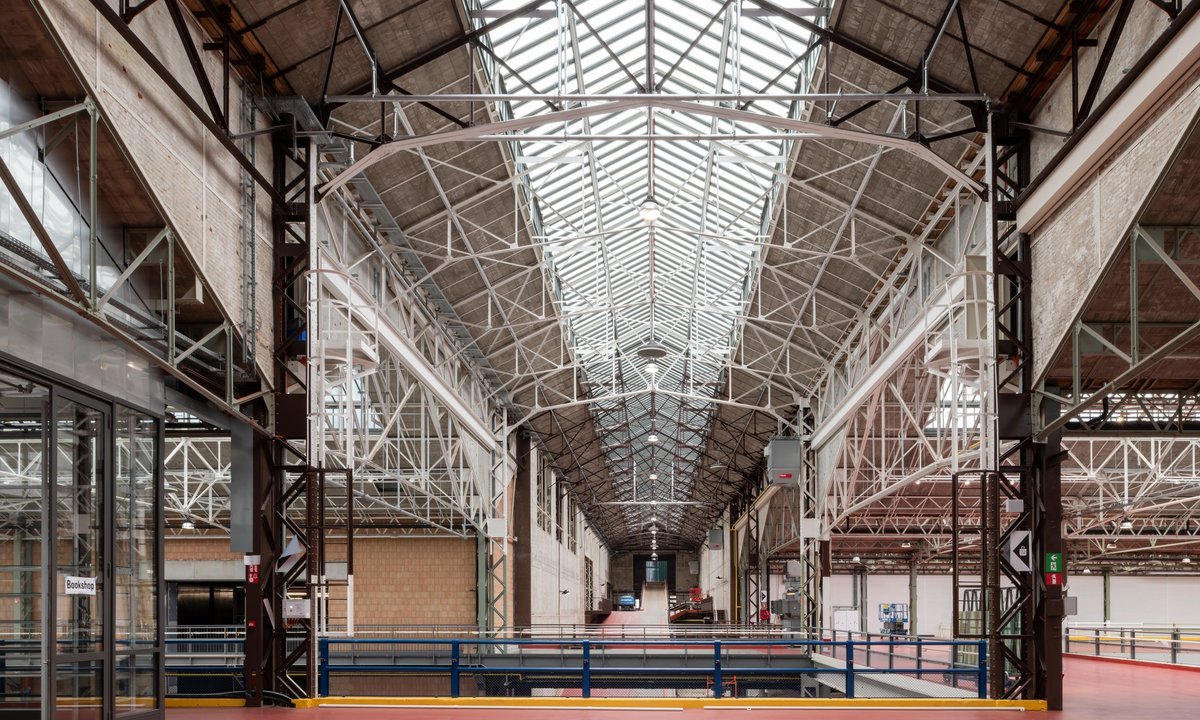
The Citroën garage, once described as a “cathedral of cars” with a monumental glass showroom, sat vacant after the carmaker’s departure in 1980. The project was announced in 2014. Architecturally, Atelier Kanal inserted three new concrete volumes above the original pitched roofs — housing galleries, a 378-seat auditorium and the relocated CIVA architecture centre, now renamed Kanal Architecture — while preserving the steel structure and the 21-metre-high nave.
“It is anything but a sealed-off bunker. It is anything but a museum reserved solely for specialists. It is a living place,” said Belgian art writer and curator Barbara De Coninck, speaking to Africanews. The complex sits on the border between the historically less prosperous west of Brussels and the east, a positioning the region hopes will act as a cultural connector.
Architects redefine museum as city space
Architects Atelier Kanal, comprising EM2N, noAarchitecten and Sergison Bates, emphasized an approach that renews without erasing the former Citroën garage. “Our work is merely adding another layer,” said Stephen Bates, co-founder of Sergison Bates, which collaborated on the winning 2017 competition design.
The consortium described the project as “radical optimism” – open and non-prescriptive, inviting citizens and communities to inhabit large parts of the building for performances, events or simply to spend time. This porous approach includes freely accessible areas like the library and rooftop terrace, aiming to transform the automotive temple into a laboratory to dream and conceive the city of tomorrow.
Minister frames Kanal as cultural flagship
Minister-Boris Dilliès framed Kanal as a cultural flagship for Brussels, stating its aim is “to thrive and to showcase Brussels internationally” on par with institutions like the Guggenheim or MoMA. The Brussels-Capital Region funded the €230 million project, which has faced political friction over costs and partnerships. Regional politician Benjamin Dalle criticized it as a “top-down political project” that should have started with local artists and communities.
The Centre Pompidou, closed for renovation from March 2025 until 2030, operates under a five-year partnership with Kanal as part of its “Constellation” program, which displays its national collection across France and internationally.
During its closure, the museum lent over 350 works from its Musée National d’Art Moderne—home to the largest modern art collection in Europe—for Kanal’s inaugural exhibition. The partnership aligns with the Centre Pompidou’s strategy to maintain global reach while its Parisian building is modernized, including a $240 million satellite launch in Brazil set for November 2027.
What visitors need to know
The museum opens for 36 continuous hours from Saturday morning, with free performances, DJ sets, films and workshops. Timed-entry tickets are required; the opening weekend allocation is exhausted. Parts of the building — including the library, playground, rooftop bar and ground-floor public zones — remain accessible without a ticket. There is no on-site car parking. By 2030, the institution targets 550,000 annual visitors.
Related reading

Gerry Adams Links Ireland, Kenya, Palestine: Colonial Powers Shape Law to Suit Their Ends
“The law should be used as just another weapon in the government’s arsenal, in which case it becomes...

Taliban Foreign Minister Muttaqi Calls Pakistan Strikes Unreasonable, Says Government Inclusive
Amir Khan Muttaqi described Pakistan’s cross-border strikes as “unreasonable,” said they had yielded Islamabad nothing, and called his...
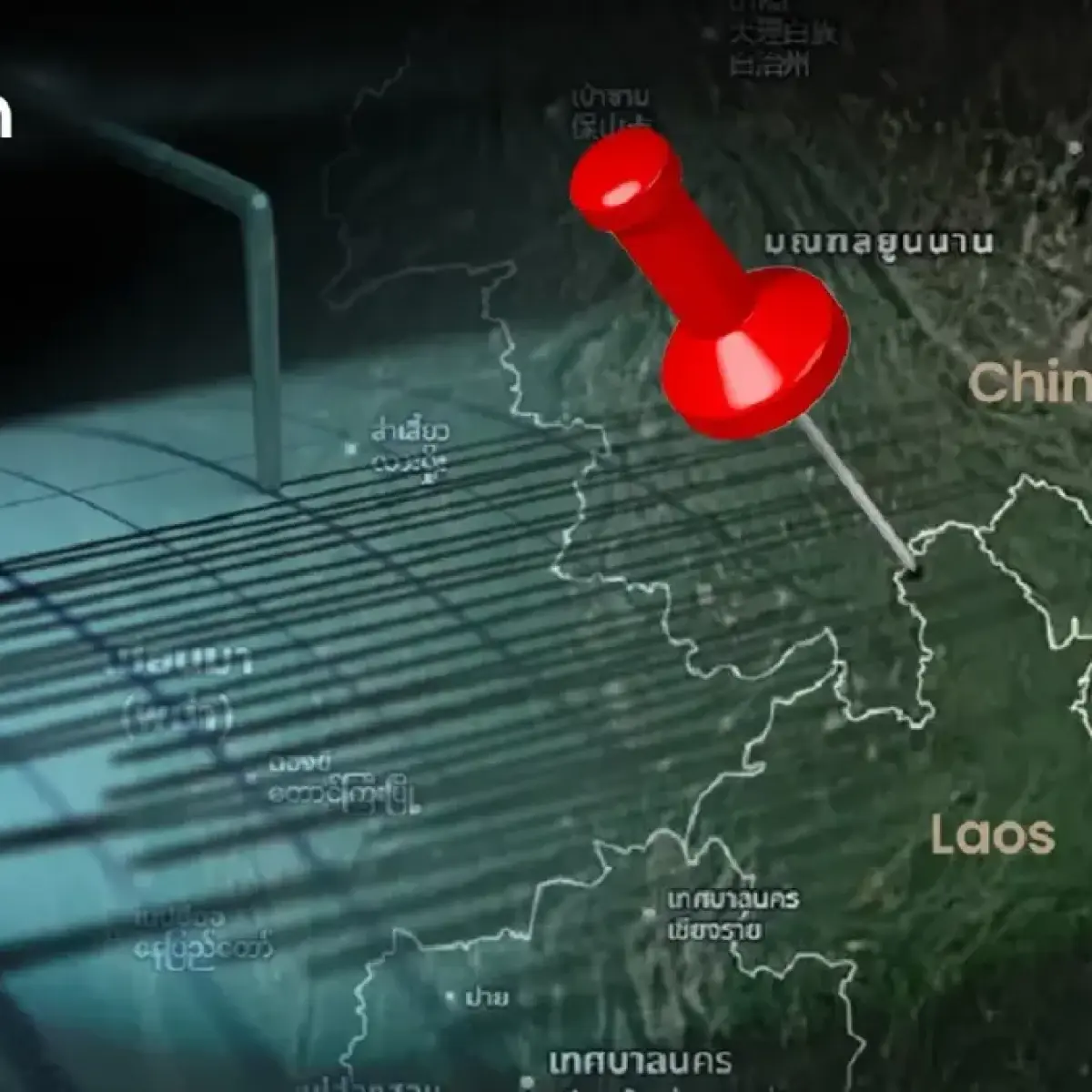
Magnitude 5.2 Earthquake Strikes Laos-China Border Region
A magnitude 5.2 earthquake struck the Laos-China border region on Saturday, November 28, at 8:17 a.m. Thai time,...

Survivalism Goes Mainstream in Europe Amid Growing Preparedness Concerns
Survivalism is going mainstream in Europe. Sales of canned goods, shelf-stable milk, and paper maps are rising, as...