Democratic Governor Kathy Hochul secured a second full term on Tuesday night, defeating Republican nominee Bruce Blakeman in a contest defined by sharp ideological divides. According to a report from POLITICO, Hochul’s victory relied heavily on a strategy that framed her opponent as a MAGA-aligned ally of President Donald Trump, while simultaneously positioning herself as a bulwark against the federal administration’s aggressive deportation and tariff policies.
The election results reinforce a long-standing political reality in the Empire State. By winning this mandate, Hochul maintains a Democratic stronghold that has remained largely untouched by Republican statewide successes for over two decades. The margin of victory reflects a state electorate that remains deeply resistant to the current Republican platform, even as the governor herself navigated a complex path to reelection.
Hochul’s path to this second term involved a significant political evolution. Originally a relatively low-profile lieutenant governor, she ascended to the governorship following the resignation of Andrew Cuomo. Since taking office, she has worked to distance herself from the scandals of the previous administration, rebuilding her political standing through a series of policy wins and a strategic realignment with different factions of the Democratic Party.
A coalition of moderates and progressives
One of the most notable aspects of Hochul’s campaign was her ability to bridge the gap between the party’s establishment and its increasingly vocal left wing. Despite being 68 years old, Hochul campaigned alongside younger, more progressive figures such as New York City Mayor Zohran Mamdani and Representative Alexandria Ocasio-Cortez. This tactical alliance allowed her to secure support from democratic socialists, ensuring that the progressive base remained energized for the Tuesday vote.

This internal party balancing act was necessary to counter the Republican campaign’s focus on the rising cost of living. While Hochul touted her efforts to address spiking costs for New Yorkers, her opponent, Bruce Blakeman, struggled to break through the Democratic advantage in key demographics. The campaign’s focus on the “Trump factor” proved decisive, as Hochul successfully linked Blakeman to the White House’s national agenda.
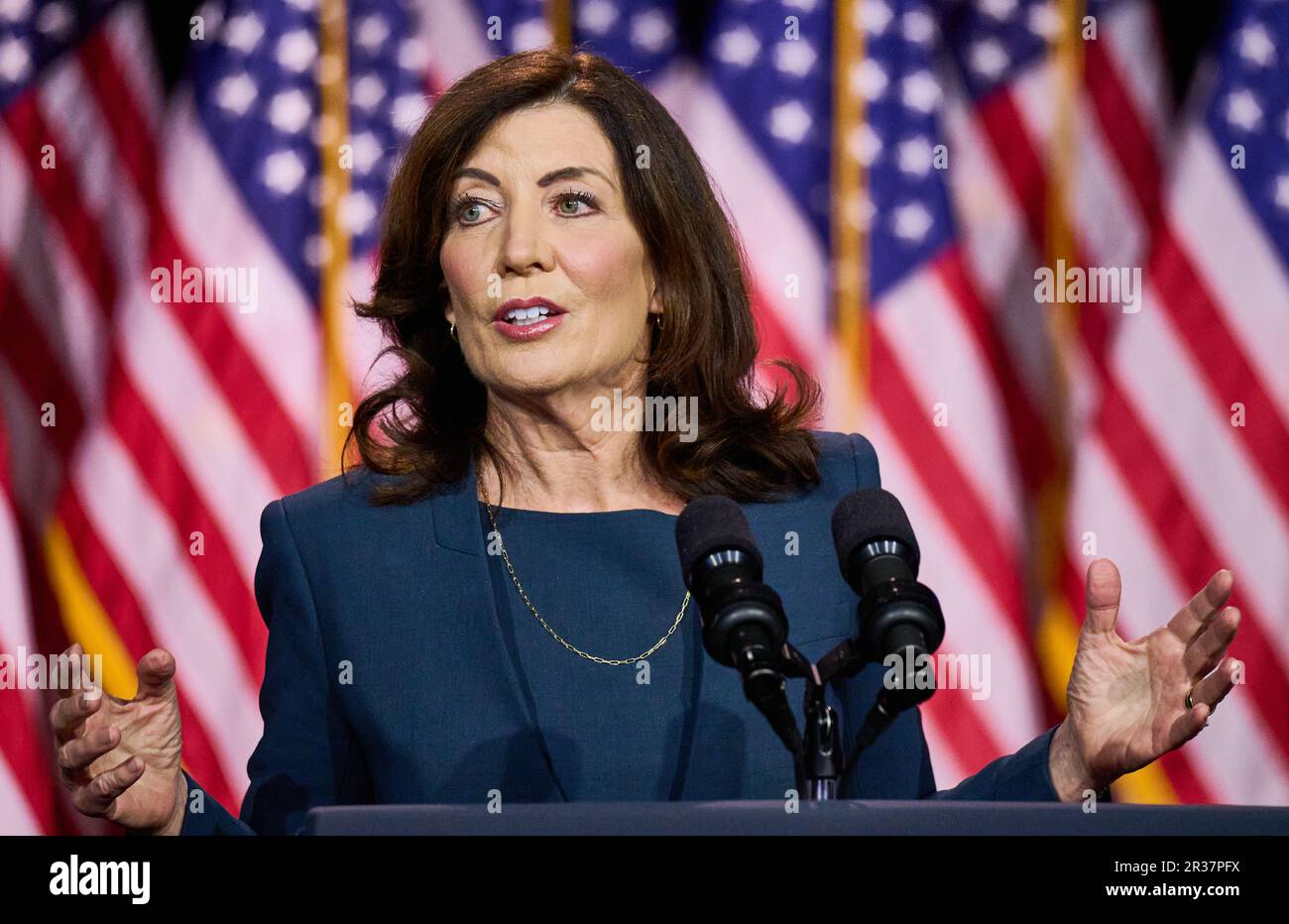
“No Republican has won statewide in New York since George Pataki won his third term as governor in 2002,” Siena Research Institute pollster Steve Greenberg said. “Republicans have a huge uphill climb in New York because there are more than twice as many Democrats as there are Republicans. This outcome is not a surprise in the least.”
The statistical reality of New York’s voter registration continues to present a formidable barrier for any GOP candidate. As Greenberg noted, the sheer volume of registered Democrats—outnumbering Republicans by more than two to one—creates a structural disadvantage that is difficult to overcome through policy messaging alone.
The economic and social stakes of the mandate
For Hochul, the second term brings immediate pressure to deliver on her promises regarding economic stability. While her victory suggests a mandate for her current direction, the underlying issues of affordability and inflation remain central to the lives of her constituents. The ability to translate campaign rhetoric into tangible relief for middle-class families will likely define her next four years in Albany.
Conversely, the Republican platform’s failure to capture the governorship highlights a broader struggle for the GOP in urbanized, high-population states. The decision by voters to reject a candidate tied closely to the national Republican leadership suggests that, in New York, the local impact of federal policy remains a more potent motivator than traditional conservative economic arguments.
As the dust settles on Tuesday night, the focus shifts from the campaign trail to the legislative sessions ahead. Hochul enters her second term with a clear directive from the electorate, but she must still manage a diverse and sometimes fractious Democratic coalition that spans from the moderate suburbs to the progressive urban cores.

Oregon 2026 Election Results: Live Updates on Local and Statewide Races
Polk County voters appear poised to approve a five-year property tax measure that would fund essential operations for...

Oklahoma voters cast ballots for governor and U.S. Senate races
Oklahoma voters head to the polls for high-stakes state and federal races Oklahomans are casting their ballots this...

Columbus State and Dimon Magnet Academy Celebrate Successful First Year of PDLS Partnership
“The numbers do more than quantify our partnership. They reflect more than a year’s worth of impact—they reflect...

Fauchon Brings Parisian gifting experiences to Bryant Park, NYC
French Luxury Meets Manhattan's Bryant Park Fauchon is bringing a refined touch of Parisian elegance to the Bryant...