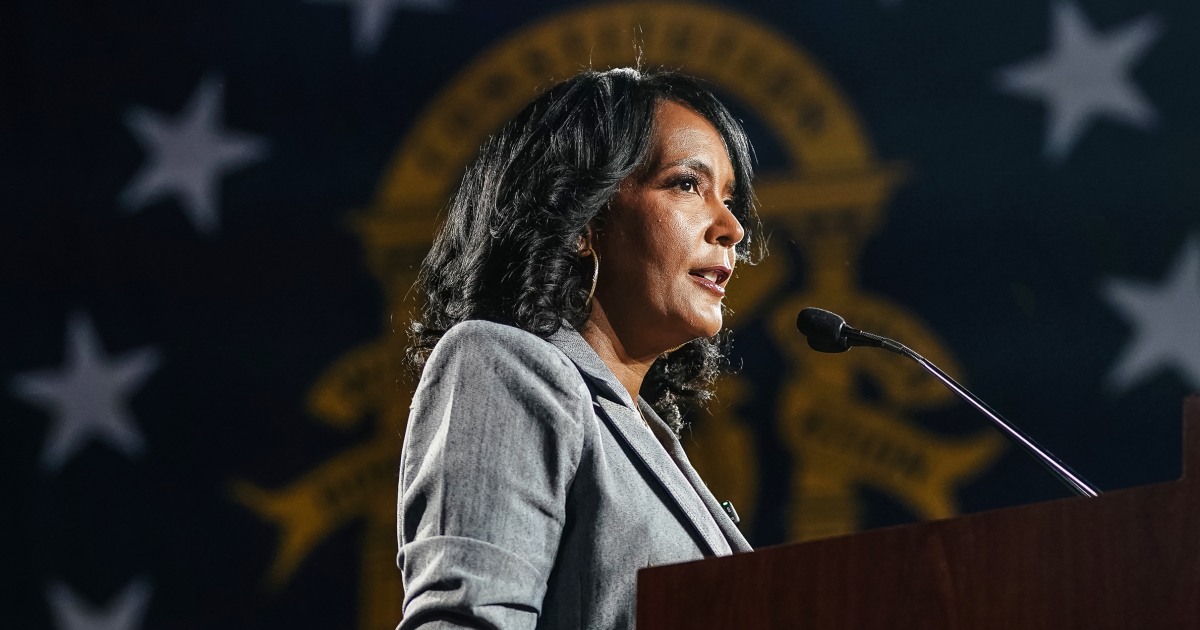
Keisha Lance Bottoms flips Georgia governorship for Democrats
Keisha Lance Bottoms has won the race for Governor of Georgia, a victory that flips control of the state’s executive office for Democrats for the first time in 24 years, NBC News reported. The former Atlanta mayor and former Biden administration official overcame a massive financial disadvantage to secure the win, defeating Republican Rick Jackson in a contest that reshaped the political landscape of a premier national battleground.
Democrat Keisha Lance Bottoms wins Georgia's governor race. – NBC pic.twitter.com/vYHdHHoOKX
The win is a historic milestone for the state. Bottoms becomes the first woman and the first Black person to be elected governor of Georgia, and the first Black female governor in the history of the United States. Her victory marks a significant shift in state-level politics; while Georgia has become a central focus in federal elections, it has remained largely Republican at the state level, with Democrats failing to hold the governor’s mansion since 1998.
Bottoms’ path to victory relied on a strategy that prioritized economic stability and affordability. As the campaign entered its final weeks, she pivoted toward messaging that linked Jackson to former President Donald Trump, whose approval ratings in Georgia have struggled. This tactic proved effective, especially as Bottoms utilized Jackson’s own primary campaign rhetoric against him.
The financial gap and the Trump connection
The scale of the spending disparity in this race was immense. Rick Jackson, a wealthy healthcare executive, invested more than $100 million of his own money into his campaign. Despite this, Bottoms maintained momentum through a coordinated effort that included significant support from high-profile national figures and state leaders.
During their only general election debate last month, Bottoms targeted Jackson’s political alignment, specifically citing his desire to be “Trump’s favorite governor.” The connection to the former President was a central theme, particularly regarding the integrity of election processes. This issue carries heavy weight in Georgia; earlier this year, the FBI seized election records related to the 2020 election, and the incoming governor will hold the critical responsibility of certifying the 2028 presidential election results.
The Republican side of the race was also marked by internal friction. Jackson, who launched his campaign unexpectedly in February, had positioned himself as an outsider similar to Trump during the primary. However, after advancing to the general election, he attempted to align himself more closely with the outgoing Republican Governor, Brian Kemp. These shifts did not fully heal the fractures from the Republican primary, as Lt. Gov. Burt Jones—who lost to Jackson in a June runoff—never publicly endorsed his rival, despite private urging from Trump.
The following table illustrates the primary contrast in the campaign’s financial and political positioning:
| Candidate | Primary Financial Driver | Key Political Association |
|---|---|---|
| Keisha Lance Bottoms | Coordinated Democratic campaign/National endorsements | Sen. Jon Ossoff / Biden Administration |
| Rick Jackson | Personal wealth (>$100 million) | Donald Trump / Brian Kemp |
Bottoms also leveraged the popularity of Senator Jon Ossoff, who held “United for Georgia” rallies alongside her and transferred millions of dollars to the Democratic Party of Georgia to bolster her efforts.
A shift in Georgia’s political direction
The implications of this election extend beyond party control. For the business community and state policymakers, the transition from the Kemp administration to Bottoms represents a change in how Georgia manages its rapid growth and economic challenges. Bottoms’ opponents frequently attacked her tenure as mayor of Atlanta from 2018 to 2022, citing the difficulties of managing the city through the Covid-19 pandemic and periods of social unrest.
However, the electorate appears to have prioritized her focus on the cost of living over these critiques. By running ads that connected Jackson to the construction of data centers and the broader economic concerns of voters, Bottoms successfully framed the race around the immediate needs of Georgians.
As the state prepares for a new administration, several questions remain regarding how the new governor will navigate the state’s polarized political environment and its role in the upcoming federal election cycles. While the Democratic victory provides a major boost to the party’s infrastructure in the South, the ability to maintain this momentum in a state that remains deeply divided will be the true test of Bottoms’ leadership.
Worth a look

Zhuhai Huafa Group debt struggles Trigger China bond market volatility
Zhuhai Huafa Group Debt Struggles Trigger Volatility in China Bond Markets The unprecedented property crisis in China has...

Attempted Murder Trial Begins for Adrian Maggos in Cheyenne
A Laramie County jury begins hearing testimony in attempted murder trial The legal proceedings for Adrian Maggos, a...

Democrat Charles Glover Defeats Incumbent Joe Boykin in Charleston County Council Upset
Charleston County Council undergoes leadership shift following November 3 election The makeup of the nine-member Charleston County Council...

Sprinkler System Contains Apartment Fire in Downtown Seattle; No Injuries Reported
A sprinkler system limits damage during Tuesday morning apartment fire A fire in a seventh-floor apartment near Pioneer...