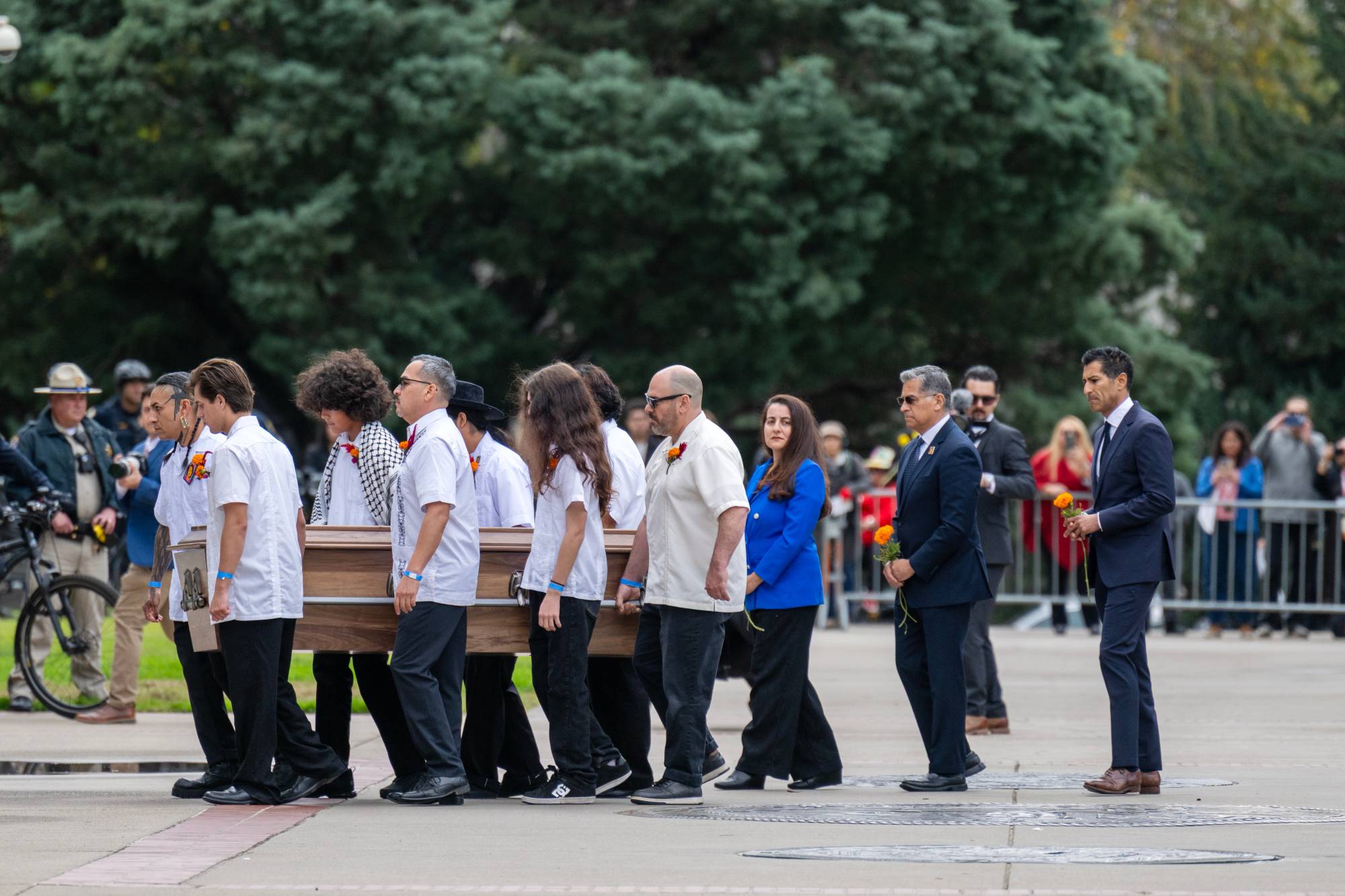
On Monday, November 16, 2026, Dolores Huerta became the first woman and the first non-elected person to lie in honor at the California State Capitol.
The ceremony, held in Sacramento, served as a profound recognition of a life spent redefining the boundaries of civic participation. Hundreds of mourners braved the rain to pay their respects to the labor icon, who passed away last month at the age of 96.
The procession along Capitol Mall Boulevard featured a solemn tribute led by the very state officials whose predecessors once operated without a single Latino lawmaker. Among those participating were the current leaders of the state Senate and Assembly, alongside Xavier Becerra, who is preparing to take office next year as the first elected Latino governor in modern history.
For those witnessing the event, the contrast between the California of the 1950s—when Huerta first began volunteering for bilingual voting access—and current politics was palpable.
“Dolores Huerta spent a lot of time in the California State Capitol, advocating for causes that she believed were just and right for the people of California,” said Senate President pro Tempore Monique Limón.

“The honor is very fitting to be there at the state capitol for the work that she did to impact thousands and millions of people, not only in the state of California, but throughout our country,” said Camila Chávez, Huerta’s youngest daughter with Richard Chávez.
The Architect of Labor Reform
Huerta’s legacy is inextricably linked to her role as a co-founder of the organization that became the United Farm Workers (UFW). Alongside Cesar Chávez and Gilbert Padilla, she negotiated some of the nation’s first labor contracts for agricultural workers in the 1960s.
These agreements were foundational, securing basic human necessities such as drinking water, sanitary toilets, and improved wages for a workforce often ignored by federal labor protections.
Her legislative impact extended far beyond the fields. In 1975, she advocated for California to become the first state to grant collective bargaining rights to farmworkers, a demographic still excluded from federal protections afforded to most other private-sector employees.
Her influence reached the federal level in 1986, when she spent months in Washington, D.C., lobbying for an immigration reform package signed by President Ronald Reagan, which provided a path to citizenship for about 3 million people.
A Complicated Legacy
While history books have long celebrated the partnership between Huerta and Cesar Chávez, recent years have brought to light a much more turbulent reality. In an investigation by the New York Times, Huerta revealed that at age 95, she had been raped by Chávez in the 1960s, who was then her boss.
She also spoke to the sexual abuse and harassment faced by other women in the movement, a topic she had previously addressed in a 2013 collaborative project with KQED, Frontline, CIR, IRP, and Univision.
Huerta explained that she kept these experiences secret for nearly 60 years out of a calculated, painful necessity to protect the fragile movement she was building. She maintained that the formation of a union was the only vehicle capable of securing rights for suffering farmworkers, and she refused to let internal conflicts derail that objective.
This complex history—marked by police beatings, death threats, and arrests—paints a picture of a woman who operated within a deeply hostile, machismo-dominated environment to force systemic change.

The Future of Organizing
The events in Sacramento this week, including a public rosary and vigil at the IBEW Hall in Bakersfield on Thursday and an interfaith memorial service on Friday, show how much influence she has.
For supporters like Ralph Velador, a school district board member from Palmdale, Huerta’s impact is personal. He said that she provided a blueprint for his own daughters to claim their voice in a society that often sought to silence them.
“She was gracious and very accessible but also principled and of integrity,” said Four Waters, a local business owner in Sacramento who came out to pay her respects.
The focus now shifts to the Dolores Huerta Foundation, an organization she co-founded with her daughter Camila. The foundation continues to train new advocates in the Central Valley, emphasizing that the most effective way to honor her memory is through the continuous, often grueling work of grassroots organizing. As the state reflects on her life, the sentiment remains focused on her enduring commitment to the marginalized.
Camila Chávez said that the way to carry her mother’s legacy forward is to focus on organizing.
Keep reading
- Topeka Weather Forecast Predicts Strong Winds and Weekend Cooling
- Indiana Defeats USC 27-13 as Cignetti Defends Schedule Strength
- Honoring Dolores Huerta: The Legacy of a Civil Rights Icon and the Power of Sí Se Puede (archyde.com)
- California sues OpenAI over 80 loss-of-control incidents and Hugging Face hack (newsarchyuk.com)

Topeka Weather Forecast Predicts Strong Winds and Weekend Cooling
Topeka residents are facing a week of volatile wind conditions as a warming trend takes hold across north-central...

Indiana Defeats USC 27-13 as Cignetti Defends Schedule Strength
Indiana football head coach Curt Cignetti stood before a room of reporters on Monday and finally addressed the...

ICC Coach Tony Wysinger to Join IBCA Hall of Fame
Illinois Central College head coach Tony Wysinger has been selected for induction into the Illinois Basketball Coaches Association...
Rare King Speech Manuscript Goes on Display in Atlanta
Martin Luther King Jr.’s handwritten final draft of his "I Have a Dream" speech is currently on display...