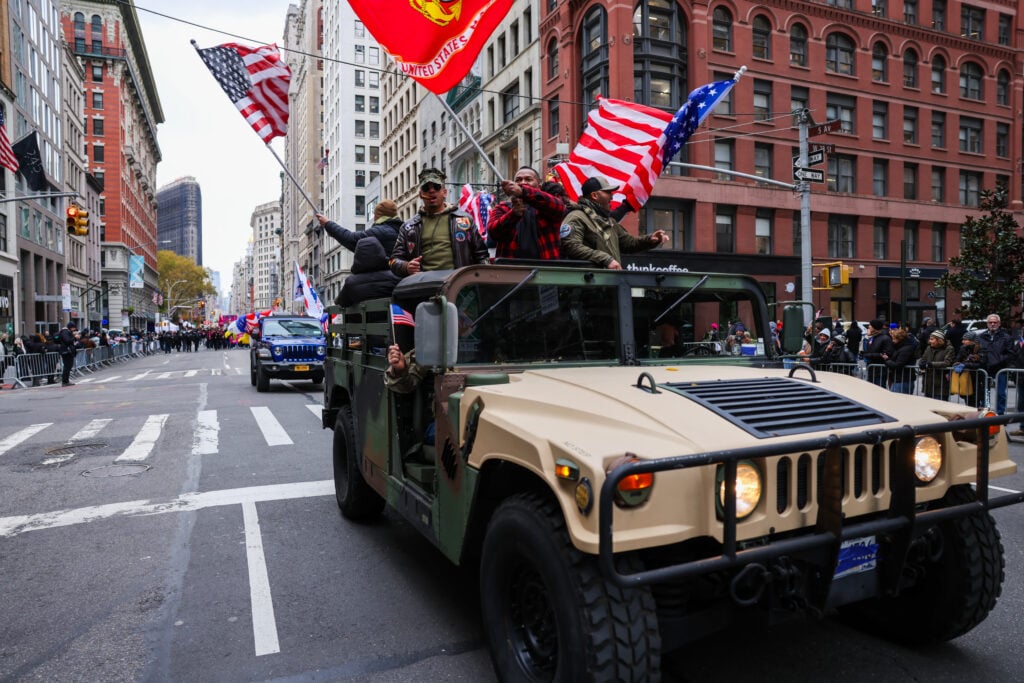
The Military as a Model for American Pluralism
In a recent essay published by Interfaith America, a veteran reflects on his service in the United States Marine Corps as a case study for how a diverse citizenry can unite behind shared ideals. As the United States marks its 250th anniversary, the author argues that the military serves as a unique laboratory for pluralism—a place where individuals from vastly different backgrounds, beliefs, and life experiences are forced to transcend personal differences to accomplish a common mission.
The author, who grew up in a Northern Virginia suburb in the 1970s and 1980s, describes his upbringing as largely insulated from political or ideological friction. Raised in a Catholic, patriotic home, he notes that he remained unaware of the differing political stances of his parents—a progressive Democrat mother and a conservative Republican father—until much later in life. This sense of social homogeneity followed him through private schooling and a youth defined by athletics.
However, his entry into the Marine Corps at Officer Candidate School introduced him to a radically different environment. He recounts that his service allowed him to work alongside Christians, Jews, Muslims, atheists, and agnostics. For the author, this experience was not merely a logistical necessity of military life but a powerful example of how a shared identity can override disparate worldviews.

Breaking Down Barriers in the Ranks
The author highlights specific instances where the military functioned as a bridge between Americans who, in civilian life, might never have encountered one another. He recalls a platoon that included a Texan, a Jewish Harvard Law School graduate, and a Hispanic former gang member from East Los Angeles. He points to this as an example of how the armed forces assemble a cross-section of the country that defies typical social stratification.
The essay also details his experience as a Company Commander in Marine Special Operations, where he relied on two senior enlisted leaders with starkly different origins: a Company First Sergeant from Chicago’s inner-city who was the child of Chilean immigrants, and an Operations Chief from rural Oklahoma who was raised competing in rodeos.
Despite our different backgrounds and life experiences, we adopted a shared identity. We did not need the same upbringing, beliefs, or worldview to earn one another’s trust. Our unity grew through shared responsibility, mutual respect, sacrifice, and service to our country.
Veterans Day and the Future of the American Experiment
The author suggests that the lessons learned in the service are increasingly relevant as the nation moves into its next quarter-century. He contends that the military model—based on service, shared responsibility, and mutual respect—offers a blueprint for navigating modern divisions.
While the military is often viewed through the lens of its combat role, the author emphasizes its function as an incubator for national cohesion. He argues that the diversity within the ranks is not a weakness but a source of strength, provided that individuals remain committed to a common mission.
As the country observes Veterans Day, the author posits that the legacy of those who have served should be measured not only by their sacrifices in the field but by their capacity to demonstrate that citizens do not need to be alike to stand together. He concludes that the fundamental challenge for the next 250 years is to maintain this commitment to a shared national identity, ensuring that internal differences remain a source of strength rather than a catalyst for fragmentation.

Related reading

Vermont Drought Conditions Expand to 32% of State
Drought Expansion Across Vermont and New Hampshire Moderate drought conditions are intensifying across Vermont, with the latest data...

Gavin Newsom initiates mass clemency for all California death row inmates
California’s Empty Death Row and the Changing Face of American Justice In a move that marks a definitive...

Ocoee River Reaches record 18.05-foot crest after heavy rainfall
The Ocoee River, a waterway that defines the landscape of the Blue Ridge Mountains, surged to historic levels...

Gov.-elect Alan Wilson Outlines Policy Priorities and Transition Team
Governor-elect Alan Wilson and Lieutenant Governor-elect Mike Reichenbach moved quickly to set the tone for their upcoming administration...