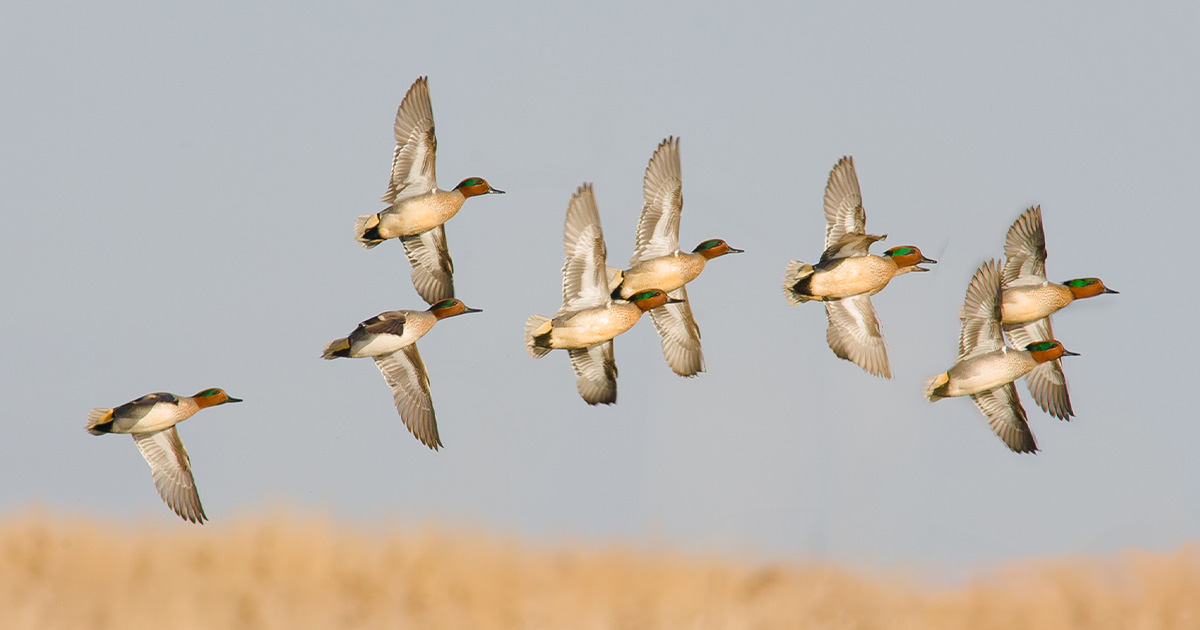
Louisiana duck hunters enjoyed a strong opening weekend across the coastal marshes despite a November aerial survey that showed below-average bird numbers, Ducks Unlimited reported Friday.
The disconnect between the survey and the hunt highlights how habitat conditions — specifically a historic drought gripping nearly the entire state — are concentrating birds in the remaining viable wetlands. According to the U.S. Drought Monitor, roughly 95 percent of Louisiana remains in drought, with just under 40 percent classified in the second-highest tier of Extreme Drought.
“The opener was really good for us in the marsh,” said Rod Haydel, president of Haydel’s Game Calls, who hunted south of Lake Charles. “There were four of us, and we limited out on green-winged teal.”
Haydel added that his party continued shooting gadwalls — locally called gray ducks — later in the week as pressure eased. He also noted seeing more mottled ducks than usual, though the season remained closed on that species for the first 15 days.
“The water levels in our marsh are about normal, and I’m sure things will continue to get better as more ducks come down, since a lot of areas up north have not been pumped yet,” he said.

Further south in Pointe à la Hache, Capt. Jay Ruiz of Black Reaper Southern Charters reported similar success. His eight-man party filled limits on opening day with a diverse bag: fulvous and black-bellied whistling ducks, gadwalls, pintails, wigeon, blue-winged and green-winged teal, northern shovelers, ring-necked ducks, and redheads.
“The birds are here, and it isn’t slowing down,” Ruiz said. “Sunday we put together a six-man limit of mixed blue- and green-winged teal and saw some redheads.”
“It was the best opening day in many years. The birds worked into the decoys, and it was a mix of teal and grays. I’m hearing about lots of redheads down, which usually means a good season is ahead.”
In Plaquemines Parish, Jared Serigne, who runs the Outside the Levees YouTube channel and outdoor media brand, echoed the optimism. He described habitat conditions as excellent in the areas he scouted, with birds spreading out to provide quality hunts through the weekend.
Biologists have long cautioned that aerial counts capture a snapshot across a massive area and can miss birds tucked into secluded marsh ponds — especially when drought shrinks the available habitat into a fraction of its normal footprint.
Agricultural fields in southwest and central Louisiana have borne the brunt of the dry weather. Without rain or pumped water, the rice and crawfish impoundments that typically hold massive numbers of dabbling ducks remain largely dry, pushing birds toward the coastal brackish and intermediate marshes where tidal action maintains water levels.
That salinity comes with a trade-off. Haydel said that some marsh areas have lost aquatic vegetation due to higher salt content driven by low river levels and lack of rainfall. Submerged aquatic vegetation — the primary food for gadwalls, wigeon, and other species — struggles when salinity spikes beyond the tolerance of native plants like wigeon grass and coontail.
The U.S. Drought Monitor’s latest assessment, released Thursday, shows the Extreme Drought designation covering much of the southwestern parishes that form the backbone of the state’s agricultural waterfowl habitat. Only a sliver of the southeastern coast near the Mississippi River’s mouth escapes the driest categories.
Until then, the marsh remains the story.
Haydel’s Game Calls, the Bossier City company Rod Haydel now leads as president, traces its roots to 1975 when his father Eli, a clarinet and saxophone player who never learned to read music, began winning calling contests in north Louisiana. Frustrated that wooden calls failed when wet, Eli spent years in his garage developing a non‑porous alternative; his first production run was funded with roughly $400.
He demonstrated the prototype in sporting‑goods stores by suspending a call beneath a rubber duck in a water‑filled fishbowl labeled “Blows When Wet.”
The gimmick worked — orders poured in, and by 1985 Eli left his day job to run the business full‑time without ever borrowing money. Today the catalog holds more than 150 items, supported by a staff of twelve and about forty independent representatives across the United States and Canada.
“The habitat looked great,” Serigne said. “There were lots of ducks seen when scouting in certain areas, and they spread out for some great hunts on Saturday and Sunday.”
Worth a look

Missouri Voters Reject Abortion Ban and Transgender Care Restrictions by Wider Margin
Missouri voters rejected a constitutional amendment that would have reinstated the state’s strict abortion ban, expanding their 2024...

Mother Seeks Answers 3 Months After Son’s Killing on Portland’s Eastbank Esplanade
Laurie Mincey Cordova is still waiting for answers nearly three months after her son, 35-year-old Colton Mincey, was...

Georgia House Runoff Could Pad Democrats’ One-Seat Majority as Cheokas Faces Wolfe
Voters across eight southwest Georgia counties head back to the polls starting Monday for a runoff that will...

UF Jacksonville LaVilla Campus Wins Final Design Approval for First Building
The Jacksonville Downtown Development Review Board voted unanimously Thursday to grant final design approval for Building 1A, the...