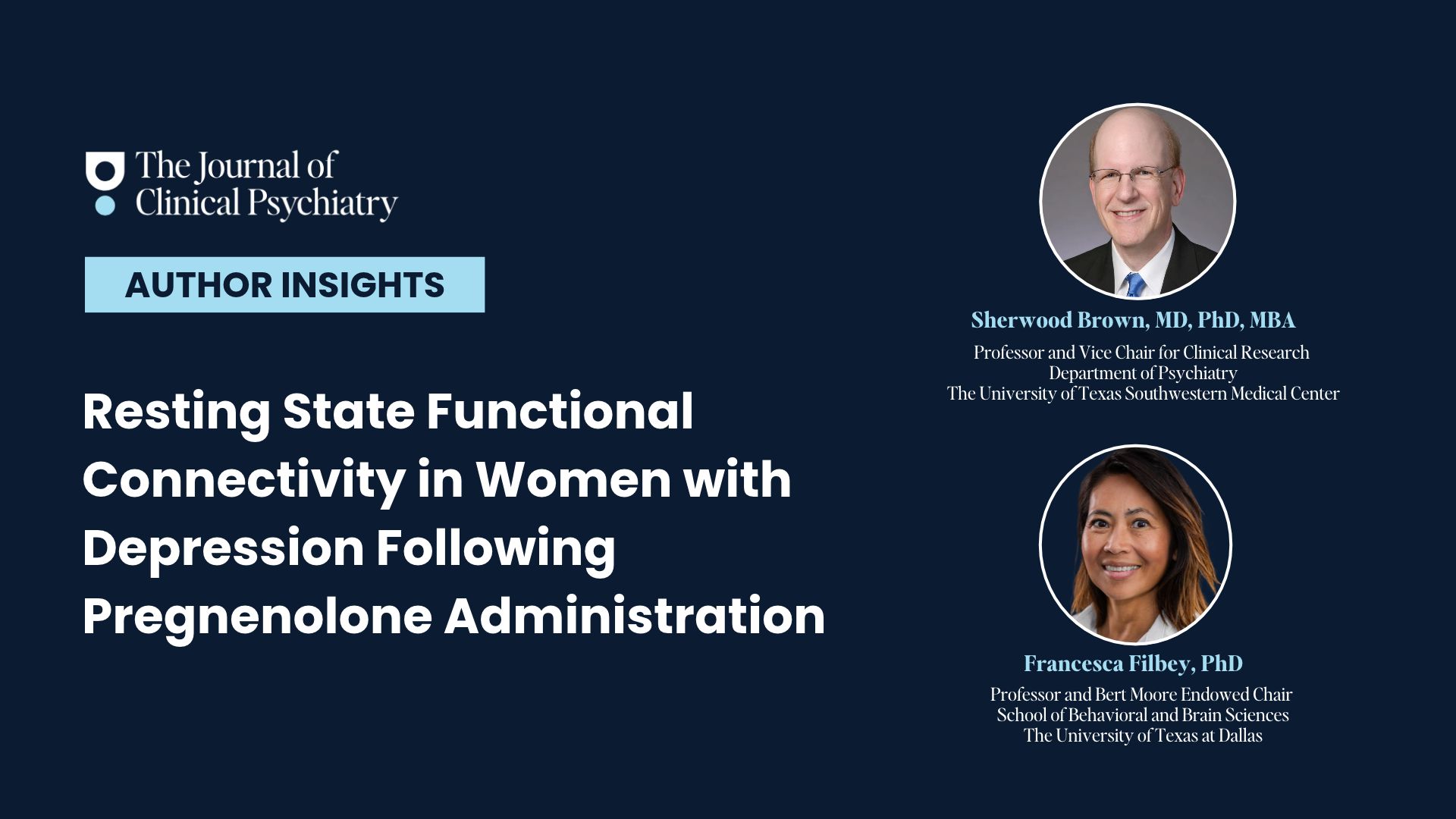
Researchers at UT Southwestern Medical Center found that a low dose of the neurosteroid pregnenolone reduced functional connectivity between the amygdala and the left frontal pole in women with major depressive disorder, while a higher dose showed no such effect compared with placebo, Psychiatrist.com reported.
The finding comes from a randomized, double-blind, placebo-controlled crossover trial in which 11 women completed seven-day regimens of 500 milligrams daily, 800 milligrams daily, and placebo, each separated by a 14-day washout. Whole-brain seed-to-voxel analysis showed the 500-milligram dose was associated with reduced amygdala–frontal pole connectivity relative to placebo; the 800-milligram dose did not differ from placebo, and connectivity after 800 milligrams was significantly higher than after 500 milligrams.
“Pregnenolone was first available as an oral preparation in the 1940s,” said E. Sherwood Brown, MD, who leads the research group. “It is produced from cholesterol, and every other steroid hormone in the human body is made through long metabolic pathways beginning with pregnenolone.”
He added that clinical evidence for pregnenolone itself remains preliminary, though randomized trials have shown promise in mood disorders and as adjunctive therapy for negative symptoms of schizophrenia.
Francesca Filbey, PhD, who presented the neuroimaging data, said the team focused on emotional-processing and cognitive-control circuits — particularly interactions between the amygdala and prefrontal regions — because prior work with neurosteroids had implicated those networks. Predefined region-to-region analyses did not identify significant differences between treatment conditions, she noted; the effect emerged only in the exploratory whole-brain analysis.
The amygdala has long been a target of interest in depression research. Earlier work from the same laboratory showed that single-dose DHEA and the allopregnanolone precursor pregnenolone decreased amygdala activity and increased medial prefrontal activity during tasks engaging cognition–emotion interactions, according to a 2013 study published in Neuropsychopharmacology.
That paper also noted inconsistent directionality in prior reports: allopregnanolone had been shown to either increase or decrease amygdala activation depending on the task used.
Resting-state connectivity offers a way to assess intrinsic network organization without the confounds of specific task demands. Animal data cited in the same review indicate that DHEA administration increases BDNF concentration and 5-HT2A receptor expression in the amygdala, while microinfusions of allopregnanolone directly into the amygdala produce anxiolytic and antidepressant effects.
The crossover design — 500 mg, 800 mg, and placebo, each for seven days with a two-week washout — was chosen to maximize within-subject power in a small sample. Only 11 women yielded complete usable imaging data across all three conditions, a limitation the investigators acknowledge.
No serious adverse events were reported in the trial. The researchers plan to test whether the connectivity changes observed at 500 milligrams correlate with symptom improvement in a larger, longer-duration study.
Related reading

Mamdani Proposes Five-Year Extension to Close Rikers by End of 2032
Mayor Zohran Mamdani proposed a five-year extension to close Rikers Island on Friday, moving the legally mandated deadline...

Researchers: Action Games Boost Cognition But Wellbeing Depends on Perceived Value
Grand Theft Auto VI launched Thursday on PlayStation 5 and Xbox Series X|S, and researchers are already parsing...

PAHO Rules U.S., Mexico, Bolivia Lost Measles Elimination Status
The Pan American Health Organization ruled Tuesday that the United States, Mexico and Bolivia have lost their measles...

Singapore SAF Needs More Commanders as NS Cohorts Shrink, Chan Says
Defence Minister Chan Chun Sing told 958 graduating specialist cadets and military experts on Friday that a larger...