
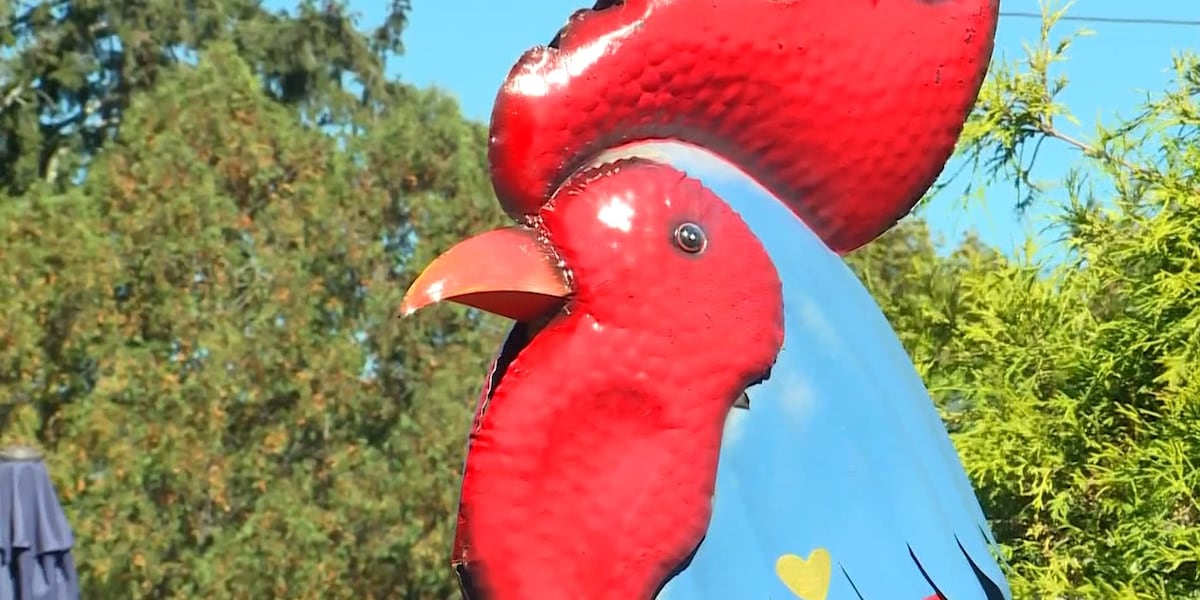
A Maine family has filed a federal lawsuit against the town of Ogunquit after racking up $1,700 in fines for displaying six-foot-tall tin rooster statues on their residential lawn.
The LeBlancs say the statues are a therapeutic anchor for their six-year-old daughter, Pyper, who is autistic and adopted after a difficult foster-care history. The town says the roosters are unpermitted commercial signage advertising the family’s attached restaurant, The Omelette Factory, which uses a rooster logo. The clash has drawn Daniel Woislaw from the Institute for Justice into a First Amendment fight that now sits before a federal judge.
How a comfort object became a code violation
Dave and Sara LeBlanc placed their first rooster in front of their home in May 2025, months after adopting Pyper. She struggles with transitions — leaving for school, returning home — and the statue became a fixed point in her routine. She hides behind it while waiting for the bus and pats its chest when she arrives back each afternoon.
Over time the family acquired about two dozen of the tin birds, though they say they never displayed more than eight at once, save for the Christmas season.
In April 2026, the town sent a letter ordering removal of all “unpermitted signage,” including the roosters. Since then the LeBlancs have been fined $1,700, which they paid under protest, according to reporting by WMTW via CNN Newsource carried by wkyt.com and wsfa.com.
Dave LeBlanc said that Pyper was bounced through so many foster homes that all she really knew was transition, adding that she is coping with “great anxiety.”
The town’s argument: location dictates function
Ogunquit’s sign code caps freestanding signs at 42 inches, requires permits for any sign, and bans signs that visually move — the roosters bob slightly on spring-mounted legs. Because the LeBlancs’ home and The Omelette Factory share the same lot, the town classifies the statues as accessory business signs rather than residential art.
Sara LeBlanc told local station WGME that she physically bought the statues for the house, not their business. The statues sit squarely in front of the family’s front door, though they are visible from the restaurant’s outdoor seating.
The Institute for Justice, representing the LeBlancs, argues the town is engaging in viewpoint discrimination by deciding the statues’ meaning based on the restaurant’s logo. Daniel Woislaw told WMTW the enforcement is “not neutral. It’s not even-handed. It’s uneven, unfair and arbitrary.”
Dozens of neighbors and community members have since erected identical roosters in their own yards in solidarity. According to the Institute for Justice, none of those displays has drawn a town notice — a fact the LeBlancs’ legal team cites as evidence of selective enforcement.
The federal lawsuit seeks an injunction against the fines and the sign-code application, plus damages to cover the $1,700 already paid. Town officials did not provide a comment on the lawsuit.
Dave LeBlanc said, “Never imagined it getting to the point where it is, but it had to. We had no choice.”
Related reading
Senior Software Engineer Node.js AWS Lambda ECS Fargate Terraform Fastify Vue.js
Fargo, North Dakota — A job posting for a senior software engineer in Fargo asks for six years...

NYC Releases ‘Get Online NYC’ Draft Plan to Connect 1.25 Million by 2034, Opens 60-Day Comment Period
New York City published a draft roadmap to connect 1.25 million more residents to affordable high‑speed internet by...

New Jersey Awards $15M for 44 Electric School Buses and 40 Chargers in Third Grant Round
New Jersey’s Department of Environmental Protection awarded nearly $15 million on Wednesday for 44 electric school buses and...

DEA Whistleblowers Claim Two New Retaliation Probes After TV Interview
"This public pressure appears to have renewed DEA's motivation to retaliate and prompted not one but two retaliatory...