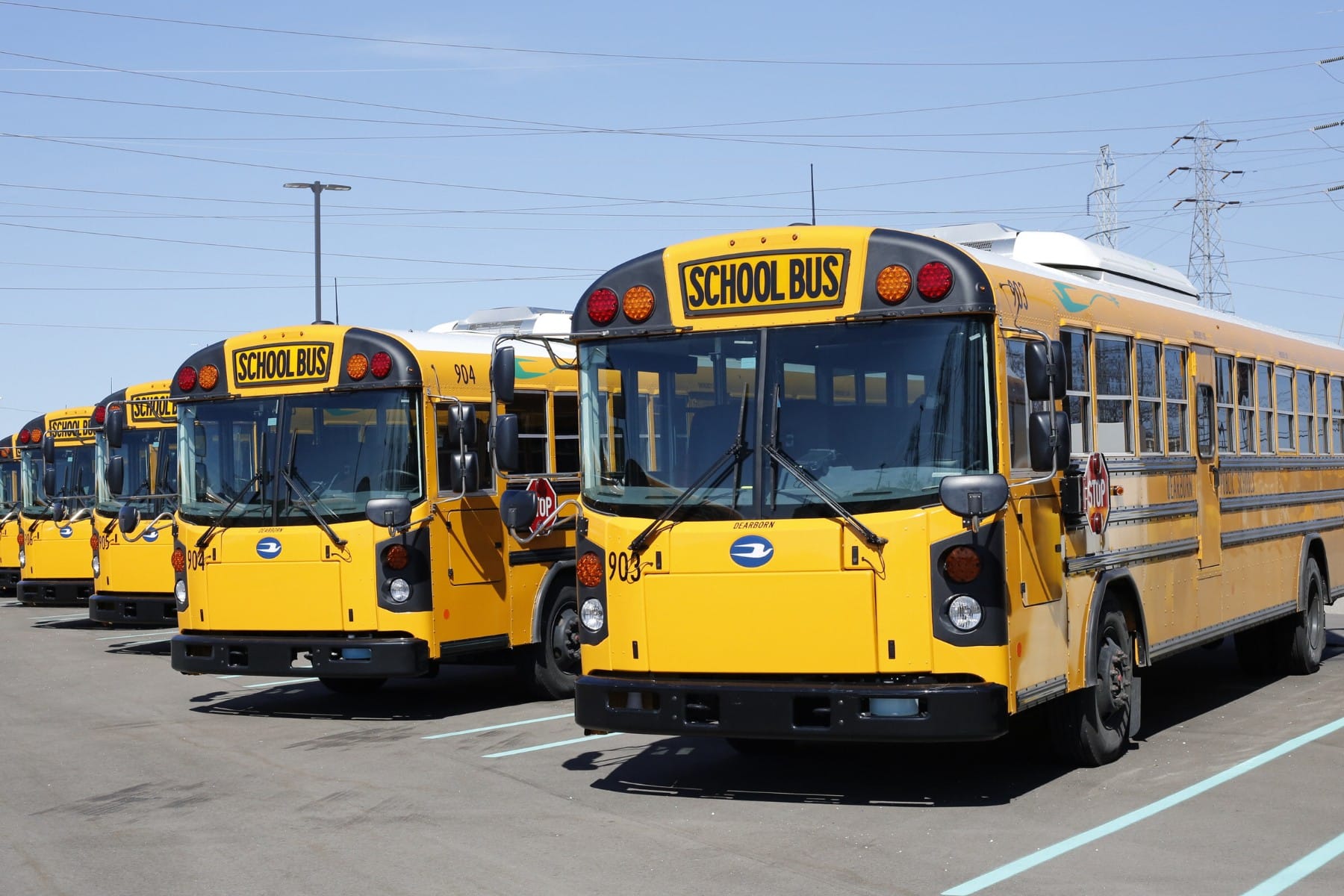
New Jersey’s Department of Environmental Protection awarded nearly $15 million on Wednesday for 44 electric school buses and 40 charging stations, the third round of grants under a 2022 law that commits up to $45 million over three years to replace diesel fleets.
The latest grants push the program’s totals to 145 buses and 129 chargers funded statewide, DEP announced. Eight of the ten recipients operate in communities the state designates as overburdened by pollution, a statutory requirement that at least half the awards go to those areas.
“We’re on a mission to deliver cleaner air and healthier communities, and the Electric School Bus Grant Program is delivering real results for our children and their families,” DEP Commissioner Ed Potosnak said in the release. “The use of electric school buses greatly reduces the exposure of those most vulnerable to the harmful pollutants in diesel emissions — our children.”
Of the 21,700 school buses registered in New Jersey, more than 99 percent still run on fossil fuels, the department said. Diesel exhaust carries fine particulates and nitrogen oxides that aggravate asthma and impair lung development — risks that concentrate at curbside pickup lines and inside the cabin during idling.
Round three spreads from Irvington to Point Pleasant
The awards range from $668,000 for two buses and a Level 2 charger at Yeshiva Nachlei Torah to $2.8 million for eight buses and eight fast chargers at Howell Township Public School District through its contractor Highland Electric Fleets. Six grants go directly to districts or schools; four go to contractors serving districts. nj.pulse.ly reported the county-by-county breakdown:
- Irvington Board of Education — up to $700,000 for two buses, two fast chargers
- Pillars Preparatory Academy, South River — up to $700,000 for two buses, two fast chargers
- Piscataway Township Schools — up to $1,336,000 for four buses, two Level 2 chargers
- Howell Township Public School District — $2,800,000 for eight buses, eight fast chargers via Highland Electric Fleets
- Wall Township Public School District — up to $2,768,000 for nine buses, seven Level 2 and two fast chargers
- Dover Public Schools — up to $1,050,000 for three buses, three fast chargers
- Washington Township School — up to $2,560,000 for eight buses, eight fast chargers via Highland Electric Fleets
- Point Pleasant School District — up to $700,000 for two buses, two fast chargers via Highland Electric Fleets
- Yeshiva Nachlei Torah — up to $668,000 for two buses, one Level 2 charger
- Yeshiva Toras Chesed — up to $1,356,000 for four buses, two Level 2 and one fast charger
Recipients also receive a personalized Fleet Electrification Roadmap through the New Jersey Fleet Advisor tool, covering vehicle selection, cost projections, and on-site electrical assessments.
Three rounds, $45 million cap, one Clean Energy Fund
The program launched with a $15 million round in October 2024 that funded 48 buses, electrive.com reported. A second round in January 2026 awarded over $18 million for 53 buses and 41 chargers. Wednesday’s $15 million tranche brings cumulative spending to roughly $48 million against the $45 million three-year authorization; the slight overrun reflects “up to” award language and contractor-matched contributions.
Money flows from the New Jersey Board of Public Utilities’ Clean Energy Fund, a ratepayer-supported pool that also backs solar incentives, heat-pump rebates, and grid modernization.
Mandates and fleet costs complicate bus transitions
New Jersey’s 21,700-bus fleet turns over slowly — typical service life reaches 12 to 15 years. The overburdened-community mandate aims to front-load benefits where childhood asthma rates exceed state averages, but advocates note that contractor-owned fleets — which serve many urban districts — face split incentives: the contractor buys the bus, but the district or state often pays for fuel and maintenance, complicating total-cost-of-ownership calculations.
DEP’s roadmap assistance tries to close that gap by modeling energy costs, charger utilization, and utility demand charges over a bus’s lifecycle.
A fleet manager in a neighboring mid-Atlantic district stated that the transition involves more than just buying a different bus; it requires rewriting the depot, including electrical service, utility interconnection, driver training, and a maintenance culture that has historically focused on diesel.
The third round effectively exhausts the original $45 million authorization. DEP has not announced a fourth solicitation.
Related reading
RI House Judiciary Advances Matos to Supreme Court After He Affirms Abortion Rights Support
Rhode Island’s House Judiciary Committee voted unanimously Tuesday to advance Superior Court Associate Justice Luis M. Matos toward...

Marlin “Bud” Gilley, Vietnam Veteran and 50-Year Truck Driver, Dies at 77
Marlin Owen “Bud” Gilley, a Vietnam veteran who spent more than 50 years behind the wheel of a...

Josh Harris Gives $15M to Penn for Wharton Center and Wrestling Facility
Josh Harris is putting $15 million behind the University of Pennsylvania on the occasion of his 40th Wharton...

Ohio State Climbs to No. 14 in CFP Rankings, Keeps Playoff Paths Open
Ohio State climbed six spots to No. 14 in the latest College Football Playoff rankings Tuesday, landing three...