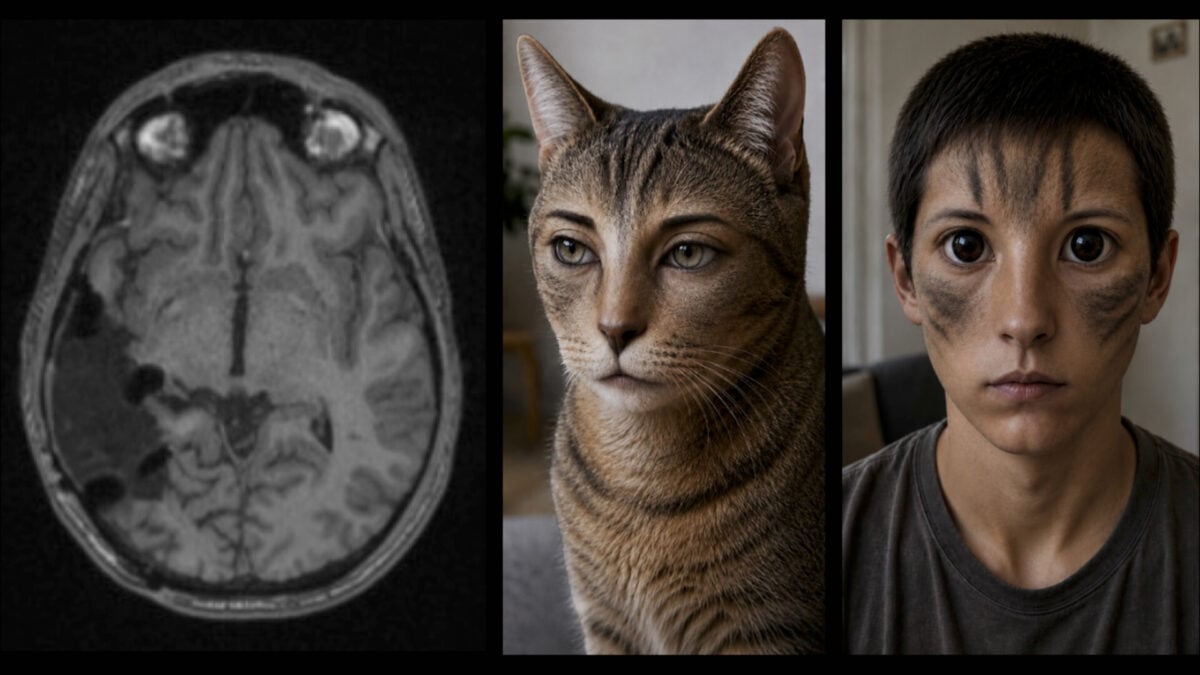
A 28-year-old man sees his cat’s eyes on human faces and human eyes on his cat after brain surgery.
- Karl, 28, developed prosopometamorphopsia after right temporal lobe surgery in 2024.
- His palinopsia transfers specific facial features — eye shape, pupils, stripes — between his cat Luna and the people he sees.
- Episodes last hours to a full day; the first face he sees each morning sets the “template.”
- Researchers used generative AI to co-create photorealistic images of what Karl sees, published in Cortex on 16 October 2026.
First face seen shapes daily distortions
Karl lives in the northeastern United States with Luna, a gray tabby. He underwent resection of an arteriovenous malformation in the right posterior temporal lobe in 2024, a brain region critical for face processing. The distortions remain a daily feature of his life two years later.
On mornings when Luna is the first face he sees, her almond-shaped eye sockets, enlarged pupils, and fur-like shading appear on human faces he encounters. These faces can be in person or on a screen.
If a person is the first face he sees, that person’s eye shape and pupil size can show up on Luna and on other people. These episodes typically last for several hours. They occasionally last the entire day.
“This case of Karl seeing his cat's features in human faces and vice versa demonstrates that individual features can be pulled from memory and influence our ongoing perception,” said Brad Duchaine, professor and chair of psychological and brain sciences at Dartmouth and lead author of the Cortex report.
Karl’s case differs from a 1986 report
The journal Cortex published a strikingly similar case four decades ago. A woman saw a poodle’s entire face replace every passenger’s face on a bus for about 30 minutes nine months after a right-hemisphere stroke.
Duchaine’s team said Karl’s transfers involve only component features like eyes, pupils, and texture. The rest of each face stays recognizable. The cross-species swap also runs bidirectionally.
The 1986 case substituted whole faces. Karl’s percepts are feature-specific and persistent.

AI creates visualizations of distorted sight
Duchaine drew a line sketch from Karl’s description to document the experience. He fed it into a large language model to produce a photorealistic image.
Karl refined the output over several months. He used Kimi K3 (Moonshot AI) at one point to help. He worked until the images matched what he saw.
The resulting visualizations appear in the Cortex paper. They show a familiar woman’s eyes in Luna’s face and Luna’s features within a human face.
“AI provides researchers like us with the ability to generate more accurate visualizations of what people are experiencing when they’re having distorted visual perceptions. If you know what the person is experiencing, you can much better research what they’re dealing with and try to figure out ways to control it. And now the patient can also take part in that process of creating those visualizations,” Duchaine said.
Duchaine said the method helps patients communicate their percepts to friends, family, and clinicians. His lab plans to continue working with Karl. The lab has collected accounts from more than 250 people reporting face distortions through its PMO website.
Neurologists explain the memory error
Brad Duchaine, a visual neuroscientist at Dartmouth University, said Karl’s face processing system is disrupted in a specific way. “Our brains store detailed memories of the faces we know well,” Duchaine said.
“In Karl, those stored features get reactivated and stuck in his face perception system, so they’re blended into whatever face he’s looking at, whether it belongs to a person or his cat,” Duchaine said.

Jan Dirk Blom, a clinical psychiatrist at Leiden University and Parnassia Psychiatric Institute in the Netherlands, was not involved in the work. He described the researchers’ analyses as “wonderfully innovative.”
Blom said the study is new because a cat’s eyes can be transposed from memory onto human faces and vice versa. “In my line of work, clinical psychiatry, we know that everything stands and falls with the descriptions that our patients give us,” he said.
“In my opinion, this is patient participation at its best,” Blom said.
Researchers study more face distortions
The study was a collaboration between Brad Duchaine, Antônio Mello, a Guarini PhD student in psychological and brain sciences at Dartmouth, and Jennifer Nosker, a neuropsychologist at Brigham and Women’s Hospital. The team has documented about 250 people with PMO who have contacted the lab.
Duchaine said Karl’s case is particularly strange. “We blend into the face rather than appearing superimposed on it, and we shift naturally as Karl changes his angle or distance,” a researcher from the Social Perception Lab noted.
Karl can say whose features he sees. The lab plans to continue collecting data and researching these conditions. They are also planning further work with Karl to understand why certain visual features persist in his perception.
Doctors face risks of misdiagnosis
Some people who contacted the lab had been told their symptoms were psychiatric. In some cases, these people were prescribed antipsychotics, Duchaine’s team said.

The Cleveland Clinic advises that new-onset palinopsia warrants medical evaluation because it can signal stroke. For Karl, the lesion was a known surgical consequence.
The distortions have persisted for two years. There is no established treatment specific to PMO. Researchers are studying whether modified visual stimuli might reduce distortions in certain patients.
The mechanisms driving the feature “stickiness” in Karl’s face-perception system remain unknown.
Worth a look

Calvert-Lewin Scores for Leeds vs Coventry; New Deal Signed Thursday
Dominic Calvert-Lewin scored his sixth league goal 48 hours after signing a contract extension to 2029. Sean Longstaff...
Mets Agree to 3-Year, $39M Deal With Alex Vesia, Pending Physical
The New York Mets agreed to a three-year, $39 million contract with left-handed reliever Alex Vesia on Saturday,...

Seven Teams Advance in Billie Jean King Cup Qualifiers After Play-offs
Seven teams booked their places in the 2027 Billie Jean King Cup Qualifiers following the conclusion of the...

Doc Giffin, Arnold Palmer’s Confidant and Assistant, Dies
Giffin served Palmer from 1966 until the golfer’s death in September 2016. He previously worked as press secretary...