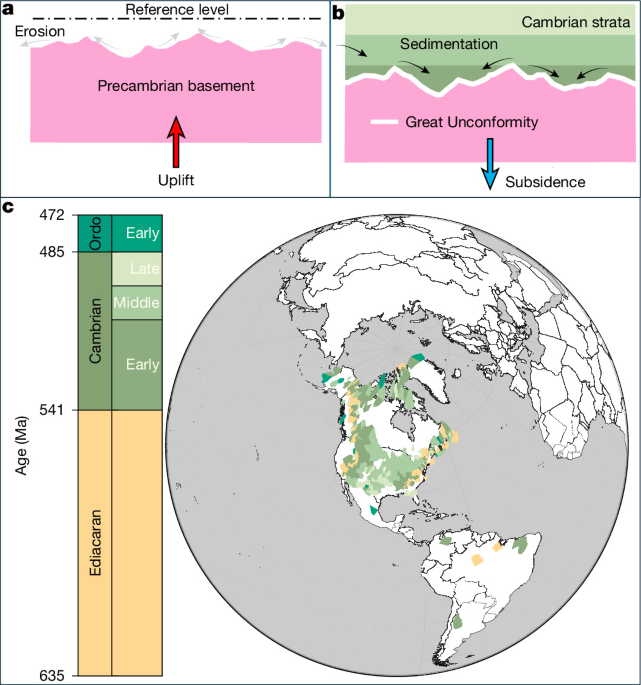
At the Grand Canyon, Cambrian sandstone about 540 million years old sits directly on crystalline basement up to two billion years old — a gap of roughly 1.2 billion years called the Great Unconformity, according to Nature. New research published Nov. 4 argues that slow currents in Earth’s mantle lifted whole continents, stripped away the missing rock, then let them sink so the seas could bury the scar.
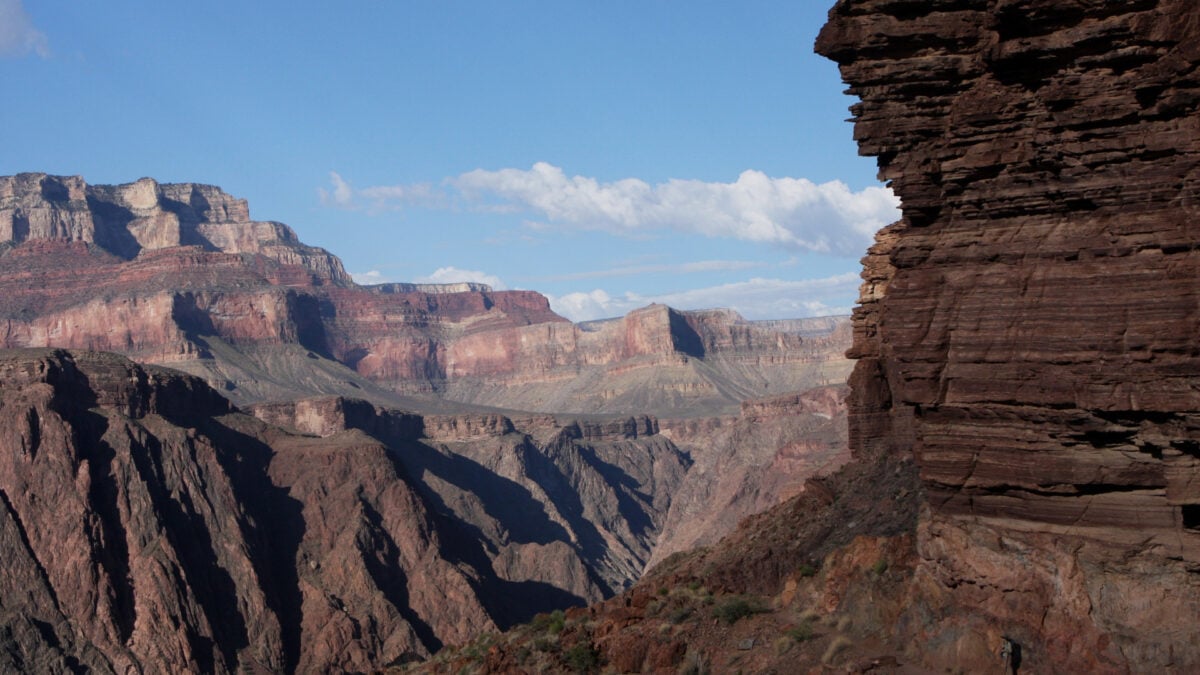
Geologist John Wesley Powell first identified the unconformity at the Grand Canyon, where Cambrian sedimentary rocks rest on igneous and metamorphic rocks more than a billion years older. In the 1870s, geologists found similar gaps on several continents. Rock layers normally stack oldest at the bottom, youngest at the top; here the record leaps forward. The gap shows up across North America, northern China and northern Europe, with other big unconformities in Europe, Australia, Africa and Asia. Depending on location, the missing record runs from 200 million years to well over a billion.
The National Park Service cautions that these gaps are not necessarily missing time
caused by unknown events
— surrounding rock layers let geologists deduce what happened, such as long-term erosion, and smaller disconformities preserve fossil and erosion evidence.
Mantle currents as the eraser
The Nov. 4 study, published in Nature volume 659, pages 106–112, was led by Santosh Dhungana, a PhD candidate at the University of Wollongong, with his supervisor, Associate Professor Nicolas Flament. The pair modeled mantle convection over hundreds of millions of years and compared the simulations with the volume of sediment preserved on continents. Deep below the crust, the mantle is solid hot rock that moves slowly; its currents can lift or sink huge land areas.
The models point to prolonged uplift of Laurentia, Baltica and North China during the Neoproterozoic, which spans one billion to about 540 million years ago, followed by long-term sinking during the Phanerozoic, the last 540 million years. As the ancient continental cores subsided into the ocean, seas and sediment buried the worn rock surface — the unconformity visible today. The work was funded by the Australian Research Council.
Imagine a book where a huge section in the middle has been ripped out. The Great Unconformity is that gap in Earth’s story, with the narrative jumping from the early chapters straight to a much later part of the story. Our research suggests these pages weren’t lost by chance.
Santosh Dhungana, lead author and PhD candidate at the University of Wollongong
Sometimes what is missing can tell us more about the story of Earth than what we can see. A single, long period of uplift followed by a long period of sinking would have been the ideal recipe for removing the rock and preserving the worn surface.
Associate Professor Nicolas Flament, University of Wollongong
Flament added that many explanations for the Great Unconformity had been proposed but few had been tested against how the Earth actually behaves over time
— and called proposing a solution to the puzzle a thrill
.
The competing cliff theory
Three months earlier, a different team offered a rival culprit. Thomas Gernon of the University of Southampton and colleagues proposed in Geology, published online Aug. 17, that a continent-scale cliff — the Great Escarpment of Laurentia
— eroded and retreated inland after the supercontinent Rodinia began to split apart around 800 million years ago. The escarpment stood one to two kilometers high and stretched across much of Laurentia, from what would become Alaska to Arizona.
Steep slopes gave rain and ice ideal access to exposed rock, and the timing coincided with Snowball Earth, the extreme glaciation between 720 million and 635 million years ago whose ice sheets may have reached equatorial latitudes. Sciquest notes the escarpment model sits closer to the tectonic camp in a long-running debate: earlier studies pointed either to Snowball Earth glaciers or to several separate regional unconformities formed at different times.
Alan Collins, a geologist, called the cliff explanation convincing: I find this very convincing.
Both lines of research bear on the Cambrian explosion, which began around 540 million years ago: the sedimentary layers on the younger side of the unconformity appear at the same time, and the vanished rock may have shifted seawater chemistry in ways that let animal life flourish. As for the escarpment theory’s own loose end, Gernon put it plainly: That’s the real hole that needs filling: pinning down the erosion history in space and time, continent by continent, precisely enough.

Gene Therapy Reduces Seizures by 90% in Epilepsy Clinical Trial
Three adults whose epilepsy had resisted at least two anti-seizure medications saw their monthly seizures fall by more...

Gaza Engineer Builds Wind Turbines From Scrap to Power Families
Above a maze of tents in a crowded displacement camp in Khan Younis, homemade wind turbines built from...

Plant-Based Dairy Swaps Could Lead to Vital Nutrient Deficiencies, Study Warns
"There are known health effects of iodine deficiency and that's why we want to raise awareness of this,"...

108-Year-Old Theologian and NZ’s Oldest Man Sir Lloyd Geering Dies
Sir Lloyd Geering, the theologian who became the only man in New Zealand to stand trial for anti-Christian...