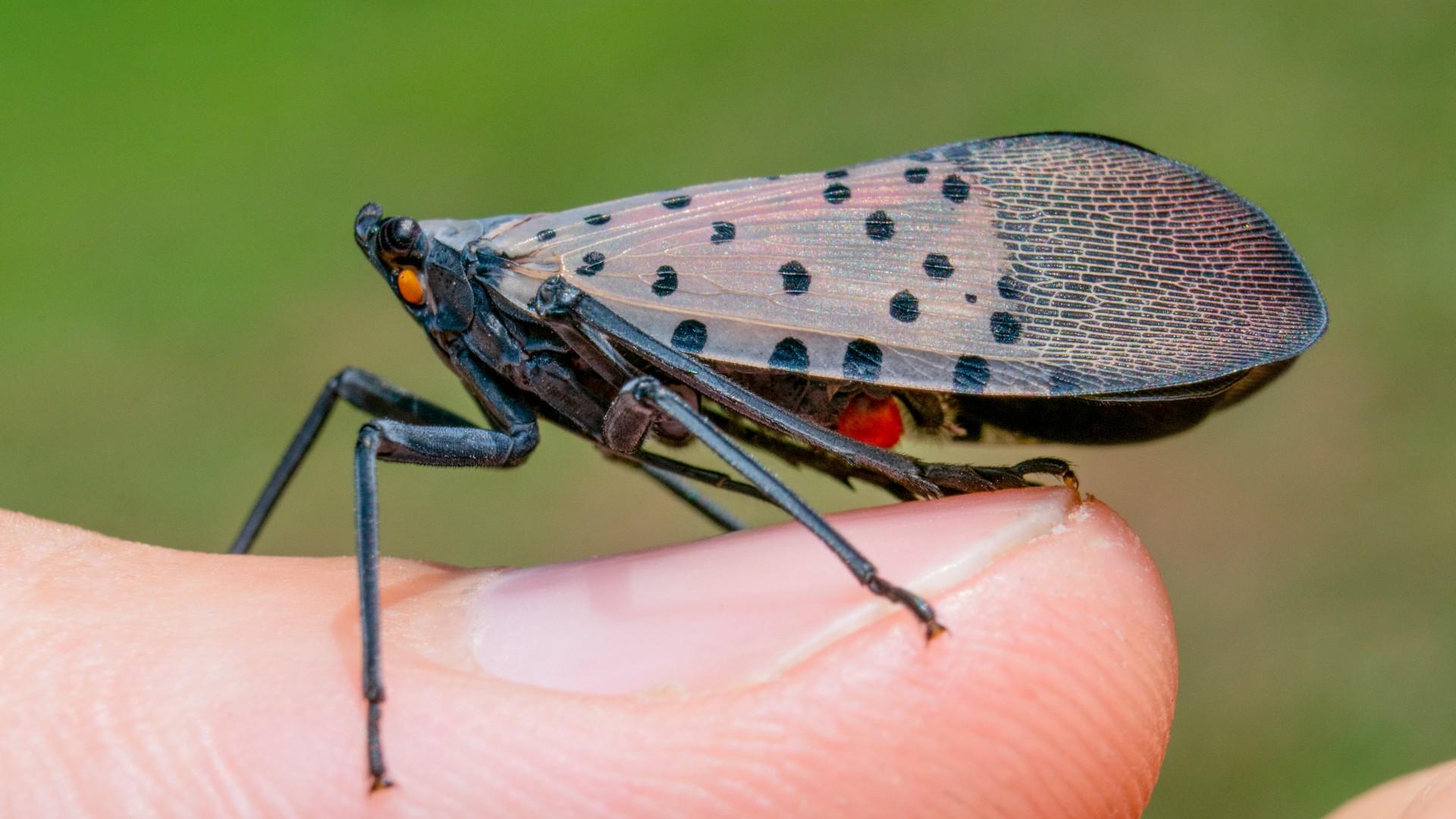
What started as a single accidental hitchhiker in a 2014 stone shipment to Berks County, Pennsylvania, has evolved into a sprawling agricultural and civic challenge across the mid-Atlantic. The Maryland Department of Agriculture reports that the spotted lanternfly has now established a presence in 20 of Maryland’s 23 counties, including Baltimore City, following its first local detection in Cecil County back in 2018.
According to distribution data outlined by the Maryland Department of Agriculture, central Maryland counties—including Baltimore, Howard, Prince George’s, Montgomery, Carroll, Frederick, and Washington, as well as Baltimore City—sit under dark red shading indicating the heaviest estimated population abundances as of March 2026. Moderate levels appear across Allegany, Harford, Cecil, Kent, Queen Anne’s, and Anne Arundel counties, while lighter populations stretch through parts of the Eastern Shore and Southern Maryland.
The Biology of an Invasive Planthopper
Recognizing the insect across its life stages remains the primary hurdle for property owners trying to keep up with the spread. Native to eastern Asia, the spotted lanternfly undergoes a distinct developmental timeline that shifts from tiny nymphs to winged adults.
Eggs are typically laid in rows on host trees, flat surfaces, fences, wood piles, and vehicles between September and the first frost, then shielded beneath a grayish coating. Jessica Boyles of the Maryland Department of Agriculture’s Spotted Lanternfly Program notes that a single female can lay up to three egg masses that frequently resemble a simple splash of dried mud.
When those eggs hatch from April to June, early-stage nymphs emerge measuring just a few millimeters long. These first through third instars feature black bodies covered in bright white spots and strong legs that make them prone to leaping when disturbed. By April, fourth-instar nymphs appear, growing to roughly half an inch with a bright red body, black stripes, and white spots.
Feeding Habits and the Threat to Vineyards
While homeowners often worry about structural damage or personal safety, the Maryland Department of Agriculture clarifies that spotted lanternflies pose no danger to humans or pets. They do not bite or sting.
The real damage is botanical. Both nymphs and adults feed by sucking phloem sap from plant stems and trunks. While they target more than 70 species of plants—including apples, peaches, grapes, and various maples—the tree-of-heaven (Ailanthus altissima), another non-native invasive species, is a primary host.
The MDA is still taking reports from every Maryland county and city. — Jessica Boyles, MDA Spotted Lanternfly Program
As these insects feed, they excrete large quantities of a sugary waste known as honeydew. This substance blankets understory leaves and outdoor equipment, drawing ants, bees, and wasps while fueling the rapid growth of black sooty mold. The mold coats leaves, blocking vital sunlight and hindering photosynthesis, which ultimately stunts plant growth and reduces crop yields. Maryland vineyards face unique vulnerabilities, as spotted lanternfly feeding is a significant stressor.
Managing Populations Without Commercial Overkill
Complete eradication is currently unfeasible, and the Maryland Department of Agriculture does not have the resources to conduct residential treatment. Instead, officials emphasize mechanical controls as a strategy for property owners.
For active tree protection, circle traps offer a method by intercepting insects as they crawl upward to feed, trapping them into replaceable plastic bags.
Property owners can also target the pest’s primary habitat by removing tree-of-heaven, though removal of tree of heaven will also not guarantee spotted lanternfly will avoid or leave your property.
For those looking to inspect their property or learn more about reporting protocols, the MDA homeowner checklist (PDF) provides step-by-step guidance on clearing outdoor gear, trailers, and vehicles before traveling across county lines.

Marsha Hayes tests media narrative at Donald Trump rally in Park City
When retired rural mail carrier, retired community college English teacher, and award-winning equine journalist Marsha Hayes drove down...

Klobuchar Leads Demuth in Minnesota Governor Race Polling
With just seven days remaining until the state heads to the ballot box, Democratic U.S. Amy Klobuchar holds...

Seahawks trade draft picks for guard Quenton Nelson from Colts
Seahawks Land Eight-Time Pro Bowl Guard Quenton Nelson in Blockbuster Trade with Colts The Seattle Seahawks are making...

ISU Art Students Illustrate Community Visions for Eastland Mall Future
Eastland Mall sits largely empty in Bloomington, Illinois, waiting for a new developer while residents wonder what will...