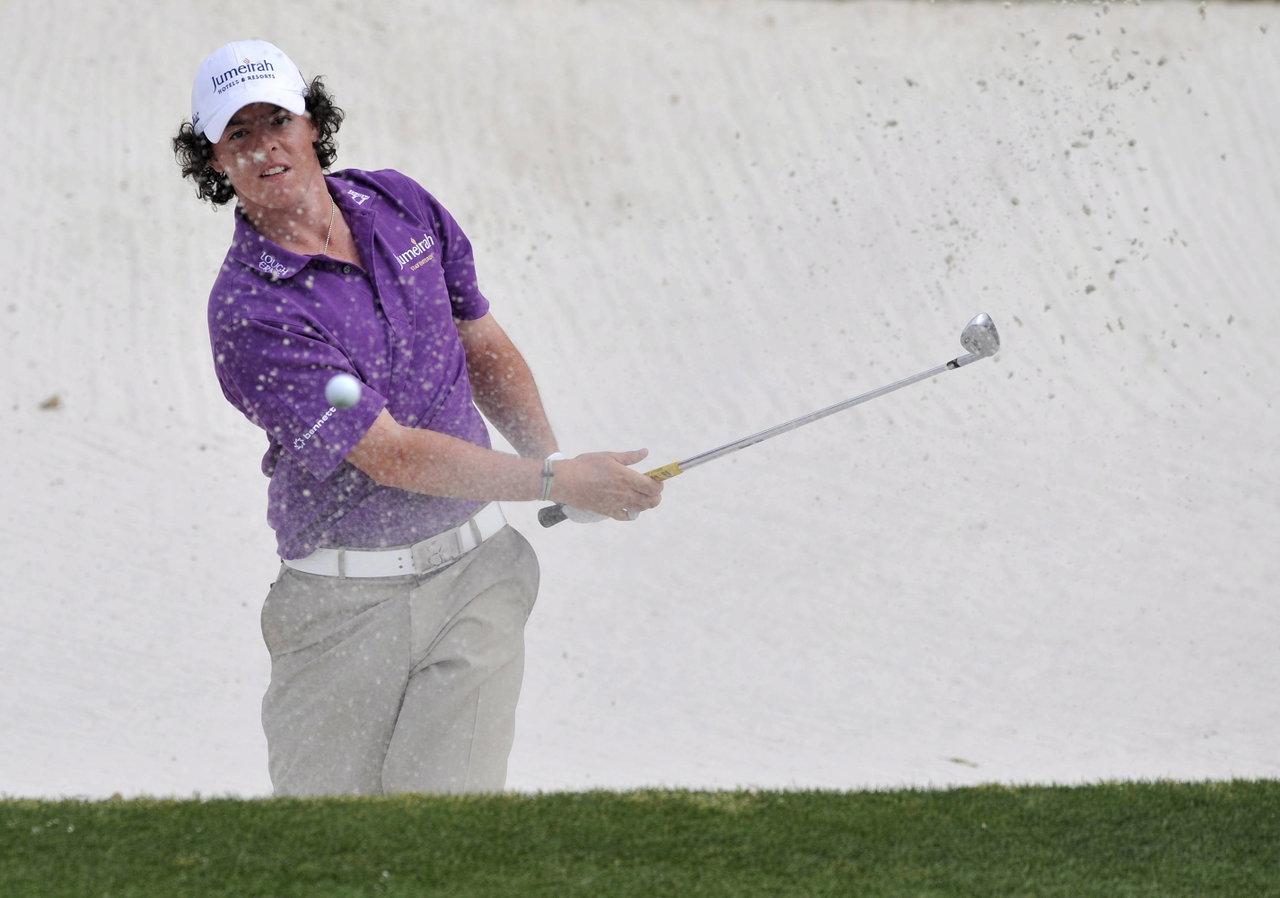
- McIlroy, 19, signed for a 73 on Friday but faced a potential two-shot penalty for kicking sand in the 18th bunker.
- Disqualification was avoided after a late-night review with Augusta National competition committee head Fred Ridley.
- McIlroy tied for 20th that week and won his first green jacket 16 years later, defeating Justin Rose in 2025.
McIlroy opened the 2009 Masters with an even-par 72 and reached four under through 15 holes on Friday, sitting sixth and five shots behind halfway leaders Chad Campbell and Kenny Perry.
A double bogey at the 16th and a recovery at the 17th preceded disaster at the par-4 18th. After finding a greenside bunker, his first attempt stayed in the sand. McIlroy swiped at it with his right foot, sending sand flying. His next shot sailed over the green, and three putts produced a triple-bogey seven. The collapse dropped him to one over par, on the projected cut line.
Television footage raised a separate threat. Under the rules at the time, players could smooth sand to care for the course but could not test the surface while their ball remained in the bunker. Kicking the sand could constitute testing, carrying a two-shot penalty. Because McIlroy’s signed card did not include those strokes, a penalty would have meant disqualification.
Committee accepts player’s explanation
At 6:30 p.m., Fred Ridley, then head of Augusta National’s competition committee, called McIlroy to ask what happened. When Ridley offered a chance to see the footage, McIlroy declined, feeling he had done nothing wrong. Nearly two hours later, Ridley called again.
“It would be in your best interests to come up and see the tape,” Ridley said assertively, according to Golf Digest.
McIlroy returned to the club roughly four and a half hours after finishing his round. He spent about 10 minutes reviewing the tape while the committee deliberated. McIlroy explained he had naturally smoothed over his footprints after the bunker shots without a second thought, admitting he might have done it more forcefully this time but describing the motion as lifting his foot out of the sand and putting it back in.
The committee accepted the explanation, ruling no rule had been broken.
“I didn’t feel like I had done anything wrong or anything to violate the rules,” McIlroy said on Saturday.
The decision drew praise for its common-sense approach, though debate lingered over the thin line between kicking and forcefully smoothing. McIlroy later joked, “I have learned not to dance in the bunker.”
He applied the lesson Saturday, splashing out to six inches on the second hole, making birdie, and leaving his footprints undisturbed. A 71 brought him back to even par, and a closing 70 with six birdies over his last 10 holes secured a tie for 20th at two under.
McIlroy’s wait for a green jacket ended 16 years later. In 2025, he defeated Justin Rose to complete the career Grand Slam. “I just can’t believe I waited 17 years to get one green jacket,” McIlroy said.
Ridley brought deep rules expertise to the 2009 ruling as a career administrator who had served as USGA president in 2004 and chaired the USGA’s Championship Committee and Amateur Status and Conduct Committee. His competitive pedigree as the 1975 U.S. Amateur champion and 1977 Walker Cup player gave him firsthand tournament experience, while his legal background as a commercial real estate attorney reinforced a deliberative approach to the bunker incident.
Keep reading
Steelers Bench Aaron Rodgers, Name Mason Rudolph Starter for Friday Broncos Game per Team Announcement
The Pittsburgh Steelers benched quarterback Aaron Rodgers and named Mason Rudolph the starter for Friday’s game against the...

Utah No. 2, BYU No. 10 in CFP Rankings; Utes Host WVU Friday
Utah sits No. 2 in the College Football Playoff rankings released Tuesday, one spot behind No. 1 Georgia,...

Virginia Supreme Court Rules Felon Gun Ban Unconstitutional Under Bruen Test
The Supreme Court of Virginia ruled unanimously Wednesday that the state’s felon-in-possession law, as applied to Derek Ginevan,...
Pierre Poilievre Says Nurse May Lose Contract After Photo With Him
Conservative Leader Pierre Poilievre told the House of Commons on Wednesday that a nurse who treated victims of...