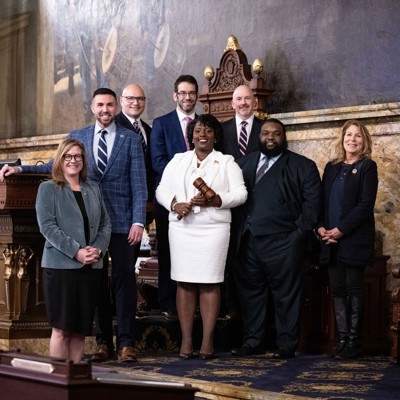
Pennsylvania House Democrats and Republicans have finalized their leadership teams for the 2027-28 legislative session, setting the stage for a period of significant partisan tension.
Following a midterm election cycle that saw Democrats flip more than 10 seats, the party enters the new session with a notably expanded majority.
The shift in seat counts fundamentally alters the legislative math in Harrisburg. While the Democratic caucus retains control of the chamber, the increased margin of victory provides them with more leverage to advance a progressive agenda, while the Republican minority prepares to pivot toward a strategy of opposition and fiscal critique.
“It’s with his partnership and leadership that we will be able to do even more and respond to the demands of this hour,” Joanna McClinton told City & State PA regarding her anticipated collaboration with state Sen. Jay Costa, who is expected to serve as president pro tempore of the state Senate.
McClinton leads a strengthened Democratic majority
Joanna McClinton has been named the “speaker-designate” by her caucus. While her official role as Speaker of the House will be confirmed by a vote of the full membership at the start of the new year, her selection signals a continuation of the current Democratic direction.
McClinton has already signaled her intent to prioritize specific policy areas, including funding for mass transit and efforts to raise the state’s minimum wage.

The Democratic leadership structure remains largely intact, leaning on experienced members to manage the expanded caucus. Matt Bradford, a representative from Montgomery County, will return as majority leader, while Philadelphia’s Jordan Harris will continue to oversee the House Appropriations Committee. The caucus also reelected its core administrative and policy leadership, including Mike Schlossberg as majority whip and Ryan Bizzarro as chair of the House Democratic Policy Committee.
The political stakes for the Democratic majority are high. With control of both chambers of the state legislature expected by January, the party faces immediate pressure to deliver on campaign promises. This unified control allows for a more streamlined legislative process, but it also concentrates significant power within a single party leadership structure.
Republicans prepare for a defensive posture
Jesse Topper will continue to lead the House Republican Caucus for the 2027-28 term. First elected as minority leader in 2024, Topper’s reelection suggests a caucus looking for stability as they face a more formidable Democratic majority. The Republican strategy is expected to focus on pushing back against what they characterize as an expansion of government reach.
“Though numbers and majorities may change, our commitment to fighting for and achieving significant policy wins for Pennsylvania has not wavered,” said Jesse Topper, House Republican Minority Leader.
Topper highlighted the caucus’s recent legislative successes as a blueprint for their future role, specifically citing their ability to block the state’s entry into the Regional Greenhouse Gas Initiative and halting new Department of Health regulations. The Republican minority intends to frame their upcoming session around “free markets and personal liberty” to counter the Democratic agenda.

The Republican leadership team also sees a mix of continuity and fresh perspectives. Tim O’Neal will remain as minority whip, while Martina White and Clint Owlett will continue as caucus chair and caucus secretary, respectively.
However, two key changes will impact the GOP’s ability to influence fiscal policy: Marla Brown will replace Sheryl Delozier as caucus administrator, and Jamie Barton will take over as the chair of the House Republican Appropriations Committee.
Barton, who represents parts of Schuylkill and Berks counties, intends to bring a different perspective to the committee’s deliberations. “More than three decades in business has taught me the importance of fiscal responsibility, and I will bring that same mindset into negotiations in my new role,” Barton said.
The legislative landscape for 2027
The upcoming session will likely be defined by the friction between the Democratic majority’s expansionist social and economic policies and the Republican minority’s focus on deregulation and fiscal restraint. The size of the Democratic majority means that the minority’s ability to block legislation through traditional means may be diminished, forcing them to rely more heavily on public discourse and policy debate to influence the outcome.
The following table outlines the primary leadership roles for both parties heading into the new session:
| Role | Democratic Leader | Republican Leader |
|---|---|---|
| Caucus Leader | Joanna McClinton (Speaker-designate) | Jesse Topper (Minority Leader) |
| Majority/Minority Whip | Mike Schlossberg | Tim O’Neal |
| Appropriations Chair | Jordan Harris | Jamie Barton |
| Policy Committee Chair | Ryan Bizzarro | David Rowe |
| Caucus Chair | Rob Matzie | Martina White |
As the January session approaches, the focus will shift from internal caucus elections to the broader legislative battleground. The ultimate direction of the Commonwealth will depend on how effectively the Democratic majority can coordinate with the Senate and how effectively the Republican minority can leverage its policy platform to influence public opinion.
Worth a look

Commanders News: Washington Needs Jacory Croskey-Merritt Back Soon | Hogs Haven
Second-year running back Jacory Croskey-Merritt is eligible to return from injured reserve this week following a spell out...

Virginia Kay Wheeler – Jewell-Rittman Funeral Service & Crematory
Virginia Kay Wheeler, known to her family and friends as both Virginia and Kay, passed away peacefully on...

Jordan Jackson Leads Huskies in Loss to Undefeated Utah Utes
The Utah Utes defeated the Houston Christian University Huskies 98-49, pulling away with a strong scoring performance after...

Tangier Island: A Fragile Living Museum Facing the Chesapeake Bay
In a column for ReportEarth, Chris Mooney argues that Tangier Island, Virginia, serves as a fragile, living museum...