
Legal battles threaten to delay final Senate results in Mississippi and Alaska
The final makeup of the U.S. Senate remains in limbo as intense legal disputes and uncounted ballots stall the certification of two critical races in Mississippi and Alaska, USA Today reported. While Democrats have already secured a 54-seat majority to the Republicans’ 44, the outcome in these two states will determine the exact strength of the Democratic margin during the final two years of President Donald Trump’s term.
🚨🇺🇸 #ALASKA SENATE UPDATE — THE COUNT IS MOVING AGAIN! The latest reported results show a small but significant update in the extraordinarily close #Senate race. 🔵 Mary #Peltola: 102,962 (+261) 🔴 Dan #Sullivan: 102,325 (+250) 👉🏻 PELTOLA LEADS BY 637 VOTES, up from 626. The…
In Mississippi, the race is a razor-thin contest between District Attorney Scott Colom and Republican incumbent Senator Cindy Hyde-Smith. With the Associated Press noting that the race has not been called, Colom holds a lead of approximately 2,500 votes—less than a single percentage point. A victory for Colom would represent a historic shift for the state, marking the first time a Democrat has won a Senate seat in Mississippi since 1982 and making him the first Black senator from Mississippi since the Reconstruction era.
Mississippi officials prepare for a battle over affidavit ballots
The uncertainty in Mississippi centers on thousands of affidavit ballots—the state’s version of provisional ballots—cast by voters who lacked photo ID or were not found on their precinct’s rolls. Republican estimates suggest roughly 20,000 of these ballots remain outstanding, and voters have until Nov. 10 to resolve any issues preventing their ballots from being counted.
Early data suggests a divergence in how these votes are trending. According to an analysis by the Mississippi Free Press, Colom has overperformed among affidavit votes, even in counties that Hyde-Smith won by large margins. However, the Republican side is preparing for a protracted legal struggle. The Hyde-Smith campaign and the National Republican Senatorial Committee have requested that officials in all 82 counties set aside and preserve these affidavit ballots, a move often used to prepare for litigation.
Mississippi Republican Party Chair Michael Hurst announced that the party has deployed more than 50 volunteer lawyers and observers to counting sites. While Hurst stated the party intends to “fight like hell” to ensure legal compliance, he also emphasized that “there’s no election denying going on here.” Conversely, Colom’s campaign has argued that pulling aside ballots that have already been processed could itself constitute a violation of state law. Because Mississippi law requires challenges to be handled on a county-by-county basis, any resulting legal battles could be fought across dozens of different courthouses.
Alaska race faces confusion and ranked-choice complications
In Alaska, the contest between Democrat Mary Peltola and Republican incumbent Senator Dan Sullivan is being complicated by both voter confusion and new litigation. Peltola currently leads Sullivan by 637 votes, but with only about three-quarters of the ballots counted, the result remains unsettled.
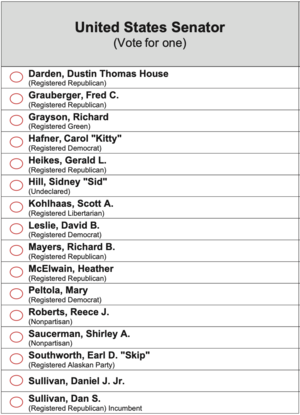
The race was shadowed for months by a fourth candidate, a retired teacher also named Dan Sullivan. Despite Republican warnings that the shared name would confuse voters, the Alaska Supreme Court declined to remove the candidate from the ballot. This confusion was compounded by a Justice Department lawsuit aimed at blocking certification if the incumbent lost; while a federal judge dismissed that case two days before the Nov. 3 election, the department has signaled its intent to appeal.
The legal maneuvering expanded on Nov. 6, when Peltola’s campaign filed suit against the state Division of Elections. The campaign is seeking the names of voters whose absentee ballots have been rejected, arguing that such transparency is necessary to prevent the wrongful disenfranchisement of her supporters. The state has resisted this request, maintaining that these records are preliminary and confidential. The state Department of Law stated that the Division has protected this information for years and will ask the court to continue that protection, arguing that releasing the names could impede the counting process.
The timeline for Alaska’s resolution is dictated by the state’s unique voting system. Because no candidate has cleared the 50% threshold, the state must conduct a ranked-choice tabulation. Absentee ballots can continue to arrive through Nov. 18, which is the same day the state expects to run the tabulation that redistributes votes from trailing candidates, including the other Dan Sullivan.
| State | Leading Candidate | Margin/Status | Key Deadline |
|---|---|---|---|
| Mississippi | Scott Colom (D) | ~2,500 votes | Nov. 10 (Ballot resolution) |
| Alaska | Mary Peltola (D) | 637 votes | Nov. 18 (Ranked-choice tabulation) |
The stakes extend beyond the individual candidates. For the Democratic party, these seats represent the difference between a comfortable majority and a more precarious one. For the Republican party, these races are the primary battlegrounds for limiting Democratic influence in the upper chamber. As the legal challenges move through the courts in both states, the final tally remains subject to the resolution of these specific procedural and identity-based disputes.
Keep reading

Ohio Wesleyan Women’s Basketball Game Highlights: OWU vs. UWP Play-by-Play
Ohio Wesleyan University faced the University of Wisconsin-Platteville in a women's basketball matchup on November 7, 2026, featuring...

Bismarck area residents honored in November 7 obituaries
Bismarck area residents honor community members in November 7 obituaries The community in and around Bismarck is marking...
The Rise of the Forward Deployed Engineer: How AI is Creating New Tech Career Paths
The AI implementation gap is creating a new class of high-demand engineers While much of the tech sector...

Man Arrested After Shooting at Santa Fe VFW Post Following Dispute
Carlos Joaquin Behrend Ramirez arrested after shooting at Santa Fe VFW Post A 44-year-old man is facing felony...