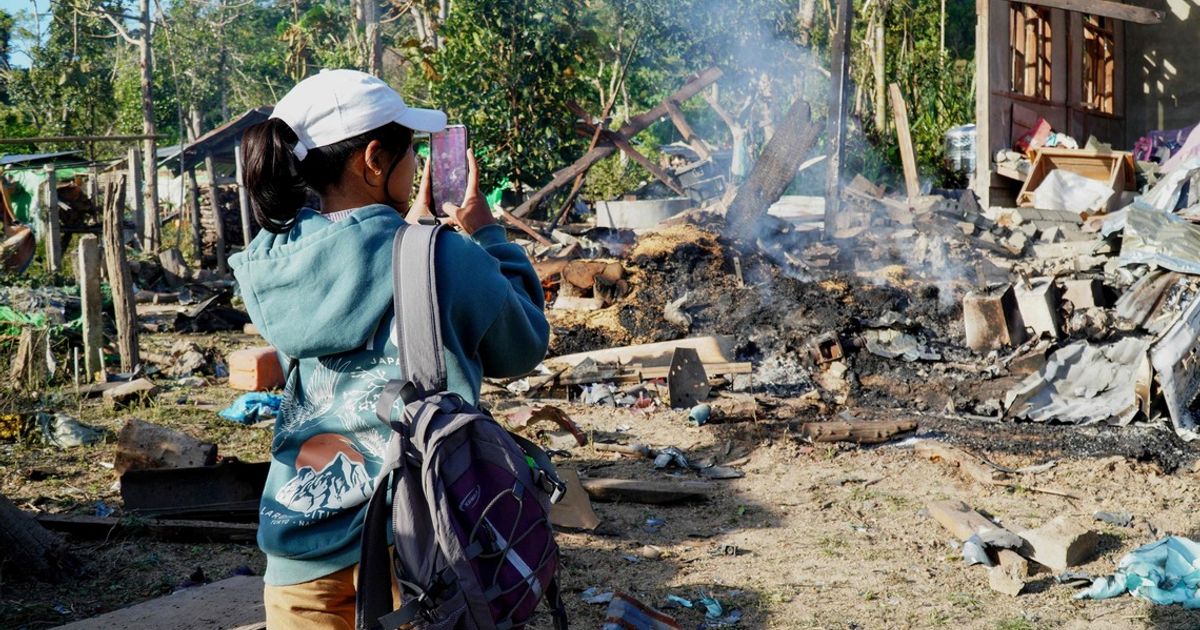
Dozens of civilians were killed in Myanmar military airstrikes over three days, including an attack on a wedding and a school.
The strikes took place between November 26 and 28. They hit multiple locations across the country, according to local witnesses and opposition sources.
On November 28, an airstrike on a wedding venue in Moe Bye village, in southern Shan state, killed at least 21 people and injured more than 35, rescuers told AFP. A witness at the scene described finding “17 dead bodies” and being “shocked and didn’t know who to rescue first.”
- At least 20 civilians, including students and teachers, killed in a strike on a school in Magway region on November 26, according to the National Unity Government (NUG).
- More than 10 killed and 20 injured in a strike on a residential area in Mrauk-U, Rakhine state, on November 28 evening.
The violence continued on November 26 when an airstrike hit a school and monastery compound in Ingyon village in the Magway region. According to the NUG and a local witness, at least 30 people were killed in that attack, including an infant and several schoolchildren. The witness said there were no active clashes in the area at the time. The NUG stated the military deployed aerial bombs, artillery shells, and explosive drones.
Later on November 28, a residential area in Mrauk-U town, in western Rakhine state, was bombed. More than 10 people were killed and around 20 were wounded. The targeted area is controlled by the Arakan Army, an ethnic armed group opposing the military junta.
The NUG and local authorities condemned the attacks as “unprovoked”, calling them war crimes and a breach of the Geneva Convention. They are collecting evidence for future international legal proceedings. They urged the United Nations, ASEAN, and neighboring countries to halt the flow of aviation fuel, munitions, and drone technology to Myanmar’s military.
The Myanmar military government has not commented on the strikes. The attacks come a week after the International Court of Justice (ICJ) issued a ruling on November 19 finding Myanmar committed genocide against its Rohingya minority in 2017.
Following the military’s takeover of power in 2021, Myanmar has been embroiled in a civil conflict. The conflict has resulted in approximately 100,000 fatalities and the displacement of over 3.5 million individuals. The NUG states that between February 1, 2021, and late October 2026, the military conducted 15,327 airstrikes across 6,653 distinct incidents. These caused 6,467 civilian casualties and led to damage at 562 schools and 848 religious buildings.
Hla Than Aung, a 62-year-old displaced man, pulled his 17-year-old daughter from the debris after the Mrauk-U strike. She died before he could get her to hospital. “As I ran carrying my daughter, I had only one thought, to save her life,” he said. “Now she is gone, and there is little meaning in the fact that I am still alive.”
“There are some people missing, including my niece,” he added. “I haven’t been able to find her yet.” A military crackdown in 2017 killed thousands of people and forced more than 700,000 to flee. Myanmar denied committing genocide, saying its forces had responded to attacks by armed groups. The ruling marked the first time an international court had found a state to have committed genocide.
Related reading

Hawaii QB Micah Alejado Hospitalized in Reno With Knee, Leg Injury; Bjorn Jurgensen to Start vs. Sacramento State
Hawaii quarterback Micah Alejado sustained a knee and leg injury that required hospitalization in Reno and will miss...

Bryant Women’s Basketball Hosts Boston University Sunday at Chace Athletic Center
Bryant University's women's basketball team will host Boston University at 1:00 p.m. Sunday at the Chace Athletic Center...

EPA Says Initial Results Show No Lead Rise in Iowa Water After Army Detonation
Initial laboratory results show no rise in lead contamination in Iowa's water supplies after the U.S. Army detonated...

LeBron Scores 21 in Fifth Straight 20-Point Game as Pacers Fall to Sixers
LeBron James scored 21 points in a game against the Indiana Pacers, leading the Philadelphia 76ers to a...