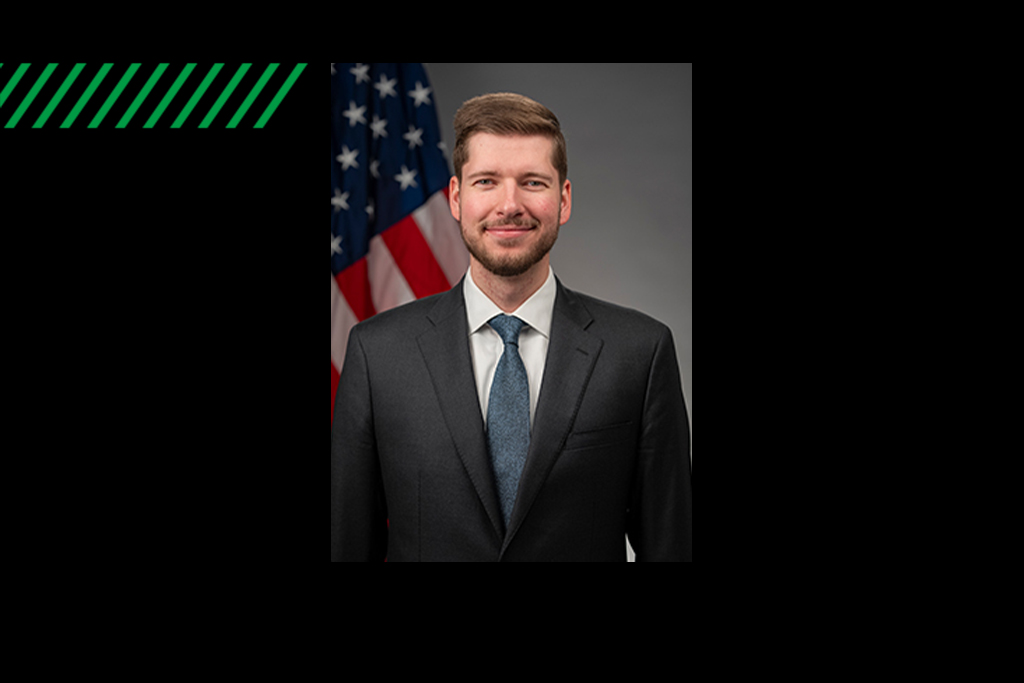
On Thursday, Nov. 12, John Reiten visited the University of North Dakota campus to deliver an address in the “Eye of the Hawk” lecture series, blogs.und.edu reported.
As special assistant to the President and deputy executive director of the National Energy Dominance Council, Reiten outlined the work of the federal body during a question-and-answer session with Ryan Adams, dean of UND’s College of Engineering & Mines.
The council was created via executive order in February 2025 to enhance national energy policy, and is chaired by Secretary of the Interior and former North Dakota Governor Doug Burgum. Reiten, a native of Minot, said his previous roles as a policy advisor to Burgum and state director for U.S. Rep. Julie Fedorchak prepared him for his federal duties.
“There was no opportunity that better prepared me to work where I do now than working in the governor’s office,” he told blogs.und.edu. “North Dakota has such a wide breadth of energy policy – coal, critical minerals, oil and natural gas, biofuels, wind and solar. We have it all.”
Energy Dominance and the Bakken Surplus
Energy dominance means providing cheap energy to domestic consumers while maintaining the capacity to export to allies abroad. Reiten contrasted this approach with past energy subtraction mindsets, noting that artificial intelligence and re-industrialization are driving a massive increase in energy demand.
North Dakota has played a central role in meeting this demand through the shale revolution, horizontal drilling, and hydraulic fracturing. Monthly oil production in the state’s Bakken Formation spiked from around 2.5 million barrels per month in 2005 to over 47 million in October 2019, according to data from the U.S. Energy Information Administration cited by blogs.und.edu.
This production surge enabled the United States to supply 60 percent of the natural gas Europe needed during the first winter of the war with Ukraine after Russia’s invasion forced European nations to diversify their energy sources.
Rare Earth Elements and International Supply Chains
Beyond oil and gas, the National Energy Dominance Council focuses on securing a reliable domestic supply chain and refining capacity for rare earth elements. China currently controls over 90 percent of the world’s supply of these materials, which are critical components for consumer electronics, automobiles, and defense systems.
Developing domestic infrastructure requires both restarting mining operations and establishing midstream refining capabilities, a challenge the administration tackles by evaluating elements on the periodic table weekly.
In the interim, the United States is pursuing international agreements to diversify global supply chains. In September 2025, the University of North Dakota signed a memorandum of understanding with Bulgarian Energy Holding, the country’s state-owned energy holding firm, to explore extracting and processing rare earths from lignite coal in Bulgaria’s Maritsa Basin, blogs.und.edu reported.
The National Energy Dominance Council was established by Executive Order 14213 on February 14, 2025, during President Trump’s second administration. It operates as an advisory body within the Executive Office of the President, chaired by the Secretary of the Interior with the Secretary of Energy as Vice Chair.
Its membership comprises the heads of major departments including State, Treasury, Defense, and Commerce, along with the Attorney General, the U.S. Trade Representative, and directors of the Office of Management and Budget and the Office of Science and Technology Policy.
The council is directed to advise the President on increasing domestic energy production across all forms, including critical minerals, and to recommend a National Energy Dominance Strategy focused on cutting red tape and enhancing private sector investment. It is also tasked with improving permitting, regulation, and export processes while facilitating cooperation between the federal government and domestic energy partners.
Reiten praised the university’s research and development efforts during his remarks. “UND is set up for so much great success,” Reiten told blogs.und.edu. “The ability to make tough international policy decisions started because of people taking risks and innovating. It’s going to take more incredibly smart and bright people working on the challenges of today and tomorrow.”
Keep reading
- Police Scotland Recovers Missing Fishing Boat Kilda Off Orkney
- NOAA Forecast Predicts Light Winter With Warmer Temperatures for Michigan
- How China Stabilizes Asia’s Energy Supply Amid Strait of Hormuz Disruptions (world-today-news.com)
- Diversified Energy Gives 350 Shoe Pairs to Oklahoma City Students (archyde.com)

Police Scotland Recovers Missing Fishing Boat Kilda Off Orkney
Police Scotland recovered the fishing boat Kilda from the North Sea and brought it to Kirkwall on Thursday....
NOAA Forecast Predicts Light Winter With Warmer Temperatures for Michigan
Michigan is bracing for a light winter marked by well-above-average warmth and significantly lower snowfall totals, according to...

Second Chances Distributes 1,000 Backpacks, Serves Meals at 7th Annual OKC Event
OKLAHOMA CITY — Second Chances, a ministry and thrift store in Oklahoma City, is preparing to serve warm...

Stetson Falls to No. 23 Louisville 83-69 After Early Lead
The Stetson men's basketball team gave No. 23 Louisville a tough early test on Thursday evening, jumping out...