
Nepal Prime Minister Balendra “Balen” Shah will visit India on November 22-23 for his first state visit since taking office in March.
When Nepal’s Prime Minister Balendra “Balen” Shah lands in New Delhi on Sunday, he brings a generation’s worth of impatience with the old diplomatic script, BBC News reported.
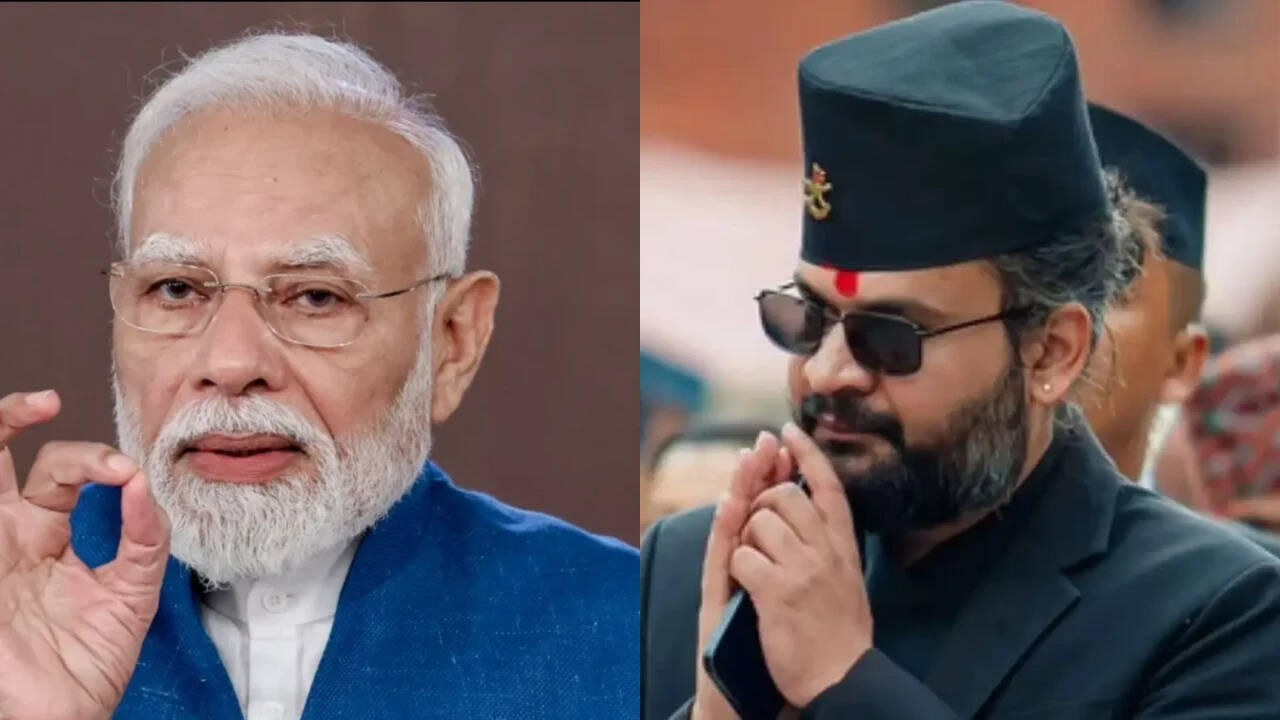
He arrives for a two-day state visit starting November 22 — his first visit to India after assuming office in March. He will meet Prime Minister Narendra Modi on Monday and call on President Droupadi Murmu, the Ministry of External Affairs confirmed Friday.
The visit reflects the importance India attaches to its “Neighbourhood First” policy, the ministry said, but the stakes are high: the visit comes on the back of the goodwill created by India’s relief and rescue assistance to Nepal after floods this year.
India has traditionally been Kathmandu's largest trade and transit partner, but China's expanding infrastructure and economic engagement in Nepal has added a strategic dimension to the relationship. Here is what is expected from #Nepal PM’s visit to India…
“The new Nepali leadership says they do not have the political baggage of the past and they want to focus on development, diplomacy and economic partnership.”
Ranjit Rae, a former Indian ambassador to Nepal, told BBC News. “They seem to be more pragmatic, less ideological. I personally feel it’s an optimistic moment.”
Kathmandu is pushing for a $2 billion economic package and a 10-point joint vision statement — branded “Samriddha Nepal, Samunnat Bharat” (Prosperous Nepal, Developed India) — that bundles energy, connectivity, digital infrastructure, health, education and sports into a single long-term framework, The Statesman reported. India has already agreed in principle to import 10,000 megawatts of Nepali electricity over ten years; the new paper tries to replicate that numbered, time-bound model across other sectors.
Ambassador of India to Nepal H. E. Mr Sudhakar Dalela paid a courtesy call on the Rt. Hon. Prime Minister Mr Balendra Shah today at the Office of the Prime Minister and Council of Ministers, Singhadurbar. On the occasion, they discussed ways to further strengthen the… pic.twitter.com/yjxRir5Cnp
Connectivity dominates the technical agenda. Nepal has long sought additional air entry routes so large aircraft can approach its new international airports at Bhairahawa, near Lumbini, and Pokhara from the west, cutting flight times and costs.
India has hesitated over the L626 corridor because of security sensitivities around air force bases near Gorakhpur, but India Narrative reported that both sides appear to have found a “smart, practical middle ground” ahead of Shah’s arrival. On rail, officials expect talks on opening the Janakpur–Ayodhya line, extending the Jayanagar–Janakpur service to Bardibas, and advancing the proposed Raxaul–Kathmandu link, The Statesman added.
Hydropower remains the relationship’s most bankable asset. India has approved projects to import up to 1,200 MW from Nepal and is looking to expand imports further, including wheeled power to Bangladesh, Rae noted. Bilateral trade exceeds $9 billion, heavily skewed in India’s favour — a longstanding irritant in Kathmandu — while India remains Nepal’s primary supplier of petroleum, food staples and its key transit route to global markets.
The border dispute that flared in 2019, when India published a map incorporating the Kalapani–Lipulekh–Limpiyadhura area claimed by Nepal, still festers. “I hope Nepal’s prime minister raises the border issue with Delhi this time,” Kanak Mani Dixit, a veteran Nepali political analyst, told BBC News. “There may not be a resolution immediately, but they should start negotiations to settle the issue.”
Dixit also warned that Shah’s youth and freshness come with a deficit of gravitas: “Prime Minister Shah and his advisors are young and fresh, but they do lack experience. Repeatedly they have exhibited a lack of gravitas in governance, which would be essential for diplomacy with an overwhelmingly powerful neighbour.”
Shah is set to visit India on November 22-23 for a two-day state visit, his first since taking office in March, which analysts say signals Kathmandu wants to keep both neighbours engaged without defaulting to the ideological camps that defined the previous three-party era.
Since the monarchy’s abolition in 2008, the Communist Party of Nepal (UML), the Nepali Congress and the Maoist Centre rotated power; the communist parties were seen as closer to China and often criticised Delhi over what they viewed as unequal agreements, BBC News noted.
Nepal PM Balen Shah will be on a state visit: MEA Spox
India’s Foreign Secretary Vikram Misri spent two days in Kathmandu on November 4 laying groundwork, and New Delhi’s new ambassador to Nepal, Sudhakar Dalela, joined Shah and Foreign Minister Shisir Khanal for final agenda talks this week, The Statesman reported. External Affairs Minister S. Jaishankar will call on Shah shortly after his arrival Sunday, The Times of India added.
Balendra Shah, born 27 April 1990 in Kathmandu, is a structural engineer and rapper who entered politics as an independent candidate for mayor of Kathmandu in 2022. He won with 61,767 votes, becoming the first independent to hold the office, and served until 2026. His campaign blended street theatre with hip-hop performances, focusing on waste management, traffic reform and heritage protection.
In January 2026 he resigned as mayor, joined the Rastriya Swatantra Party and contested the general election as its prime ministerial candidate, defeating former prime minister K. P. Sharma Oli in the Jhapa 5 constituency. At 36, he became the world’s youngest serving state leader when he assumed the premiership in 2026.
The clock starts Monday.
Nepal announces upcoming visit of Nepal PM Balen Shah to Delhi: pic.twitter.com/AO1mRoBEMf
More on New Delhi
Worth a look

Pancreatic Cancer Five-Year Survival Rate and What It Means For You
Advocacy groups note that pancreatic cancer is the only major cancer with a five-year survival rate below 20...

Indonesia Secures $15 Billion in Chinese Investment Pledges at Shenzhen Business Forum
Indonesia secured US$15 billion in new Chinese investment commitments on Friday as President Prabowo Subianto watched Indonesian and...

Three Vaccinated People Show Hepatitis B Reactivation After Injectable HIV Switch, HIV Glasgow 2026 Finds
Three vaccinated people acquired hepatitis B during a study of switching to long-acting injectable HIV treatment, a finding...

Lorne Doerkson Sworn In as B.C. Premier With 25-Member Cabinet
Lorne Doerkson was sworn in as British Columbia's 38th premier Friday with a 25-member cabinet. Lorne Doerkson was...