Nevada voters approved a constitutional amendment requiring photo identification for in-person voting, while California voters rejected a similar measure in the November election. Nevada’s Question 7 passed with 62.1% support on its second required vote, and California’s Proposition 39 failed 60.5% to 39.5%.
Nevada enshrines voter ID in constitution
Question 7 amends the Nevada Constitution to require all in-person voters to present a valid photo ID. The measure accepts eight forms of identification, including driver’s licenses, state or federal ID cards, passports, military IDs, student IDs and tribal IDs. An ID may be expired up to four years, and voters over 70 may use an ID expired for any length of time.
Mail voters must provide the last four digits of their Nevada driver’s license or Social Security number alongside their signature. Those with neither can use a number assigned by the county clerk at registration. The provisions take effect for the 2028 election.
The amendment needed to pass twice because it changes the state constitution. It first passed in 2024 with 73.2% approval. Governor Joe Lombardo made voter ID central to his 2022 campaign and introduced it in his 2023 Election Integrity Act. After legislative Democrats declined to consider the bill, Lombardo sponsored the initiative that became Question 7.
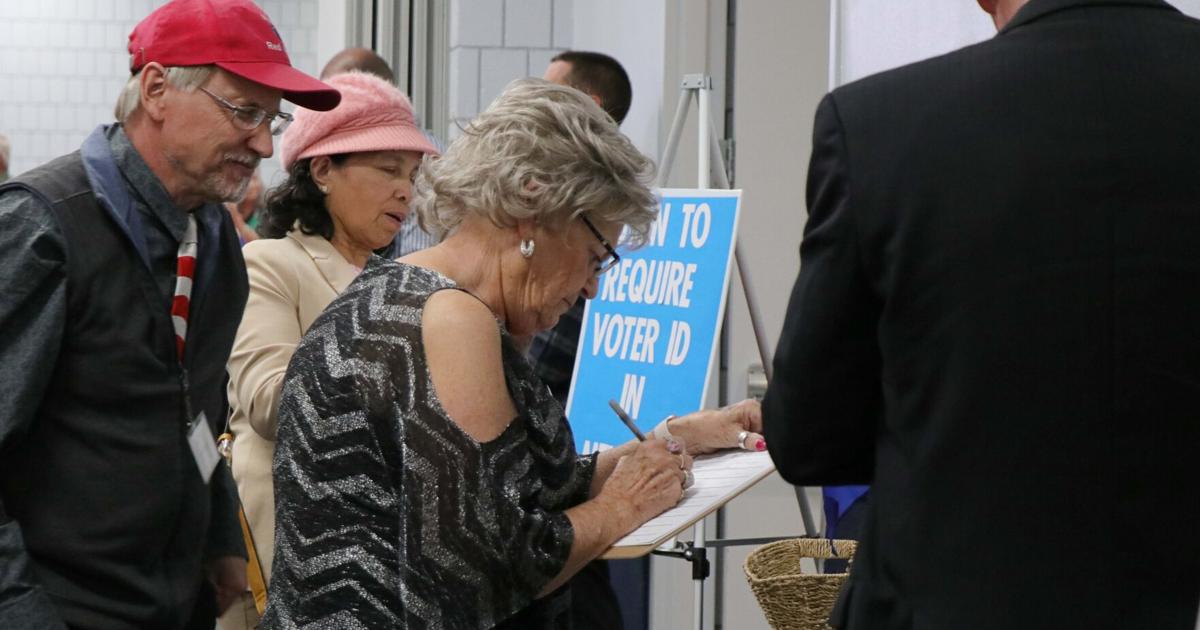
The measure survived a unanimous Nevada Supreme Court rejection of a legal challenge from the chief legal strategist for the Democratic Party. “Requiring photo ID won’t make it harder to vote. It makes it harder to cheat,” the Nevada Appeal column said.
California measure defeated after heavy spending
California Republicans qualified Proposition 39 as an initiated constitutional amendment requiring government-issued ID for in-person voting or the last four digits of a designated government ID for mail ballots. The measure also included citizen verification provisions.
An NBCUniversal poll in September showed Prop 39 leading 49% to 42%. In response, opponents spent more than $33.5 million to defeat it. The California Democratic Party argued the measure would increase election costs and delay the state’s monthlong counting process.
Attorney General Rob Bonta’s ballot summary described the measure as one that “prohibits people from voting” unless they meet its requirements, and that it “invalidates mail ballots” and “prohibits in-person voting.” Governor Gavin Newsom called it an attempt by Donald Trump to rig California elections. Senator Alex Padilla labeled it “Trump’s BS.” Governor-elect Xavier Becerra said it was “Donald Trump’s voter interference agenda.”
National context and turnout evidence
Thirty-six states have some form of voter ID law. Before Question 7, Nevada and California were among 14 states without such a requirement. Every European country mandates photo ID for in-person voting.

A Pew Research survey last year found 83% of U.S. adults and 71% of Democrats favor voter ID requirements. Proponents acknowledge there are not millions of fraudulent votes but argue the system is “needlessly vulnerable” without ID.
Critics have called voter ID laws racist voter suppression, a charge also made against Georgia’s 2021 law. Georgia’s voter turnout increased after its photo ID requirements took effect.
Different paths to the ballot
Nevada’s measure advanced through a governor-sponsored initiative after legislative inaction. California’s measure qualified as a Republican-backed initiative. The divergent outcomes reflect different political environments: Nevada’s passed twice with supermajorities, while California’s collapsed under a $33.5 million opposition campaign and unified Democratic leadership messaging linking it to Trump.

Auburn Ends 16-Year Bryant-Denny Drought, Beats No. 6 Alabama 30-23
Auburn ended a 16-year winless streak at Bryant-Denny Stadium with a 30-23 victory over No. 6 Alabama on...

Archbishop Rummel Opens Season With Win Over H.L. Bourgeois
Archbishop Rummel opened its basketball season Saturday with a 45-41 home victory over H.L. Bourgeois, but the Raiders...

Bismarck Small Business Owners Say Local Holiday Shopping Is Making a Comeback
Bismarck small business owners said Friday that local holiday shopping is making a comeback, with increased foot traffic...
New England Native Names Stonington, Connecticut, Essential Holiday Destination for Lobster-Trap Tree
In a column for Business Insider, New England native Morgan Rizzo argues that Stonington, Connecticut, is the region's...