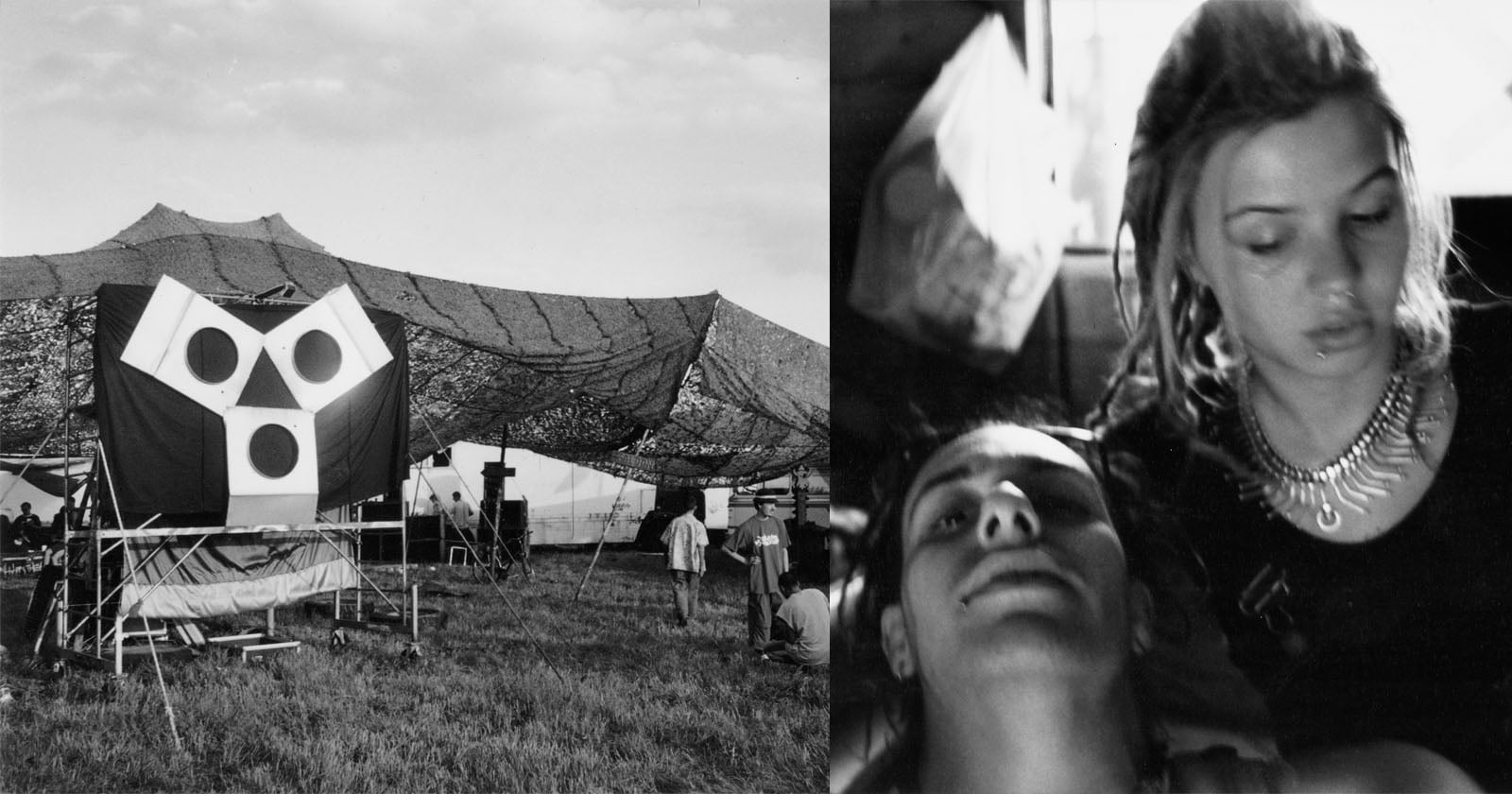
A new photography book documents Europe’s underground free-party movement at the turn of the millennium through the lenses of two participants who lived it.
Never Alone 1997–2004: Raving in Europe, published by Drago–Propaganda, collects 160 original analog photographs by Cheyenne Clementi and Valentina Morandi, PetaPixel reported.
- The book spans 196 black-and-white pages with previously unseen images from 1997 to 2004.
- Accompanying text by Tobia D’Onofrio frames 1997–2004 as the golden age of illegal free parties in Europe.
- England’s 1994 Criminal Justice Act pushed the scene toward Italy and the continent.
- Clementi and Morandi met in high school in Milan before documenting the movement separately.
Counterculture captured from inside
Clementi and Morandi were active participants, not outside observers. Their photographs show a culture built on emotion, affection, and togetherness at a time when music and personal connections — rather than social media and mass communication — brought people together, PetaPixel reported. The images document free parties spreading across Europe as an alternative to mainstream society through music, community, and a shared rejection of conventional lifestyles.
From criminalization to continental expansion
“Rave was born as a disappearing ritual in which the art of invisibility was practiced, and parties were temporarily autonomous and free zones that appeared and disappeared into thin air within a few hours,” said Tobia D’Onofrio, author of Rave New World, who wrote the book’s accompanying text. “1997–2004 can therefore be considered the golden age of the so-called illegal free parties and of rave culture. It was the moment of the phenomenon’s expansion across Europe… the rave scene had been criminalized to the point that in 1994 the Criminal Justice Act in England outlawed free parties. At that point, the energies shifted to the rest of Europe, and Italy immediately became the scene of legendary parties,” D’Onofrio told PetaPixel.
The book examines how rave culture developed into more than a musical movement, representing a rejection of conventional working and social structures in favor of communal living, constant movement, and a different relationship with time and space.
Free parties became meeting places for people united by anarchic sensibilities and a desire to escape everyday routines.
Clementi and Morandi both attended the same high school in Milan before pursuing separate photography careers, eventually bringing their shared rave-scene experiences together in Never Alone. The book is available online and through specialist bookstores.
Keep reading

Columbia Police Give Away 200 Turkeys; Supply Exhausted in First Hour
Columbia Police Department officers distributed 200 Thanksgiving turkeys and shopping bags of side dishes in front of the...
Mother-Daughter Team Rehabs 400+ Bats Yearly at Pennsylvania Center
More than 400 bats a year pass through the Pennsylvania Bat Conservation and Rehabilitation Center in Mertztown, where...

Baton Rouge Man Arrested After Fight Over TV Remote Control
An 18-year-old Baton Rouge man was arrested Monday after a fight that police say began over a television...

Texas Juvenile Justice Chief Resigns After $34K Travel Scrutiny, Including $900-a-Night Hotel Stay
Former Texas Juvenile Justice Department Executive Director Shandra Carter resigned on Oct. 23 after being asked to "resign...