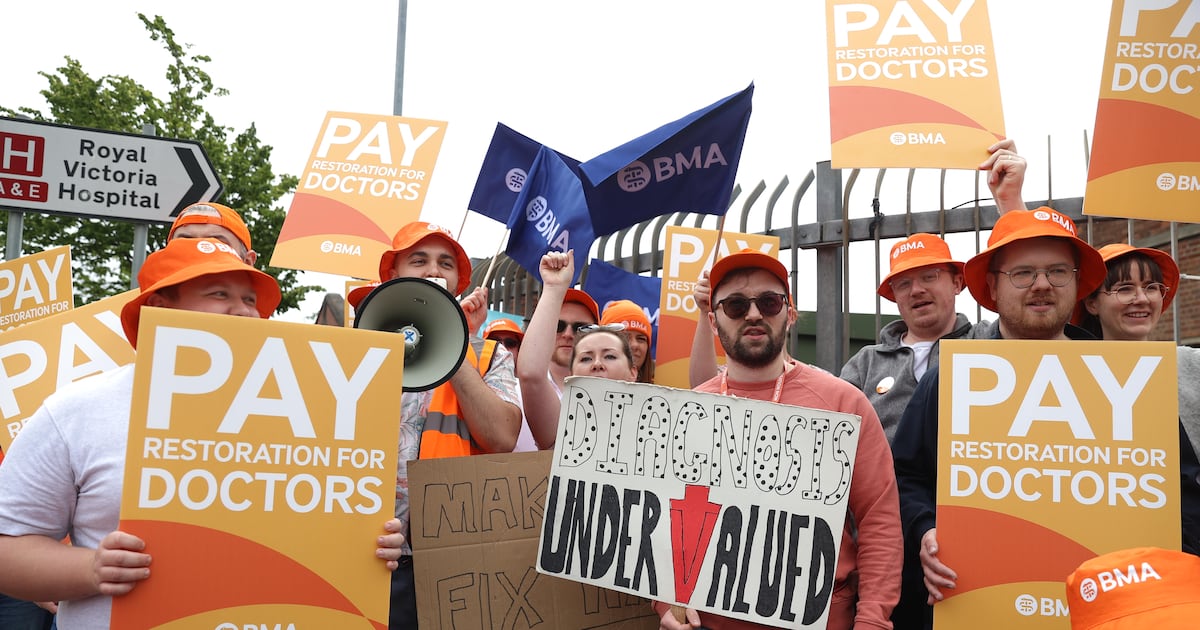
Resident doctors in Northern Ireland walked off the job at 7am for a 24-hour strike over pay erosion, halting routine services across hospitals and GP surgeries.
The dispute centers on doctors arguing that their pay is worth 20 per cent less than it was in 2008. Hospital consultants in Northern Ireland earn a starting salary of £110,681 that tops out at £145,517 based on a 40-hour working week.
In comparison, baseline pay in Ireland ranges from €233,527 to €280,513 for a 37-hour working week.
Dr Steven Montgomery, chair of the British Medical Association NI resident doctors’ committee, said members “should not have to take strike action for a second time” to address the crisis.
“It is a last resort. We don't want to be out on strike,” said Dr Steven Montgomery, chair of the British Medical Association NI resident doctors' committee.

Our pay is eroding and we need to address that in order to retain young doctors in Northern Ireland. When I talk to colleagues it’s clear they want the best for the health service in Northern Ireland and for our patients. But it is also clear that they are facing burnout and moral injury and what we are paid does not reflect that. Doctors train for many years, carry enormous responsibility and are asking for the value of their pay to be restored.
Dr Steven Montgomery, chairman of BMA NI resident doctors’ committee
Montgomery said that he regularly hears colleagues discussing moves to the Republic of Ireland, Great Britain, Canada, Australia, or New Zealand.
Dr Oisín Fearon is a resident cardiologist training at the Mater Hospital in Belfast. He said the health service is “in a slow, terminal decline unless something is done to change it”.
Northern Ireland Minister for Health Robbie Butler said that he understands the frustration expressed by healthcare trade unions. But he maintained that he cannot implement the current pay demands without an agreed departmental budget.
I have met the BMA and have outlined the financial constraints facing my department. My door remains open but, to be clear, going beyond the 3.5% as recommended by the independent pay review body would have significant repercussions for nurses, teachers, police officers and indeed the entire public sector workforce. It is my intention to progress the recommended pay award as soon as possible, however, I am currently unable to do so in the absence of a sufficient budget being agreed for my department.
Robbie Butler, Stormont Health Minister
Total pay increases over the preceding three-year period hit 30 per cent for resident doctors, 25 per cent for specialist doctors, and 24 per cent for consultants, according to Butler. Montgomery disputed how those departmental figures were calculated.

Over 2,200 appointments were canceled during the June walkouts.
The current walkout is the second resident doctor strike this year, following similar actions in June. Butler said that the industrial action will have consequences for patients, waiting lists, and service delivery during the winter period.
The British Medical Association rejected the independent pay body’s recommended 3.5% pay rise before voting in favor of the strikes reported by Ocean FM.
Dr Steven Montgomery, chair of the BMA’s Northern Ireland Resident Doctors Committee, said a recent survey of penultimate and final year medical students found over 54% did not plan to work in Northern Ireland. He warned that if the situation did not change, the NHS in Northern Ireland would cease to exist.
Specialist, associate specialist, specialty grade, and consultant doctors are scheduled to continue the industrial action with their own 24-hour walkout on Monday.
Related reading

Houthi Missile Damages PIF Tower, Saudi Authorities Say
A Houthi missile strike damaged the tallest tower in Riyadh on Thursday, shattering windows across multiple floors of...

30-Year-Old Tottenham Man Arrested in Dublin Over Thomas Oduro Murder
A 30-year-old Tottenham man was arrested in Dublin on Monday on a UK warrant for the murder of...

Putin Rules Out Limited Ceasefire After Kerch Bridge Strike
What I can tell you is that our systems have been involved for many months, if not years,...

European Leaders at Berlin Summit Ready for Talks With Russia on Ukraine War
European leaders in Berlin declared themselves ready to negotiate with Russia on ending the war in Ukraine, presenting...