
“What I can tell you is that our systems have been involved for many months, if not years, bringing drones to the shores of Crimea, and launching them at Crimea to degrade air defense systems,” said Oleg Rogynskyy, chief executive officer of UForce, a British-Ukrainian defense company.
Ukraine struck the Kerch Strait Bridge for a third time in a week, collapsing the main road arch and damaging the railway span, just as President Vladimir Putin met Donald Trump and Xi Jinping in Shenzhen.
.@SEPeaceMissions and I had a very productive meeting today with German Chancellor @_FriedrichMerz and his National Security Advisor Günter Sautter. We updated them on @realDonaldTrump discussions in China and the latest efforts to achieve a just, lasting and durable peace in… pic.twitter.com/Us4OU7fQdC
The 19-kilometer crossing, a $3.8 billion symbol of Russia’s 2014 annexation of Crimea, had already lost its road deck in strikes on Monday and Tuesday. Thursday’s attack halted rail traffic, the last functioning supply artery for Russian forces in southern Ukraine, forcing a suspension of train services.
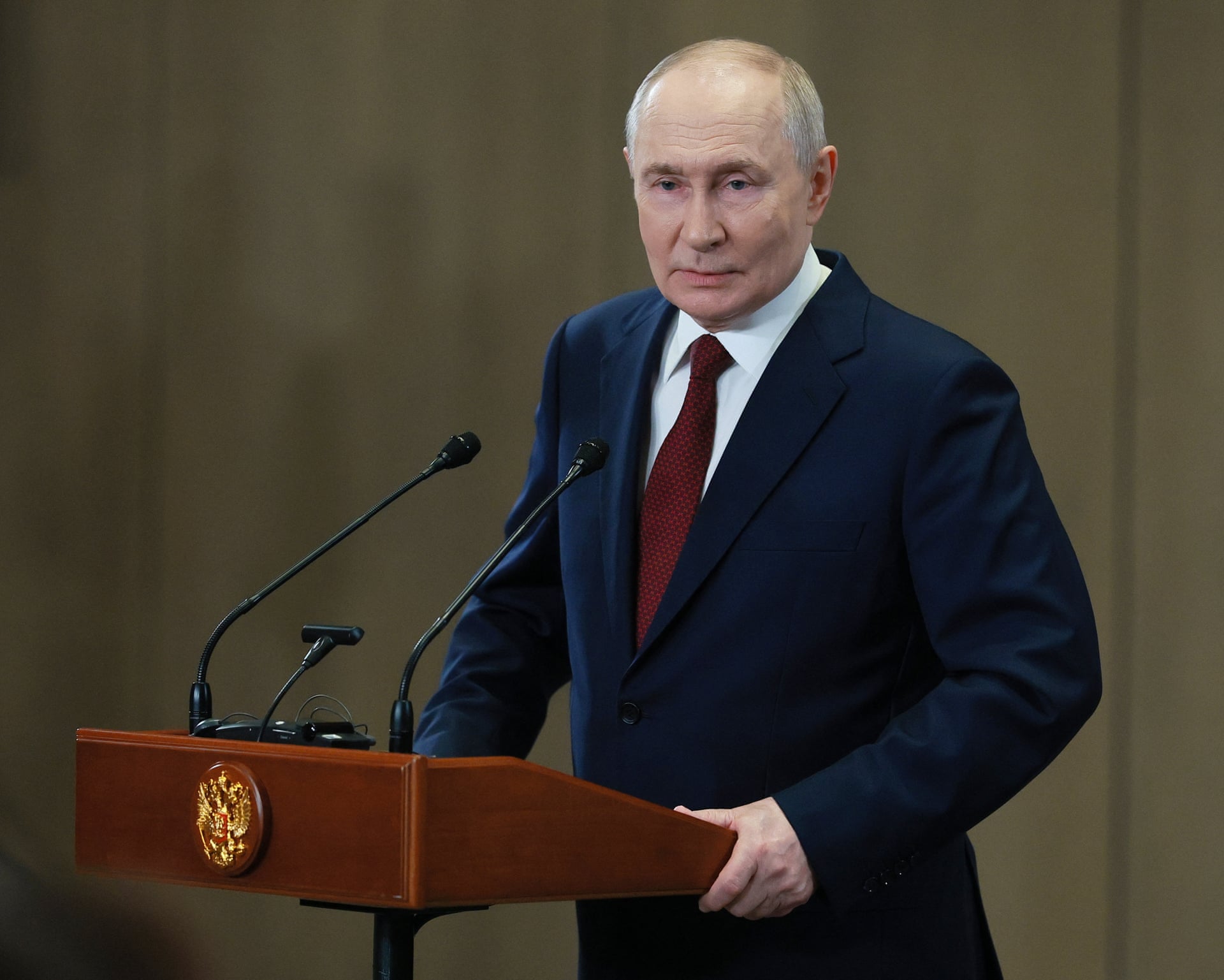
Putin responded hours later, ruling out a limited ceasefire and vowing a “painful” retaliation. “We will not make agreements after strikes on the Crimean Bridge. We will respond to these strikes,” he told reporters in Shenzhen, according to Russian state media.
Seven-Stage Campaign Dismantles Defenses
The bridge’s destruction was not a single strike but the culmination of a months-long operation. Ukrainian forces systematically dismantled Russian air defenses and electronic warfare systems across occupied Crimea and the Krasnodar region throughout the summer, clearing a corridor for the final missile and drone assault.
President Volodymyr Zelenskyy described the effort as a seven-stage campaign. It employed a mix of domestically produced systems — Neptune missiles, Palianytsia rocket-drones, and Flamingo FP-5 cruise missiles — alongside Ruta cruise missiles manufactured by the Dutch company Destinus. The Guardian reported that the Russian embassy in The Hague subsequently questioned whether the Dutch government was “openly taking part in the conflict.”
Without a doubt, Russia has lost 2026 to Ukraine on the battlefield. And without a doubt, it is hell-bent on vanquishing the civilians with ballistic missiles. And this is not a question of people's resilience. It is simply that these are unfair rules. Even in war, there are… pic.twitter.com/QTYJoGzU1c
Sea drones played a critical early role. In early August, a Magura unmanned surface vessel launched by Ukraine’s Group 13 released aerial drones that struck Russian air defense batteries on the Crimean coast, paving the way for the sustained November attacks.
Logistics Shift to Vulnerable Land Route
With the road span destroyed and the railway damaged, Russia must now rely on the M-14 coastal highway running through occupied portions of Kherson and Zaporizhzhia regions. That route lies within 300 kilometers of Ukrainian-held territory, exposing supply convoys to drone and missile strikes.
pic.twitter.com/qXEpk85mrI
“Logistically speaking, Crimea is turning into an island,” Kyiv-based analyst Igar Tyshkevych told Al Jazeera. The Institute for the Study of War assessed that Ukrainian forces have also struck the highway connecting Rostov Oblast to Crimea, further complicating Russian resupply efforts.
Repairing the bridge presents a formidable engineering challenge. The collapsed arch sits inside the railway structure, blocking the transport of replacement spans by sea. Any months-long fabrication project on site would be a stationary target for Ukrainian drones, infrastructure engineers told RFE/RL, estimating a best-case repair timeline of roughly one year.
Battlefield Economics Shift
The operation showcased a shift in battlefield economics. Ukraine used relatively cheap, mass-produced drones and missiles to degrade defenses protecting a multi-billion-dollar asset, achieving effects comparable to cruise missiles at a fraction of the cost.
“Ukraine used cheaper systems to achieve the effects of cruise missiles, to the extent they degraded Crimean air defenses to the point where they were able to get through with purely Ukrainian systems to take out the bridge,” Rogynskyy said. He said that U.S. procurement processes have already begun studying how Ukraine combined these systems.
Satellite images by @absreliable of the Crimean Bridge following an overnight Ukrainian drone attack show scorch marks and signs of damage, including on the arch of the road bridge. The extent of the damage is difficult to assess from these images alone. However, despite… pic.twitter.com/485AAc2LJn
Marc DeVore, a lecturer at the University of St. Andrews, told Newsweek that Ukraine plans to allocate 61 percent of its defense budget to drones and a further 26 percent to air defenses next year, leaving only 13 percent for conventional weaponry. UForce, which manufactured the Magura sea drone, recently raised $700 million in private equity at a $6 billion valuation, backed by investors including Valor Equity Partners and Menlo Ventures.
Escalation on Parallel Tracks
Russia struck bridges in Kyiv on the same day as the third Kerch attack, killing two people and injuring five in the capital. Projectiles also hit near the Dutch and Austrian embassies, causing minor damage to the Dutch mission.
Russia resumes alternate road traffic on the Kerch bridge, with the governor releasing footage that crops out the damaged arch and shows only the intact arch of the rail bridge. https://t.co/GwT5yhtky5 pic.twitter.com/6w8IllVS5x
The White House readout of the Trump-Xi-Putin meeting did not mention Ukraine. Trump referred to Putin as “my friend” before their Wednesday meeting on the APEC sidelines.
UForce, a British-Ukrainian defense company, manufactures the Magura unmanned surface vessel that Group 13 used in early August to launch aerial drones against Russian air defense batteries on the Crimean coast. The company earlier this month raised $700 million in private equity financing at a $6 billion valuation.
Azov, an oil depot is on fire following a Ukrainian drone attack. pic.twitter.com/w8PTV0zQ22
Its investors include Valor Equity Partners and Menlo Ventures, early backers of SpaceX, Tesla, and Anthropic. Former NATO Supreme Allied Commander Europe General Christopher G. Cavoli and former UK defense minister Sir Ben Wallace sit on its board.
“UForce was born out of necessity, and the war in Ukraine…sets the pace nobody would choose, but everybody is realizing we have no right to fall behind,” Rogynskyy said.
Neptune strikes a symbol: Kerch Bridge railway track damaged During the night of 19 November, explosions rang out over the Kerch Strait once again. Missile troops – specifically, Neptune coastal missile systems of the Ukrainian Navy – carried out a missile strike on the… pic.twitter.com/H83pJbd1OD
More on Donald Trump
🔥 An oil depot is ablaze in Azov, Russia’s Rostov region, following drone strikes. Translation of audio: “Holy shit. No fucking way. Something blew up big time. Fucking hell. Fucking shit.” pic.twitter.com/g5va2MTlSK
Trump on Putin's war on Ukraine: "I think he could be tougher. I think he could be a lot tougher, frankly." pic.twitter.com/o8OwSrHiUg
Присвячуємо це памʼяті наших друзів і колег Андрія і Юрія без яких це було б неможливо. R. I. P. https://t.co/qYH3HBRvNU
The Crimean Bridge has been partially destroyed. Road traffic between temporarily occupied Crimea and Russia is cut off, and bridge debris has blocked the shipping channel. With fewer routes, Russia’s logistics will be under much more strain, especially in the Zaporizhzhia and… pic.twitter.com/9M2VfUdcXZ
"This train terminates here." On the night of November 19, Ukrainian Neptune missiles struck the railway section of the Crimean Bridge, with hits recorded near the arch and on the tracks. The extent of the damage is still being assessed, but train traffic has stopped. Now a… pic.twitter.com/ytZOeQCzvG
🇷🇺 The Kerch Bridge arch is in the sea. Putin's bridge to Crimea has lost its main road arch. After a second Ukrainian strike in two nights, photos and video published Tuesday appear to show the steel arch over the road bridge's navigation span, roughly 745 feet long, lying in…
Ukraine’s strike on the Kerch bridge was especially designed to humiliate Putin before his meeting with Trump and Xi on Thursday, an officer involved in the operation told me for @thetimes. “We planned this as symbolic gesture before the meeting of Trump, Putin and Xi, to show… pic.twitter.com/BqxfcsFlXU
🚨🇺🇦 CAUGHT ON CAMERA: UKRAINIAN STRIKE HITS PUTIN’S CRIMEAN BRIDGE — MAJOR DAMAGE REPORTED Dramatic footage appears to capture the moment the Crimean Bridge (Kerch Bridge) was struck during a Ukrainian attack, sending a massive explosion into the night sky. The 19-kilometre…
- European Leaders at Berlin Summit Ready for Talks With Russia on Ukraine War
- Japan PM Takaichi Gets No Formal Bilateral With Xi at APEC, Only Handshake
- Trump meets Xi and Putin in China for nuclear arms and Ukraine talks (newsarchyuk.com)
- Trump, Xi, Putin Hold First Trilateral Talks at APEC Summit (world-today-news.com)

European Leaders at Berlin Summit Ready for Talks With Russia on Ukraine War
European leaders in Berlin declared themselves ready to negotiate with Russia on ending the war in Ukraine, presenting...

Japan PM Takaichi Gets No Formal Bilateral With Xi at APEC, Only Handshake
The Japanese prime minister arrived in Shenzhen on November 18 for the APEC summit and left without a...

European Leaders Ready to Negotiate With Russia on Ukraine War, Berlin Summit Says
European leaders declared themselves ready to negotiate with Russia on ending the war in Ukraine at a Berlin...

ICJ Finds Myanmar Had Genocidal Intent Against Rohingya
The International Court of Justice ruled Thursday that Myanmar committed genocide against the Rohingya, the first time in...