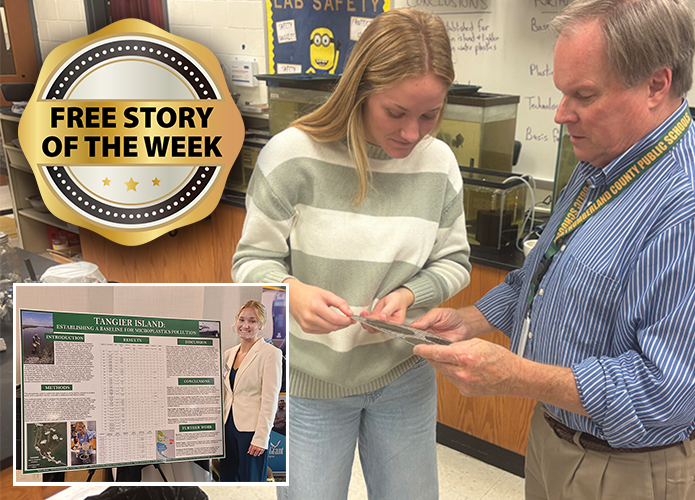
Northumberland High School senior Tawny Bowis presented the first baseline study of microplastic pollution on Tangier Island to the Virginia Sea Grant Leadership Conference in October, the only high school student among 30 poster presenters.
Bowis, who crews the family ferry Chesapeake Breeze during the summer, collected 26 samples from the island’s beaches, marshes and creeks in July. Working with her aquaculture class and teacher Gary Dickens, she found surface sand carried an average 11.5 basic particle count (BPC) compared with 9.5 BPC in core samples. High-traffic zones averaged 14.1 BPC; remote areas averaged 7.6 BPC.
“I’m very connected with Tangier,” Bowis said. “With a number of cousins and her grandmother hailing from Tangier and calling the Island ‘home,’ Bowis’s connection helped drive her work.”
The research began as an independent study advised by the Virginia Institute of Marine Science (VIMS). After Bowis reached out for guidance, VIMS offered several topics; she chose to establish a microplastic baseline for Tangier. Dickens joined her on the first collection day to demonstrate proper technique.
Once the ferry docked and visitors dispersed, Bowis and crewmates sampled roughly five sites a day, storing samples in a high-school refrigerator until the fall semester, when the aquaculture class filtered each sample under vacuum pressure and counted UV fluorescence on filter paper.
Northumberland High is the only public high school in Virginia offering Aquaculture I and II, Dickens said. The curriculum, derived from Virginia Tech, meets twice a week and revolves around hands-on chores: feeding oysters, monitoring ammonia levels, tending eelgrass tanks and testing guppy populations. “Eel grass is a foundation species in the bay. It’s not easy to raise,” Dickens said.
The class received its eelgrass from VIMS and must maintain a cool germination period. In December the eight-student class plans its first overnight trip to the Eastern Shore to study bay scallop restoration, a species nearly lost to the Chesapeake but surviving in North Carolina.
Bowis’s findings upended her initial hypothesis. She expected deeper sediments to hold the most plastic, but strong currents around Tangier appear to deposit pollution from elsewhere on the surface. The baseline she established gives researchers a reference point for future monitoring of an island already threatened by rising seas and erosion.
Beyond the lab, Bowis captains the volleyball team, serves as student council president, holds vice-presidencies in BETA Club and Fellowship of Christian Athletes, captains the Indian Spirit Dance Team, competes in swimming and softball, belongs to Mu Alpha Theta Math Honor Society and emcees school pep rallies.
She plans to study marine science at William & Mary after graduating in the spring. “I want to come back to my community and help improve it somehow,” she said.

5 Purdue Players to Test Wisconsin’s Road Rebound
Wisconsin's bowl hopes took a hit with a 24-21 loss at Maryland last Saturday, and the Badgers (6-4,...
Cheyenne Grenaway Argues She Has Never Found an Antidote to Worry
In a personal essay for her Substack newsletter, Cheyenne Grenaway writes that she has not found an antidote...

Charleston Southern Names La Gamba Women’s Soccer Coach
Charleston Southern University announced Antonio La Gamba as its new head women’s soccer coach Tuesday, handing the program...
Stanford WBB Opens Historic 7-Game Road Swing at No. 16 Washington as Hailee Swain Leads Youth Movement
Stanford women's basketball opens a historic seven-game road swing Friday night at No. 16 Washington, the program's longest...