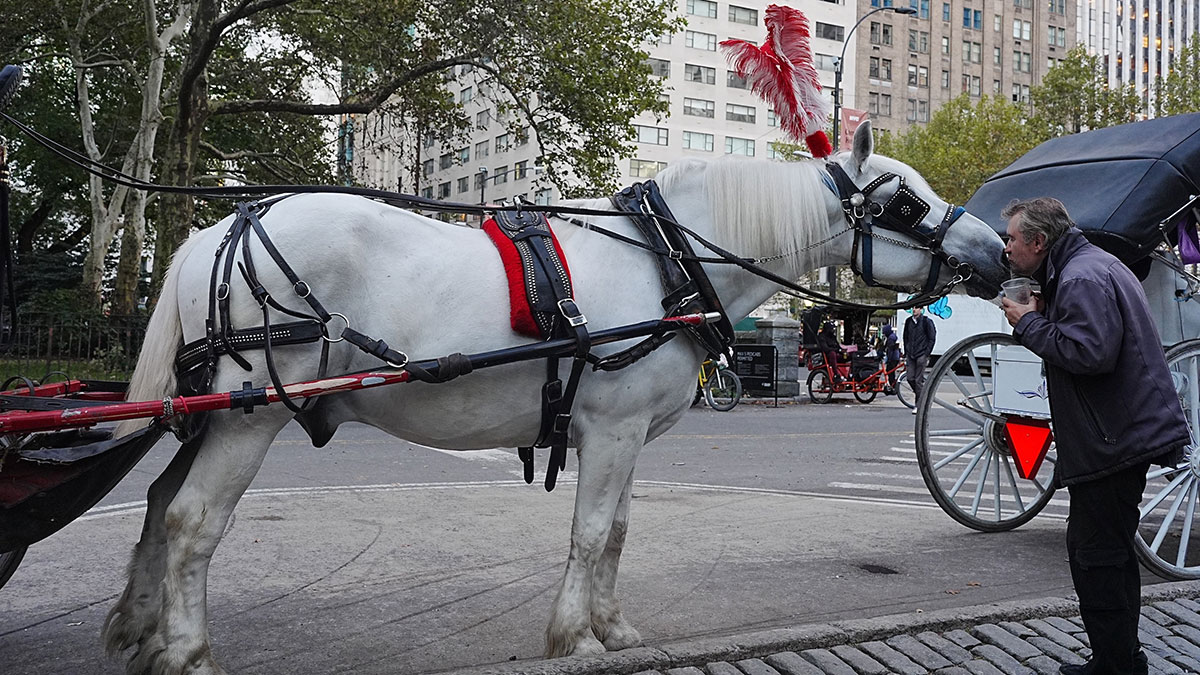
“You just trust me implicitly? You do realize I have a top hat and a whip, right?”
Saturday Night Live’s fake carriage driver asked his fake customers last weekend, mocking the 200 middle-class workers the City Council just voted to put out of business.
The skit aired days after the council passed Intro 573-A—dubbed “Romanch’s Law”—which phases out horse-drawn carriages in Central Park by June 2028, City Journal reported. Speaker Julie Menin championed the ban after 19 years of lobbying by NYCLASS, a group financed largely by a single real-estate magnate and once fined by the Campaign Finance Board for egregious violations tied to this same issue.
The legislation is named for Romanch Mahajan, the 18-year-old tourist killed in June when his carriage overturned after the horse bolted. Investigators believe stray underground voltage in Central Park shocked the animal—a maintenance failure that falls on the city and the Central Park Conservancy, not the driver.
A Manhattan jury reached a similar conclusion last year when it acquitted a driver prosecuted by District Attorney Alvin Bragg after his horse, stricken with an undetectable cancer, collapsed and died.

“I invested my life savings and dedicated years of hard work to building a business legally,” medallion owner Atakan Aktay told NY1 at a rally before the vote. “So we are not against change. We are against being left behind.”
Each medallion cost owners more than six figures. The bill offers no compensation for those assets, no funded retraining mandate, and no guarantee the horses—rendered valueless overnight—avoid the slaughter pipeline. Drivers say they cannot afford to keep animals they love once the income stops.
“This is not a plan. It’s a concept of a plan, that sometime in the spring, the mayor will assign some agency to look at some consideration to publish on a city website, of what he’s going to do with absolutely no funding, no legislative mandate or anything.”
Christina Hansen, driver, speaking to NY1
The Transport Workers Union says it submitted three detailed proposals—including a shift to electric carriages and a fair buyout—and never heard back from the speaker’s office. Menin’s staff counters that a new joint working group with the TWU and the administration will oversee the transition, but drivers call that engagement performative.
Leisure and hospitality employment in the city has shed 15,400 jobs since September 2025 and remains 6 percent below pre-pandemic levels, state labor data show. Council Member Gale Brewer celebrated her “yea” vote with a exaggerated neigh on the chamber floor. Manhattan Borough President Brad Hoylman-Sigal and Council Member Harvey Epstein amplified the SNL “human murders” line on social media afterward.
Mayor Zohran Mamdani, who once hunger-struck for taxi medallion owners crushed by debt, has signaled he will sign the bill but has delayed for weeks. “How can you fight for one group of medallion owners while allowing another group to face financial devastation?” Aktay asked NY1.
The ban does not take effect for nearly two years. In the interim, drivers work in the park under a bullseye: last week an out-of-state woman allegedly struck a driver in the face with a skateboard while screaming abuse accusations. The SNL skit, echoed by elected officials, has now branded the entire workforce as cruel and murderous on national streaming television.
Before joining the Council, she served as Commissioner of the Mayor’s Office of Media and Entertainment and Commissioner of the Department of Consumer Affairs. She founded the nonprofit Wall Street Rising after the September 11 attacks, growing it to 30,000 members and helping more than 600 small businesses remain in Lower Manhattan. Menin also served as chairperson of Manhattan Community Board 1 for seven years, where she was unanimously elected to three consecutive terms.
Stables are regulated by the Health Department and horses receive mandated vacation and extreme-weather breaks. No credible evidence of systemic cruelty exists. What exists is a small, independent workforce—no subsidies, no algorithms, no gig platforms—made convenient scapegoats for a political class that finds their difference easy to ridicule.
Related reading
Hartford Policy Reinstatement Rules: Coverage Gap Not Retroactive
A lapsed Hartford policy can be reinstated by paying the past-due premium within the carrier's stated reinstatement window,...
Mississippi Democrats Demand Probe After Inactive Voter Rolls Reach 230,000
Mississippi Democrats are demanding an investigation after the state's inactive voter rolls reached 230,000 this year, a surge...

ESPN FPI Favors Ohio State 71.3%, SP+ Projects Tight 26-21 Win
ESPN analytics give Ohio State a 71.3 percent chance to beat Nebraska in Lincoln on Saturday, but the...

Pamela Loxley Drake Argues Parade Anchors Holiday Presence
In a column for Columbia County Spotlight, Beaverton resident Pamela Loxley Drake argues that the Macy’s Thanksgiving Day...