Ohio’s “Changing Campus Culture” initiative is surveying students again this school year after a pause, but with a new methodology that breaks comparisons to past data and a 71% budget cut from the level two years before the 2026-27 budget.
Ohio resumed its campus climate survey with $400,000 in the 2026‑27 budget, a 71% cut from the prior $1.4 million allocation.
Ohio resumed its campus climate survey in the 2024‑25 academic year after a multi‑year gap, the Ohio Department of Higher Education (ODHE) told Signal Statewide.
The department also shifted to a biennial schedule, aligning with states such as New Hampshire and Maryland, and said responses collected this year will then be able to be compared to those collected two years ago. That data “potentially” will be shared online, ODHE officials added.
How the survey works
ODHE develops the questionnaire and gives each campus a state‑hosted link or lets schools distribute the same questions on their own platform. Questions cover intimate partner violence, sexual harassment, stalking, non‑consensual contact or intercourse, and how responsive students believe officials would be to a hypothetical incident. Responses are anonymous. Using identical questions across campuses creates “a common set of data across all participating Ohio campuses,” ODHE writes online.
Why the survey stopped and started
Since the first administration in 2016, the survey has been paused three times. Two pauses stemmed from challenges during the COVID‑19 pandemic, ODHE officials said.
A third pause came after federal lawmakers passed a law requiring higher education institutions across the country to administer a climate survey; Ohio did not want colleges reporting similar data twice. Years later, the federal government’s own survey still hasn’t materialized, making the pause preemptive.
Funding dropped sharply
In the 2026-27 budget, state legislators set aside $400,000 total for the effort, roughly a 71% decline from the close to $1.4 million allocated two years earlier.
Joseph Storch, general counsel at New York’s Excelsior University and an expert on these surveys, told Signal Statewide that dedicated, consistent money is critical because it allows surveys to be repeated over time. He called the work “fragile” and more vulnerable to budget cuts than other priorities.
Participation remains voluntary
Ohio encourages but does not mandate the survey at public and private campuses. An advocacy group cited by Signal Statewide says 10 states and Washington, D.C., require colleges to offer some type of campus climate survey under state law. Storch said Ohio’s uniform questions still give leaders “a fighting chance of understanding the experience of folks [when] we would not know their experience otherwise.”
What the data show so far
More than 31,000 students responded in 2021‑22, the latest year represented on a public dashboard. The department’s website hosts an archive of 50 recorded webinars, tips for boosting response rates, and a 156‑page toolkit released earlier this year. ODHE officials said the initiative has had an “overwhelmingly positive impact on how campuses respond to and prevent sexual violence,” noting more institutions now collect assault‑related data and participation in training has risen.
“Our campuses continue to strive to create safer campus environments, and those very efforts can lead to increases in reporting as institutions build trust in their processes and students are made more aware of how and where to report,” officials wrote via email to Signal Statewide.
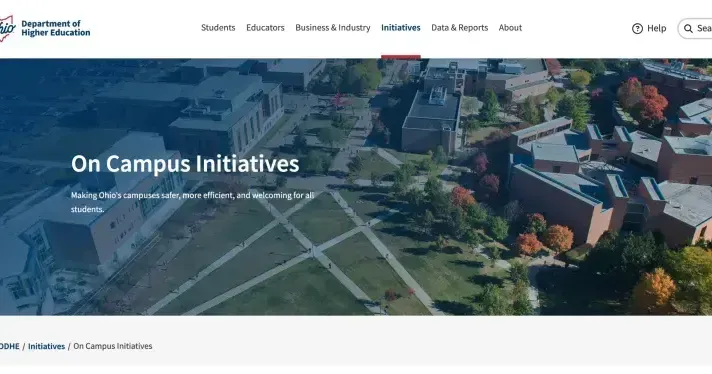
The Ohio Department of Higher Education (ODHE) serves as the administrative department of the Ohio state government responsible for overseeing higher education, a role established when the Ohio General Assembly created it as the Ohio Board of Regents in 1963 and later renamed it in 2015.
Its principal responsibilities include providing higher education policy advice to the governor and the Ohio General Assembly, developing strategy for the University System of Ohio, advocating for and managing state funds for public colleges, and coordinating and implementing state higher education policies. The chancellor, a cabinet-level position appointed by the governor, leads a professional staff in carrying out these duties.
Free resources for sexual assault victims are available at RAINN.org.
Worth a look

Trump Administration Proposes Rescinding Roadless Rule in Blue Mountains
In northeastern Blue Mountains, the Trump administration is pursuing policy changes that would expand roadbuilding and motorized access...

Kings Hosts Debate Keeping Sabonis, LaVine, Hunter Amid Murray’s Growth
Sacramento Kings radio hosts Allen Stiles and Kevin Gleason debated how the franchise should weigh rookie point guard...

Springfield Vintage to Close Storefront After Nov. 27, Shift to Pop-Up Model in 2027
"I've already bought my vintage camper so when I go to my Rock-A-Billy events where people wear their...

Fountain Hills Becomes Second Arizona City to Ban Automated License Plate Readers
Fountain Hills banned automated license plate readers on Nov. 17 in a 5-2 Town Council vote, becoming the...