OpenAI Group PBC announced Tuesday that it plans to acquire Pierre Computer Company Inc., a low-profile developer tooling startup whose technology already underpins the Codex programming assistant, SiliconANGLE reported. The terms of the deal were not disclosed, but the move makes clear that OpenAI intends to control not just the AI models writing code, but the infrastructure where that code is stored, organized, and reviewed as autonomous agents generate it at unprecedented scale.
Observers pegged the Pierre deal as a direct shot at that dominance, positioning OpenAI to offer developers an alternative built specifically for the age of agentic coding.
The Libraries Already Inside Codex
Pierre operates a cloud service where AI agents store the code they generate, along with related files such as software licenses and interface design elements. The company claims its service delivers significantly better performance than competing technologies. One customer, AI startup Lovable Inc., used it to cut code retrieval latency by about 70%, a margin that compounds when agents are working across massive codebases.
Deal news this AM from OAI: Exclusive: OpenAI targets Microsoft's GitHub with deal for startup https://t.co/xAlbThFd0e
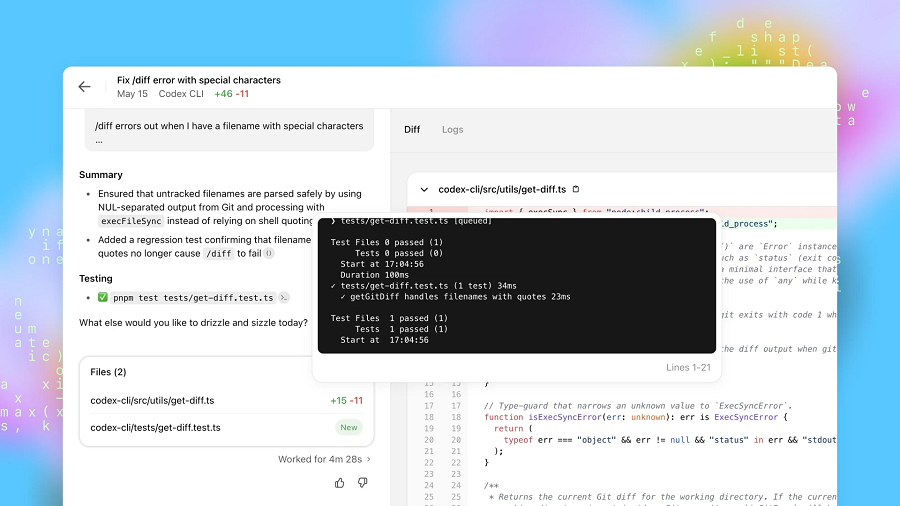
Pierre also develops two open-source libraries that OpenAI has already integrated into Codex. Trees powers the folder navigation sidebar, equipping it with search features and drag-and-drop controls for moving subfolders. It also flags code files that have been recently added or updated, helping developers review those files first when performing tasks such as troubleshooting an outage. Diffs, the other library, drives the main interface showing the code a user is currently editing. When a file updates, Diffs points out the specific lines of code that changed, either in a separate interface section or inline, sparing developers the hassle of manually finding them among hundreds of files.
From Supplier to Core Infrastructure
OpenAI plans to continue offering Trees and Diffs under an open-source license after the acquisition closes. At the same time, the company intends to integrate the features of Pierre’s paid code hosting service directly into Codex. Investing.com reported that this integration aims to transform Codex from an automated completion utility into an end-to-end repository and review environment, absorbing Pierre’s technical team alongside its developer tooling suite.
The longer-term plan extends beyond Codex. OpenAI said the Pierre team will help “ship new products and platforms,” with an emphasis on building software that optimizes coding agents. A key focus is streamlining agent workflows involving Git, the open-source tool developers use to manage code files. Trees, Diffs, and Pierre’s paid storage service all provide built-in support for Git, which OpenAI makes extensive use of internally.
OpenAI’s Pando Speeds Internal Coding
The Pierre acquisition follows OpenAI’s Monday revelation that it built a software engine called Pando to boost the performance of its internal Git environment. Pando reduces the amount of time it takes OpenAI engineers’ coding agents to create and read code files. According to Investing.com, that architecture cut code deployment latencies by roughly 80%, and OpenAI is currently exploring avenues to commercialize the underlying infrastructure for enterprise clients.
OpenAI will acquire developer tools startup Pierre Computer as it moves into territory long dominated by Microsoft’s GitHub, Axios reports. OpenAI plans to integrate Pierre's code storage technology into Codex, expanding the AI coding tool into the infrastructure where… pic.twitter.com/KlPGNc3dEv
Bringing Pierre in-house lets OpenAI control the full loop: the agent generating code, the Trees and Diffs interfaces displaying it, and the storage system preserving it. That vertical integration becomes critical as rapid enterprise adoption of AI-generated code increasingly strains conventional version control workflows, which have experienced reliability hurdles under the surge of agentic AI coding.
Who Bears the Weight of This Shift
Developers who have relied on GitHub for version control may soon have Codex as an option offering integrated code storage and review capabilities for AI-generated output. The 70% latency improvement Pierre delivered for Lovable suggests the performance gains could be substantial for teams managing hundreds of parallel code files.
Pierre’s libraries will remain freely available, preserving the tools individual developers use today.
What remains unclear is how OpenAI will commercialize the Pando infrastructure built to manage parallel agent workflows for enterprise clients. Until the transaction concludes—subject to customary regulatory approvals and standard completion conditions—both entities will operate independently, leaving developers to watch whether OpenAI’s bet on agent-native infrastructure reshapes how software gets built.
OPENAI TO ACQUIRE PIERRE COMPUTER OpenAI is acquiring developer tools startup Pierre Computer, whose technology is already used in Codex,. OpenAI plans to integrate Pierre's Code Storage into Codex, putting it in more direct competition with Microsoft's GitHub as AI agents take… pic.twitter.com/r6vu0dba5L
More on Codex
HOLY MOLY. OpenAI has told Axios exclusively that it will acquire Pierre Computer, setting up a direct challenge to Microsoft's GitHub. The developer-tools startup's technology is ALREADY embedded into Codex. The deal would expand Codex beyond writing code into storing,… pic.twitter.com/PTjuSmtbjK
OPENAIが開発者ツールスタートアップのPierre Computerを買収し、Codexにコードストレージを統合、MicrosoftのGitHubに挑戦:AXIOS
Related reading

Pinion Acquires A1 Development Solutions to Expand Land Advisory Services
Established in 2017 to manage the intricate permitting, utility coordination and government relations required for livestock and grain...

School of Medicine Greenville Registrar Manages Academic Records
The Registrar's Office at the University of South Carolina School of Medicine Greenville adheres to the University of...

Transportation Planner Hayden Clarkin: RIPTA Hub Relocation Plan Ignores Bus Riders’ Needs
Providence Transit Planner Argues $77 Million Hub Move Would Harm Bus Riders In a column for pvdeye.org, transportation...

Mt. Lebanon community and schools react to tragic murder-suicide
Patrick Lynch and His Two Children Die in Apparent Murder-Suicide at Mt. Lebanon Parking Garage on Election Day...