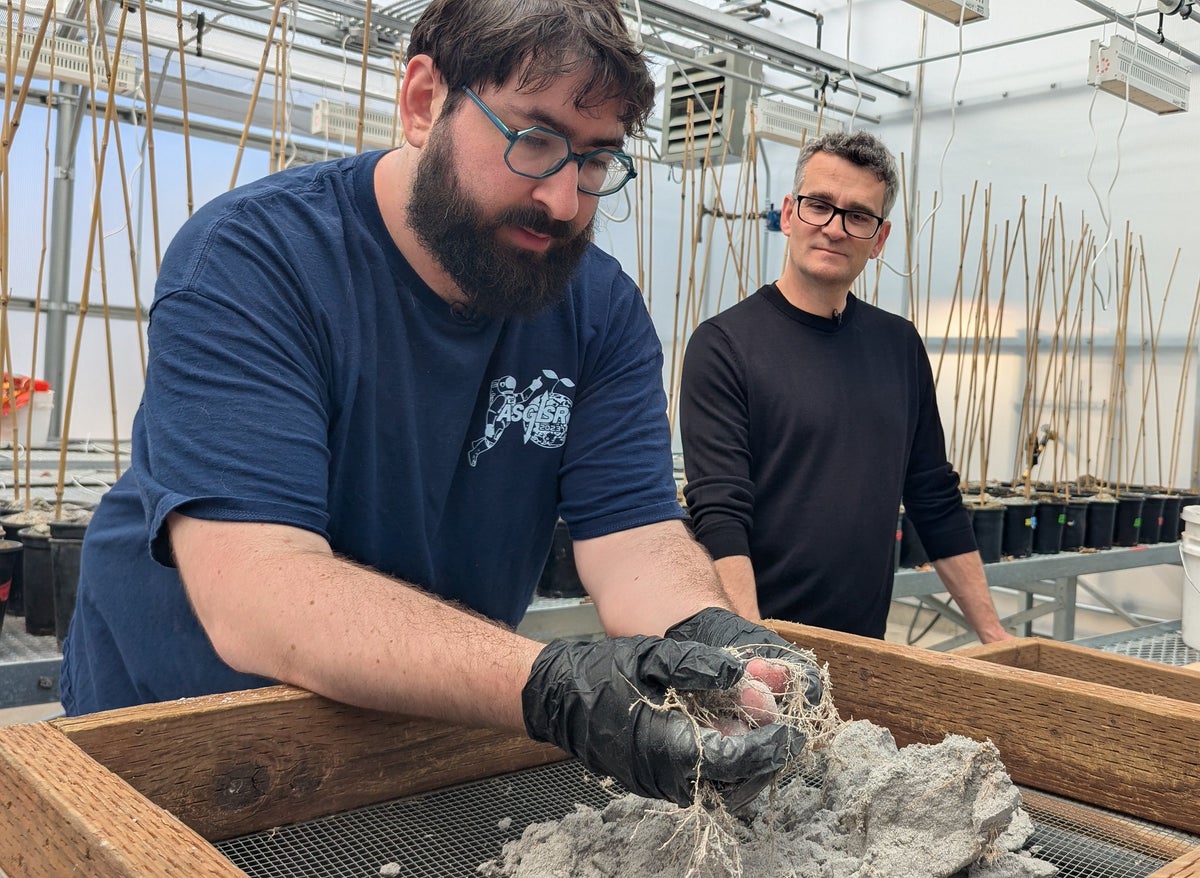
“Lunar soil, made up of dust and rock, contains no nitrogen at all, so no crop can grow without supplementation,” said Aymeric Goyer, a plant biologist at Oregon State University who led the research.
A NASA-funded study published November 19 in npj Microgravity confirms potatoes can complete their life cycle in simulated lunar regolith when amended with worm compost.
Researchers grew the Modoc potato variety in five different lunar regolith simulants representing both mare and highland regions, using vermicompost at volumes of 0, 5, 15 and 30 percent. Without organic matter, plants were severely stunted — three of four barely produced roots. At 30 percent vermicompost, tuber yields matched those in sandy soil from Hermiston, Oregon, a region known for high potato productivity.
Gene Stress Varies by Simulant Type
Whole-transcriptome profiling revealed each simulant triggered a distinct gene-expression signature. One mare simulant elicited nearly 1,400 differentially expressed genes compared with the Earth-soil control, while a highland simulant produced only about 124, indicating substrate-dependent phytotoxicity rather than a uniform stress response.
Tuber Chemistry Stays Close to Earth Norms
Despite leaf-level stress signals, harvested tubers showed minimal metabolic deviation. Glycoalkaloids — natural potato toxins that rise under stress — did not increase significantly. Copper, zinc and aluminum were modestly elevated in tubers from certain simulants, a finding the authors flag for continued monitoring.
Why Potatoes, Why Now
“Potatoes provide more calories per unit area than many other crops,” Goyer said. “They have more potassium than bananas, are rich in vitamin C, contain high-quality protein and have a high satiety index.” NASA’s Artemis programme targets a crewed return in 2028; China aims for the same before 2030. Both plan long-term bases near the lunar south pole where in-situ food production becomes essential.

“They are nutritious – they provide more potassium than a banana, are rich in vitamin C, have good proteins – and they have a high satiety index,” Aymeric Goyer, a plant biologist at Oregon State University who led the research, said.
Compost as a Lunar Waste Loop
Vermicompost — organic matter processed by earthworms — can be produced on-site from food scraps and crew waste, closing a nutrient loop that pure mineral fertilizer cannot. All experimental treatments received Osmocote Plus 15-9-12 slow-release fertilizer to isolate the compost effect.
David Handy, the study’s first author and a postdoctoral researcher at OSU, told Universe Space Tech that the compost helps balance out some of the toxicity seen in lunar regolith, reducing the effects of harmful compounds on plants. Handy added in Popular Science that the team believes the compost helps balance some of the toxicity observed in the regolith.
The researchers envision a closed-loop system in which astronauts’ waste and exhaled carbon dioxide help sustain their crops, Goyer explained to The Washington Post, as reported by ZME Science. Vermicompost can be produced at a lunar base using food scraps and organic waste, turning crew waste into a resource that pure mineral fertilizer cannot provide, the OSU team said.

In the future, astronauts could take a small amount of organic matter such as vermicompost to the moon, the research team said, according to The Mirror. The approach mirrors earlier work in Peru where researchers grew potatoes in Mars-like soil, and a 2023 Chinese study showed three types of bacteria can convert calcium phosphate into plant-available phosphorus, Finance. Biggo.com reported.
Potato Advantages for Space Diets
Potatoes provide more calories per land area than many other crops, Goyer said, as reported by Deccan Chronicle, making them a practical staple where growing space is limited. People are also working with tomatoes, lettuce and legumes like alfalfa, Goyer added, according to Deccan Chronicle.
NASA previously tested 1,000 potato varieties with the International Potato Center in Lima starting in 2016, Finance. Biggo.com reported. In 2017, researchers in Peru all but proved the theory from the 2015 film The Martian, saying potatoes could be grown on the red planet, the Indian Express and The Brighter Side noted. NASA astronaut Don Pettit later grew a potato on the International Space Station, calling it Spudnik, The Brighter Side added.
Follow-Up Study Tests Larger Pots and Ten Potato Varieties
“We are working on a second study where we report on the growth of potatoes grown in larger pots. In this case, we obtained potatoes of size you typically see at the store,” Goyer said. A follow-up paper will compare ten potato varieties in simulated regolith to identify the most resilient candidates for lunar agriculture.
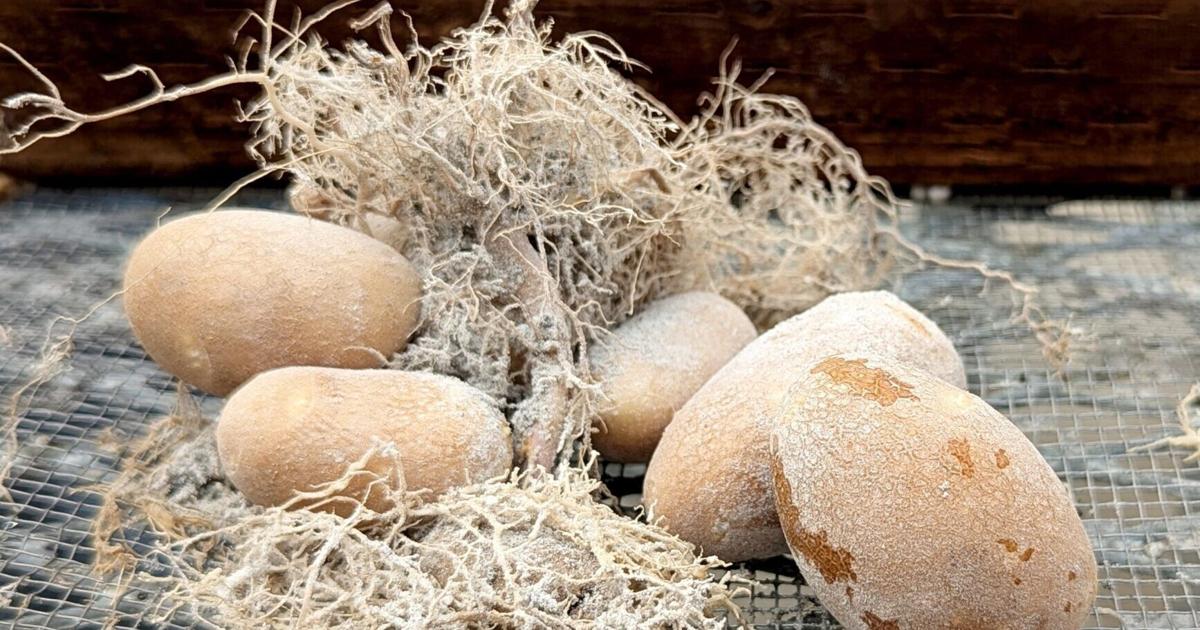
NASA turned to Aymeric Goyer, a plant biologist who has led research at Oregon State University since 2008, first as faculty at the Hermiston Agricultural Research and Extension Center and, since 2022, as associate professor in the Department of Botany and Plant Pathology on the Corvallis campus.
His doctorate in Molecular and Cellular Plant Biology from the University of Paris XI, followed by postdoctoral work on plant metabolism at the University of Florida and Washington State University, equipped him to tackle the metabolic and gene-expression challenges of growing food in extraterrestrial substrates.
“Unfortunately, we have not tasted them yet. We used what we harvested for lab analyses,” Goyer added.

Persimmons: Nutritional Benefits and Rare Bezoar Risks for Vulnerable Groups
Ynetnews reported that Israeli doctors are warning that persimmons can form hard, obstructive masses in the stomachs of...

Singapore Announces 2027 Property Tax Rebate, Raises AV Thresholds for Social Support
Singapore will give owner-occupiers a one-off property tax rebate in 2027 and raise the annual-value thresholds that gate...

The Galaxy Z Fold8 Is Basically the iPhone Duo for Android Fans, Only Lighter and Now Cheaper Than Ever
The discount brings the 256 GB model down from its $1,899 launch price, arriving the same week the...

Pakistan’s FDI Falls 34% Despite Stability as Investors Cite Policy Unpredictability, High Costs
Pakistan secured macroeconomic stability in FY26 but net foreign direct investment fell 34 per cent to $1.64 billion,...