
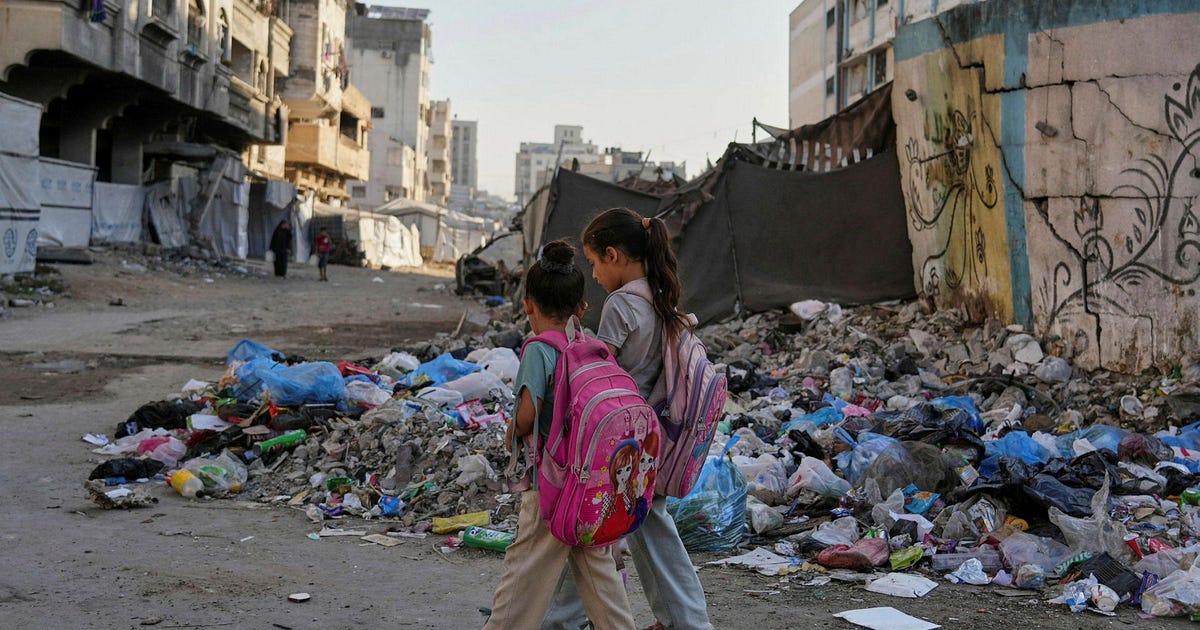
A new Oxfam and CEOBS report finds indicators of potential environmental contamination across more than 99 percent of Gaza, with the military assault directly affecting roughly 78 percent of the territory’s land area.
The findings, released Monday, draw on satellite imagery, remote sensing, and open-source data to map heavy metals, explosive residues, asbestos, dioxins, and biological contaminants across the strip. Researchers say the pollution threatens the air, soil, water, and food systems that 2.3 million Palestinians depend on for survival.
The israeli use of toxic explosives & incendiary weapons has caused environmental contamination across over 99% of Gaza: aka genocide https://t.co/9zzIrTc4gu
Contamination spans nearly all of Gaza
The report’s spatial analysis identifies contamination indicators across virtually the entire territory. The heaviest concentrations in North Gaza, Gaza City, and Deir el-Balah correspond to the most sustained bombardment, ground operations, and debris accumulation.
UNEP estimates more than 61 million tonnes of debris have been generated since October 7, 2023 — roughly 29 tonnes per person in Gaza. Oxfam calculates that clearing the rubble would require a vast environmental management challenge, with the potential for hazardous materials to disperse through dust, soil, and water. The material includes asbestos from refugee-camp roofing, industrial chemicals, and heavy metals from damaged solar installations.
PRESS RELEASE: More than 99 per cent of #Gaza shows indicators of environmental contamination from Israel's military assault READ HERE: https://t.co/nIx81uPiPV pic.twitter.com/1k8QkTzMzU
Water and sanitation systems collapse across Gaza
Testing in July 2026 detected faecal coliforms in 19 percent of 79 groundwater wells sampled, up from 2 percent in 2021. Only 19 percent of sewage pumping stations remain functional, and just 30 percent of the wastewater network retains any operational capacity. Approximately 40,000 cubic metres of raw sewage pour into the Mediterranean daily, with another 15,000 cubic metres lost through cesspits and leakage.
Around 85 percent of Gaza’s water infrastructure has been damaged or destroyed, leaving residents with roughly 18 litres of water per person per day for all uses. A WHO analysis of nearly 5,000 water samples in 2025 found more than 77 percent failed health standards and over 8 percent contained E. coli. Sampling could not reach Rafah, one of the most heavily damaged areas.
GeoConfirmed ISR. GeoConfirmed data was used by @Oxfam for their report. "Environmental War Crimes" "How Israel’s military assault has turned Gaza into a toxic wasteland, threatening human survival." "GeoConfirmed: 3,698 incidents in total, all used; 208 classified as…
Legal framing and Israeli response
The report argues the environmental destruction contributes to evidence relevant to the prohibition on deliberately inflicting conditions of life calculated to bring about a group’s physical destruction under Article II(c) of the Genocide Convention. Oxfam International Executive Director Amitabh Behar described the assault on Gaza’s environment as “environmental war crimes threatening life now and for generations to come”.
Israel’s foreign ministry called the report “shameful and scandalous” and accused Oxfam of “traded its credibility for campaigning”. The ministry said the scale of destruction reflects the scale of Hamas’s tunnel network and weapons depots beneath civilian areas. Israel’s mission in Geneva previously rejected a UN commission’s genocide findings as a “libellous sham”.
New Oxfam and CEOBS analysis finds 99% of Gaza shows indicators of environmental contamination. Toxic residues from Israel’s military assault is threatening the air, soil and water that people rely on. Israel must allow independent testing and essential aid. Read:… pic.twitter.com/Q19N7WQhN1
Health consequences appear
Gaza’s Health Ministry reported a child’s death from acute lead poisoning and warned of undiagnosed chronic exposure among other children. Multidrug-resistant pseudomonas has been detected in water at primary healthcare centres.
The report warns that with health and monitoring systems destroyed, much of the harm from toxic waste will go “undetected and unattributed for years”. Oxfam calls for a Palestinian-led environmental assessment and cleanup alongside reconstruction, with unrestricted access for specialists and equipment.
Reconstruction costs estimated at $71.4 billion over decade
A joint UN, EU, and World Bank assessment by April 2026 put debris at more than 68 million tonnes, with rubble removal alone estimated at over $1.7 billion. The same assessment cited direct physical damage at $35.2 billion and economic losses at $22.7 billion by October 2025, with recovery and reconstruction needs at $71.4 billion over a decade — $26.3 billion in the first 18 months. Gaza’s GDP fell 83 percent in 2024 to $362 million.
The report estimates the total explosive energy dropped on Gaza at approximately 13 Hiroshima-sized nuclear bombs.
Fishermen and farmers confront poisoned livelihoods
A farmer quoted by greatreporter said they returned to support themselves and return to farming so they could survive.
A new report by Oxfam and the Conflict and Environment Observatory finds that areas around Beit Hanoun, Wadi Gaza and northeast of Khan Younis face heightened risks of long-term soil contamination because their clay-rich soils are more likely to retain pollutants, threatening the safety of food crops when agricultural production resumes.
Independent assessment blocked by Israeli access restrictions
Oxfam confirmed that carrying out such an assessment has been impossible due to that refusal. CNN reported that the Israeli military office coordinating aid said reconstruction will only begin after Hamas fully disarms, and that last December Israel barred dozens of aid organizations, including Oxfam, from working in Gaza, alleging they failed to comply with new registration restrictions.
CEOBS, the Conflict and Environment Observatory, brings expertise in remote environmental assessment using satellite imagery, open-source data, and the Wartime IncidentS to ENvironment Database (WISEN) framework. Since October 2023, CEOBS has monitored the environmental dimensions of the war in Sudan, documenting damage to water infrastructure, deforestation, and hazardous exposures.
In June 2026, the organization launched WISEN WATCH, a citizen science tool on the Zooniverse platform that enables volunteers to verify radar-detected structural damage to environmentally relevant facilities, scaling up conflict monitoring across large geographic areas.
What happens next
Oxfam demands Israel end its siege, stop bombardment, and allow unrestricted access for aid, environmental assessment, and essential equipment. The organization insists recovery must be Palestinian-owned, rights-based, reparations-oriented, and rooted in accountability — and that international funding does not replace Israel’s obligation to make reparations for harm caused by unlawful acts.
Israel continues to restrict entry of testing equipment and technical expertise, which the report says “continue to prevent a full assessment of the scale and extent of contamination”.
Keep reading

NATO Ambassadors Convene Emergency Session After Russian Weapons Crash in Poland
Three Russian weapons — two Kh-101 cruise missiles and a jet-powered drone — crashed inside Poland on November...

Seven WHO Candidates Pledge Africa Deliverables at CPHIA
Seven candidates nominated by member states will compete to lead the World Health Organization when Tedros Adhanom Ghebreyesus...

Burnham Secures EU Deals at 2026 Summit; Treasury Estimates 0.5% GDP Lift by 2040
Burnham, who took over from Keir Starmer in July, used the 2026 summit to secure deals on food...

UN Climate Talks Collapse Without Fossil Fuel Deal
United Nations climate talks in Antalya, Turkey, collapsed Sunday without a final agreement after two extra days of...