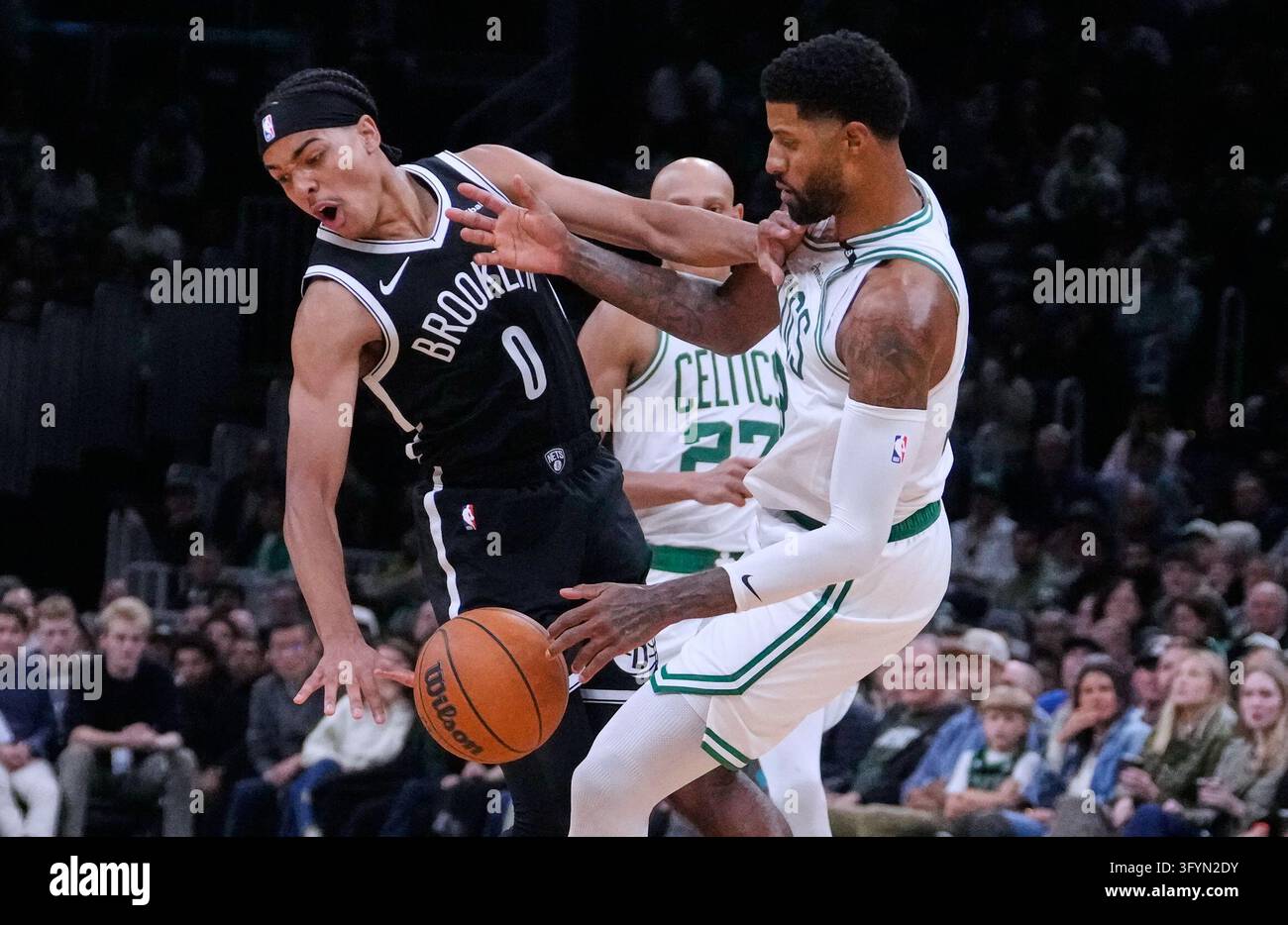
Paul George provided the Boston Celtics with critical secondary playmaking and scoring in a 125-124 overtime victory over the Brooklyn Nets on Tuesday, October 28, 2026. While Jayson Tatum captured the headlines with 40 points and the game-winning shot, George finished with 20 points, seven rebounds, and seven assists, offering a versatile performance that balanced the Celtics’ offense during a tight contest at TD Garden.
This performance matters because it solves a recurring problem for Boston: the over-reliance on Tatum to create every high-value possession. As reported, the Celtics need a collection of players capable of creating offense without making every possession depend on Tatum, and George’s ability to recognize openings and move the ball without requiring the offense to reset provides a benefit when defenses concentrate on the superstar.
George provides a second creator
The Celtics have never lacked a primary engine in Jayson Tatum, who proved his dominance Tuesday by producing 40 points and eight assists without a single turnover. However, the game against Brooklyn highlighted the danger of a one-dimensional attack. The Nets managed to take a five-point lead late in the fourth quarter and forced overtime via a last-second three-pointer from Mikel Brown Jr.
During those stagnant stretches, George’s versatility became the difference-maker. By contributing across multiple statistical categories, he prevented the Brooklyn defense from simply locking their focus on Tatum. According to data shared via NBACentral, George is currently averaging 22.3 points, 6.0 rebounds, and 3.5 assists per game this season, shooting 44% from three-point range.
His seven assists on Tuesday were a signal that his value extends beyond being a perimeter threat. He acted as a secondary decision-maker, allowing the offense to flow naturally even when the primary option was contested.
A shifting roster formula
Boston is currently integrating new pieces into a system that fans remember from their championship era. The addition of George and Mitchell Robinson has changed the team’s geometric approach to the game. This transition is most evident in high-pressure, close-game scenarios where the “new formula” is still being tested.
While George took a central role, the victory was a collective effort. Derrick White contributed 16 points and Jordan Walsh added 15, providing the depth necessary to survive a determined Nets squad. This balance ensures that the team doesn’t collapse if one player has an off night or is neutralized by a specific defensive scheme.
There is, however, a lingering question regarding durability. George played 25 minutes on Monday in a blowout win over Chicago and remained available for Tuesday’s game despite the grueling back-to-back schedule. For a veteran whose health has been a talking point in the past, his ability to handle this workload is as important as his box score.
The balance of power at TD Garden
Boston doesn’t need George to match Tatum’s 40 points every night; they need him to make the offense harder to defend.
When George handles the ball, the gravity he draws opens lanes for others, effectively making Tatum more dangerous because he is no longer the only target on the floor.
| Player | Points | Assists | Rebounds |
|---|---|---|---|
| Jayson Tatum | 40 | 8 | Not Specified |
| Derrick White | 16 | Not Specified | Not Specified |
| Jordan Walsh | 15 | Not Specified | Not Specified |
The victory marks Boston’s third straight win, but the real takeaway isn’t the win streak. It is the evidence that the Celtics have found a way to pair elite individual brilliance with a sustainable, balanced system. Tatum provided the unforgettable finish, but George provided the stability that allowed the Celtics to reach that final possession.
The open question remains whether George can maintain this level of multi-category production over a full 82-game slate, particularly during the heavy congestion of the NBA calendar.

Trunk-or-Treating Sparks Debate Over Halloween Traditions
The traditional American Halloween ritual of door-to-door trick-or-treating is facing a systemic shift as "trunk-or-treat" events—where children collect...

Massachusetts voters face nine ballot questions this election day
Massachusetts voters face nine distinct ballot questions this Election Day, covering a sweeping range of civic issues from...
Baltimore County Council Approves Pay Hikes for Top County Officials
The Baltimore County Council is moving to significantly increase salaries for top county officials and future council members...

Ari Laureano Alleges He Was Attacked With Flagpoles at Thorns Match
Ari Laureano opened his coat at a Portland Thorns match on Friday, Oct. 23, 2026, to reveal an...