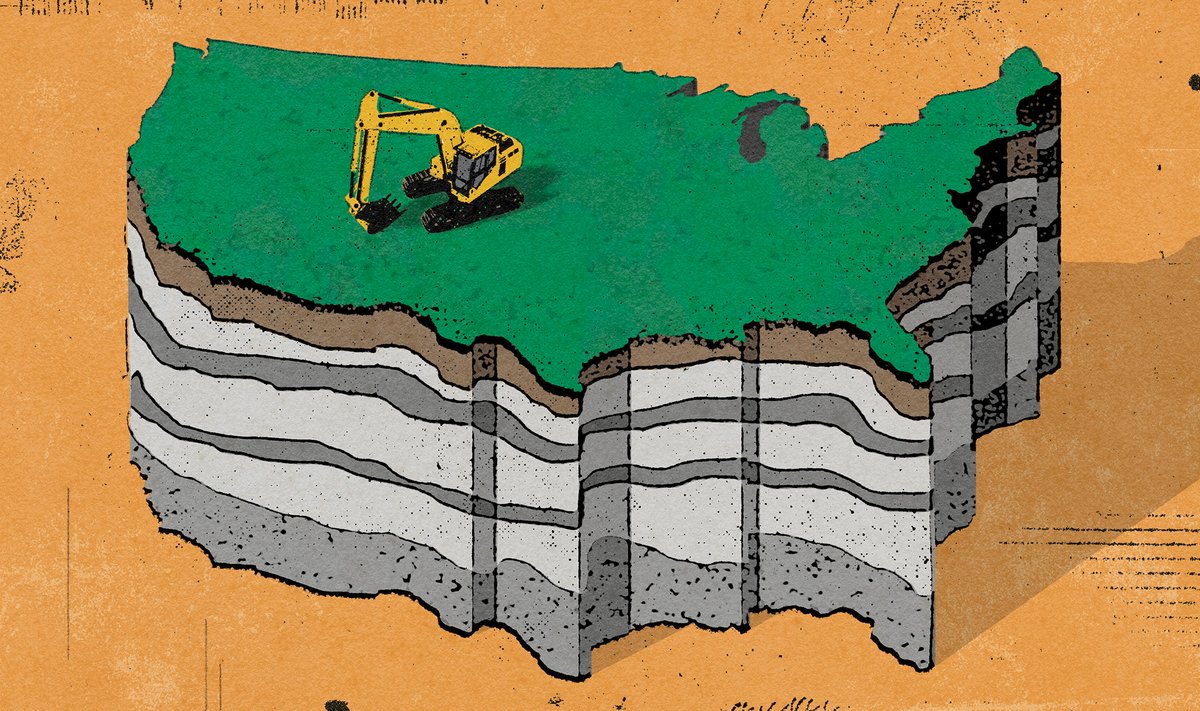
Twenty-two tons. That is all the gallium the United States uses in a year, a rounding error in the global metals market, yet the Pentagon cannot get a gram of it domestically.
China produces nearly 99 percent of the world’s gallium, a chokehold that Amitava Roy stumbled into a decade ago when he fired a synchrotron at a sample of “red mud” from a Louisiana alumina plant, Scientific American reported. The x-rays revealed loosely bound gallium scattered through the waste — scientific trivia at the time, strategic gold today.
“Then I realized people are interested.”
Roy told Scientific American.
Interest spiked after Beijing weaponized the mineral. Export controls arrived in 2023; an outright ban on shipments to the United States followed in December 2024, covering gallium, germanium and antimony. A trade truce suspended that ban in the fall of 2025, but the Center for Strategic and International Studies says Chinese exports have not meaningfully resumed. The truce expires in January.

The U.S. has not made any of its own since the 1980s and has no stockpile, according to sources. Now the Department of Defense is spending hundreds of millions to change that — without opening a single new mine.
Atlantic Alumina’s Gramercy, Louisiana refinery, the only operating alumina plant in the country, sits atop red mud piles exceeding 30 million tons. The Pentagon awarded ElementUSA $30 million for a demonstration plant to pull gallium and scandium from that waste, with an $850 million commercial facility planned on-site.
Simultaneously, the refinery itself — backed by $400 million in DOD funding — is installing circuitry to capture gallium before it ever hits the tailings pond, targeting 50 tons annually, more than double national demand.
“If you want to extract something, you need to know where it is and how it is there.”
Roy said.
His synchrotron work mapped the speciation — whether gallium sits locked in a crystal lattice or floats free — data that dictates which acid or solvent pulls it out. Elizabeth Holley of the Colorado School of Mines, working with ElementUSA on rare earths from the same mud, calls the approach “minerals without mines,” noting it extracts value from material already excavated while neutralizing caustic sludge.
The strategy extends beyond Gramercy. ElementUSA has identified additional bauxite residue sites in Texas and elsewhere in Louisiana. Roy recalls a birder friend stumbling across red mounds at a long-shuttered plant north of Baton Rouge. “All these piles are there,” Roy said. “They were just waiting for someone to want them for war.”
The Department of Energy has already selected five gallium-recovery projects, including one with the Gramercy manufacturer. Roy has a proposal pending. The race is no longer geological; it is chemical engineering and permitting speed against a January deadline that could slam the Chinese door shut again.
- Harvard Women’s Swimming and Diving Sweeps Brown, Columbia at Blodgett Pool
- Pa. Consumer Advocate Files Complaint to Prevent Customers From Subsidizing Data Centers
- Trump lands in China for trilateral summit with Xi and Putin (newsarchyuk.com)
- China Building 3km Runway on Antelope Reef, Analysts Say (world-today-news.com)

Harvard Women’s Swimming and Diving Sweeps Brown, Columbia at Blodgett Pool
Harvard’s women’s swimming and diving team swept Brown and Columbia on Saturday at Blodgett Pool, winning the dual...
Pa. Consumer Advocate Files Complaint to Prevent Customers From Subsidizing Data Centers
Pennsylvania consumer advocate Darryl Lawrence filed a legal complaint in October with the Public Utility Commission to prevent...

Pathways Healthcare’s Cranston Office Opened 2012, Medicare Certified 2019
Pathways Healthcare’s Cranston office has operated since 2012, but Medicare did not certify the agency until 2019 —...
Oregon Attorney General Sues OpenAI Over ChatGPT Child Safety Claims
Oregon Attorney General Ellen Rosenblum filed a lawsuit Wednesday against OpenAI and its corporate affiliates, alleging the company...