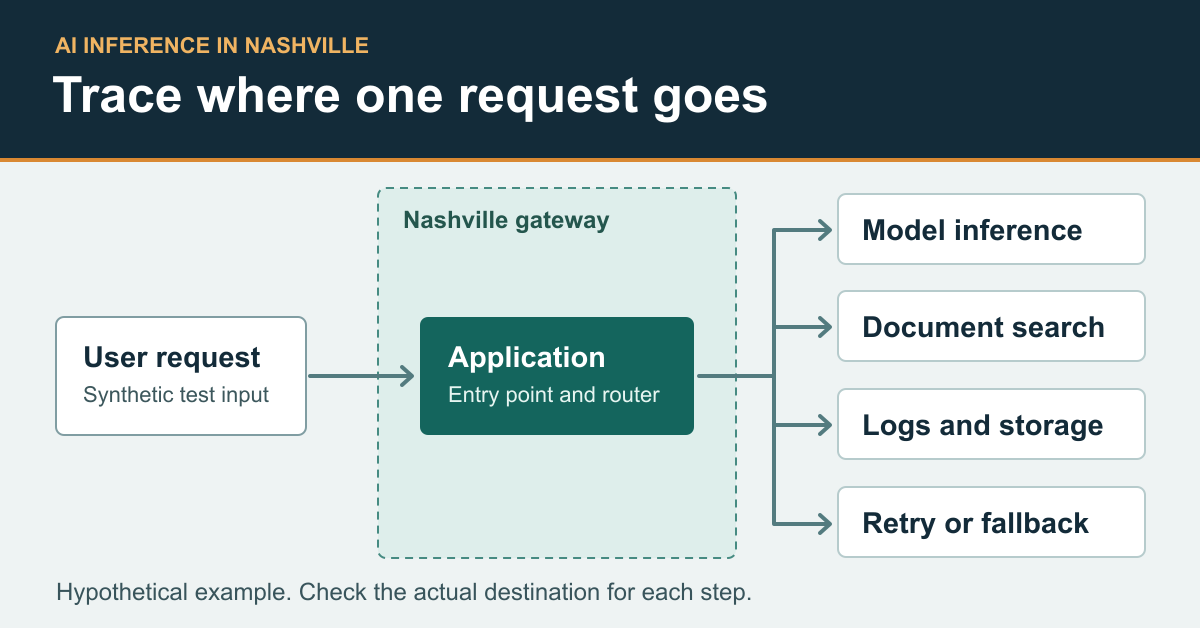
AI inference in Nashville requires tracing data beyond the local server. A local server does not reveal where prompts, document retrieval, response logs, or retry attempts go.
Teams must start with a clear statement the application owner can approve.
Procurement must specify which boundary the supplier must honor: a metro, a cloud region, or a country. Without this, no meaningful acceptance test is possible. Storage and processing should be listed separately, as a copy may remain in one place at rest while being used elsewhere.
Facility descriptions, like Flexential’s Franklin page or TierPoint’s Nashville-area sheet, list cabinets and on-ramps but not where a hosted model or log destination will process a request.
Proposals must be compared against the same application and data policy. An application owner must ask whether the model runtime and document service physically operate in the named site or metro. This includes remote model loading, managed backups, and diagnostic exports.
“A local gateway can handle user traffic while forwarding content to a regional model or search service. That can meet a regional policy, but it fails a metro-only policy when the managed service is outside the metro,” Percepture’s report stated.
Carry one synthetic request ID through each service. For each step, record the allowed location, the observed destination, and the evidence owner.
For logs, OpenTelemetry’s generative AI conventions distinguish ordinary telemetry from content capture. A trace ID, endpoint class, and response code can establish the route without placing prompts in the telemetry system.
In an approved test environment, send synthetic requests through normal service and simulate a failure. Watch which calls the application repeats and what it sends to each destination.
A hypothetical case involved a Nashville team testing 24 requests. Twenty-one completed through the approved local model. After a simulated failure, three went to a remote model not allowed by the work order. The deployment failed its location requirement.
“If the required destination is unknown, leave that check open. A documented location boundary does not establish response time; a fast response does not establish where it ran,” the report said.
Does a Nashville server mean the prompt stays in Nashville? No. The nearby server might be a gateway.
Is private connectivity enough? No. A private circuit can change how traffic gets to a service, but the data must still be processed in an approved location.
“When no allowed path is available, choose a controlled failure, an approved cached answer, or a non-AI workflow that can handle the request,” Percepture’s guide advised.
Percepture provides expertise in AI infrastructure and data sovereignty through its Sovereign AI Stack, a nine-layer framework that guides organizations in evaluating control requirements across jurisdiction, data, model, compute, network, operations, keys, people, and supply chain.
The organization also stresses the importance of traceability, noting in a report that a local gateway may meet regional policies but “fails a metro-only policy when the managed service is outside the metro,” requiring synthetic request IDs to verify processing locations.
If the exact processing location cannot be verified, ask the vendor to narrow its written commitment or propose a different deployment.
Keep reading

Rebecca Shi: Immigrants Fill 30% of Construction, Care Jobs
“It’s not easy waking up at 3 a.m. every day and milking a 1,500-pound animal,” said Rebecca Shi,...
Nevada County Quorum Court Examines Jail Finances, Approves Ordinances
Nevada County is owed $203,366 for housing inmates, money Judge Mike Otwell said would otherwise leave the county...

Sheriff Details Four Arrests From Previous Week
Sheriff Brian Williams detailed four additional cases from the previous week. Jordan Edward Crook, 29, of Dearman Street,...

KCRA Investigation Finds Possible Loophole Hides Evictions, Landlords Allege Fraud
In California, some evictions are confidential and restricted from public access, unless a landlord can get a judgement...