Delhi’s summer nights have lost their ability to cool down, trapping millions in homes that radiate heat long after sunset and driving a surge in air-conditioning that only worsens the problem.
The city’s nighttime cooling capacity has dropped, researchers cited by DNYUZ say, turning dense neighborhoods into ovens that keep indoor temperatures above 30 degrees Celsius well past midnight.
For millions in the Delhi metropolitan area, the consequences cascade from sleeplessness to lost wages and mounting health risks. Residents of India’s dense capital tried switching off fridges and leaving doors open all night to cope with rising temperatures that affect their sleep, health and ability to work, The New York Times reported.
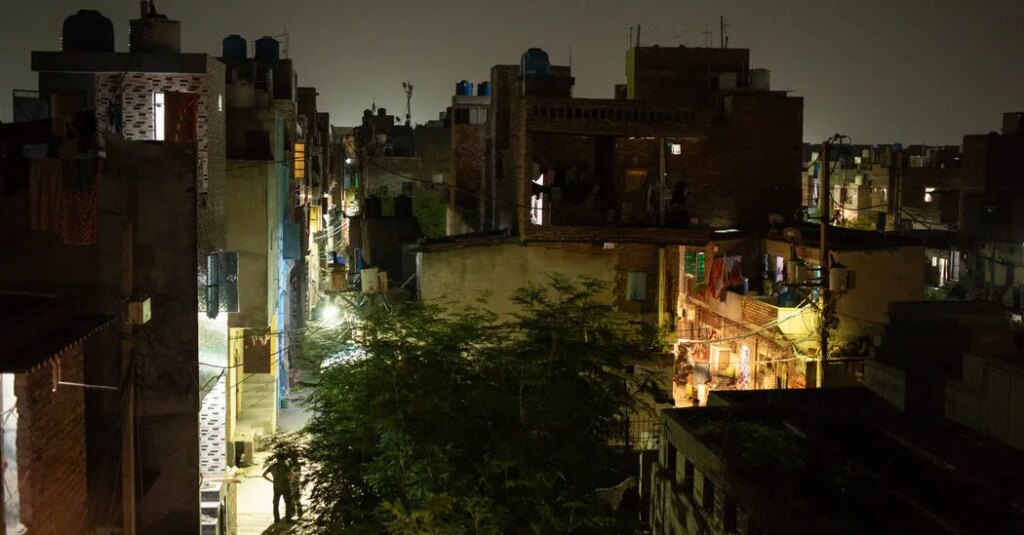
In Shahbad Dairy, a northwest Delhi neighborhood of cowsheds and dairy shops, Sudershan — a 38-year-old electrician and painter who goes by one name — sleeps in a windowless room measuring nine by eleven feet with a seven-foot ceiling.
Local authorities have paved the lane outside twice, raising it by more than a foot and shrinking his doorway, which cuts off what little airflow existed. By 11 p.m., he lies in bed with a fan rigged to a wooden ceiling bar running at full speed.
Between 2 a.m. and 3 a.m., I wake up because of the heat.
Sudershan, electrician and painter
Sudershan told DNYUZ he then faces a nightly choice: try to sleep again before sunrise, or sit outside until dawn. The housing stock across low-income settlements — mostly brick, cement, and galvanized metal sheets with low ceilings and windows no larger than a sheet of paper — was never built for this climate.
Architect Mr. Rawal explained the physics: “Materials do trap heat, but they do not find an opportunity to lose heat in the nights. And that’s why the nighttime temperature remains high.”
Families improvise. Madhu Kamal Varma, a 38-year-old tailor and cook, keeps both entrances to her one-room house open from 10 p.m. to 3 a.m. so her children can sleep while she watches.

Her husband, Kamal Varma, a bricklayer and painter, devised the schedule after she was hospitalized with heat-induced low blood pressure. In another home, Noor Jehan, a mother of four girls, sprinkles talcum powder, bathes repeatedly, and wraps wet dupattas around herself and her children — until the fabric starts to smell.
I feel so revolted.
Noor Jehan, resident
She also switches off the family’s 17-year-old refrigerator at night because its exhaust heat made the room suffocating. “It feels a little cooler without the fridge on, so the children can also lie down with some relief,” she said. Rawal confirmed the logic: “at least it will not build up heat inside.”
The Delhi metropolitan area, encompassing the National Capital Region’s 46,069,000 people at 62.6 percent urbanisation as of the 2011 census, concentrates millions in dense, low-rise settlements of brick, cement and metal sheets with minimal ventilation. Architect Mr. Rawal explained the physics: these materials trap heat but “do not find an opportunity to lose heat in the nights,” keeping indoor temperatures above 30°C well past midnight.
Panasonic reported in July that its India sales had shot up by 50 percent year-over-year. On July 16, the India Meteorological Department recorded a maximum of 39.3°C and a minimum of 30°C in west Delhi’s Sawda Colony; a handheld sensor inside the Thakur family’s home read 33.1°C at 7:30 p.m., barely below the 34°C outdoors.
Related reading

Pilot Projects Find Cool Roofs Cut Indoor Heat by 4-5 Degrees
Pilot projects in two coastal towns near Chennai are testing whether cool roof tiles and reflective paint can...

Was Japan Prime Minister Takaichi Snubbed at China’s Big Summit
Japanese Prime Minister Sanae Takaichi arrived at the APEC summit in Shenzhen on November 18 to a reception...

Russia’s State Duma Approves $609B Three-Year Defense Budget, Cuts to Health and Education
Russia's State Duma approved a three-year federal budget on Tuesday that directs more than $600 billion toward defense...
Rescuers Recover Three Bodies, Search for 23 Trapped in Indonesian Mine
Rescuers recovered three bodies on Wednesday and continued searching for 23 miners trapped in a flooded illegal gold...