
Pope Francis wrote those words on Jan. 24, 2021, describing a third encounter with the devil that coincided with the start of a two-year spiritual crisis, according to excerpts from his private diary published Tuesday.
The Vatican released “The Private Diary of Pope Francis” on Nov. 24, 2026, a 160-page volume compiled by Cardinal Víctor Manuel Fernández, one of Francis’ closest aides and the prefect of the Dicastery for the Doctrine of the Faith.
The book draws from a leather-bound planner Bergoglio began using in December 1992 as auxiliary bishop of Buenos Aires, continuing through his election as pope on March 13, 2013, until his final entry on Aug. 18, 2024.
Fernández, who wrote the commentary framing the entries, said Francis showed him the diary during a meeting and told him, “From this, you will all see,” entrusting the writings to him after his death on April 21, 2025. Pope Leo XIV approved the publication.
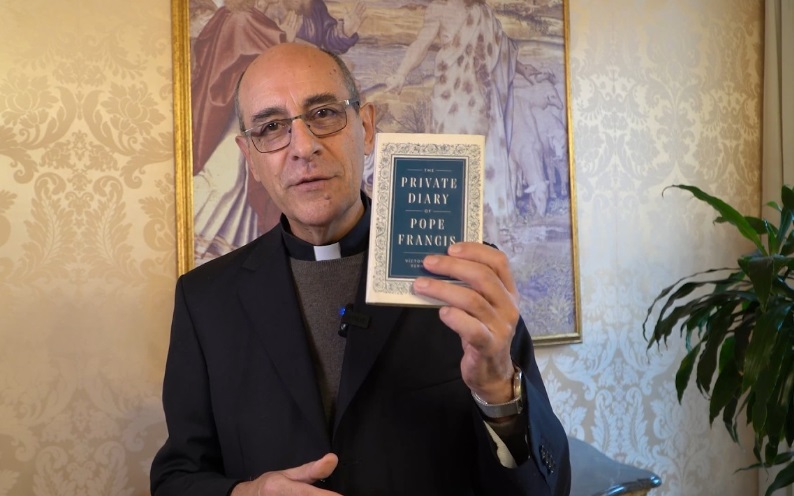
The diary was published simultaneously in 94 countries and five languages by the Vatican Publishing House, with Image Books, an imprint of Penguin Random House Christian Publishing Group, releasing the English-language version in the United States and Canada. Cardinal Fernández was appointed prefect of the Dicastery for the Doctrine of the Faith on July 1, 2023, and made a cardinal two months later by Pope Francis.
The diary records three visceral encounters Francis described as meetings with the devil. Two occurred while he served in Buenos Aires; the third came days after his return from a disastrous January 2018 trip to Chile, where he initially discredited victims of the country’s most notorious abuser priest.
“A few days after returning to Rome, I was in a meeting. I saw him and heard his voice, triumphant possessing everything. ‘Now I’ve gotten everything I wanted,’” Francis wrote in the Jan. 24, 2021 entry, quoting the devil. He added that he could not forget “the powerful raspiness of his voice.”
Earlier, on June 7, 2018, Francis wrote that he “saw the entrance to hell. Pagan seduction in full force” in the Chile scandal. In July and August 2018 he added: “What shame and evil this has brought on the church!” and “Once more the gates of hell. May holiness and conversion abound in the midst of so many scandals.”
Fernández revealed that Francis later explained to him that “when the devil cannot obtain his objectives through” direct attacks, he tries to seduce through curiosity.
A crisis of power and omnipotence
The 2021–2022 crisis, Fernández explains, was “connected to power” and the temptation to exercise it omnipotently — what Francis called “reductive curiosity,” or believing he alone could solve every problem and essentially thinking of himself as God. The cardinal links this to a tendency Francis acknowledged in his first papal interview in 2013: an “authoritarian” governing style that critics frequently faulted.
Fernández writes that the crisis was “mixed with governance issues, pressure regarding decisions to make, and aridity and desolation.” Francis underwent colon surgery in July 2021, removing 33 centimeters of his intestine, which the cardinal describes as “insupportable” pain that deepened the spiritual darkness.
The book dates the onset of the crisis to Jan. 24, 2021.
By Dec. 30, 2022, Francis had apparently overcome the crisis by entrusting himself entirely to God’s mercy.
A Jesuit’s discernment made public
As a Jesuit, Francis engaged in continual spiritual discernment — self-examination to determine whether he acted for self-interest or the good of others. The diary’s 86 pages from his Argentine years and 55 pages as pope capture that interior labor. Fernández omitted entries affecting third parties but included a note on Cardinal Robert Prevost, now Pope Leo XIV: “A great pastor, a generous missionary and an irreproachable man.”
Related reading

EU Proposes 22nd Sanctions Package to Target Russian Banks and Athletes
The European Commission on Monday proposed its 22nd sanctions package against Russia, targeting 60 banks, cryptocurrency platforms, a...

PLA Navy to Display Type 055 Destroyer, Three Warships at Zhuhai Airshow
China will put its newest warships on public display at the Zhuhai Airshow for the first time next...
Zelenskyy Confirms Ukraine Sank Russian Corvette, Damaged Cargo Ship in Libya
Ukrainian sea drones sank a Russian corvette and damaged a cargo ship at the Libyan port of Benghazi...

Oxfam and CEOBS Find Contamination Indicators Across 99% of Gaza, 78% Directly Affected by Assault
A new Oxfam and CEOBS report finds indicators of potential environmental contamination across more than 99 percent of...