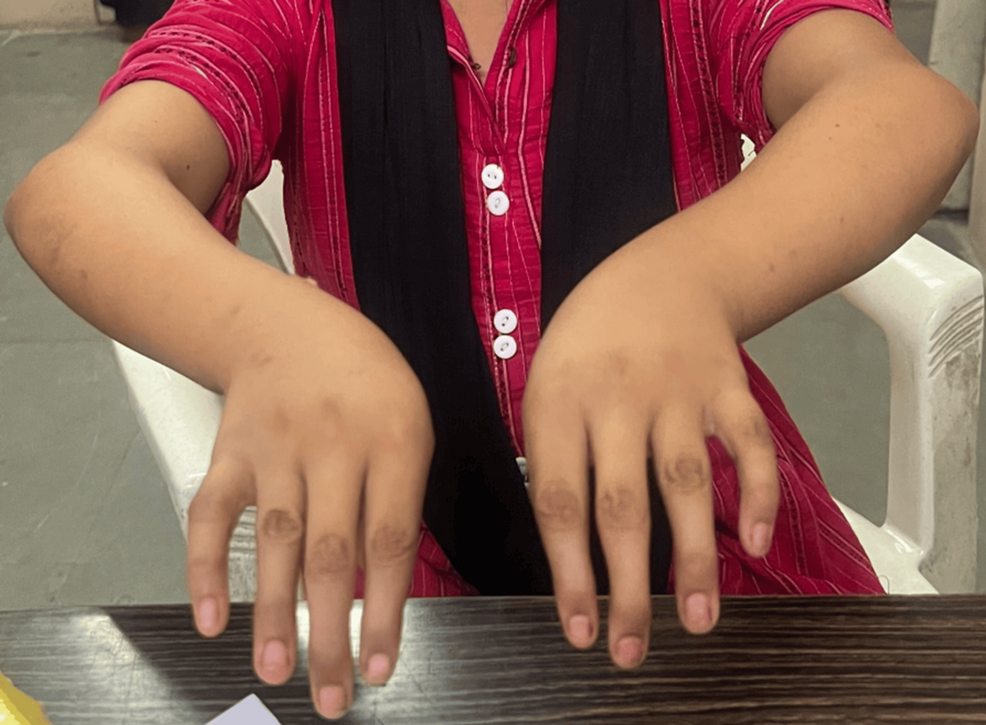
Bilateral cubitus varus and poor height gain brought a 14-year-old girl to an outpatient clinic, leading to a provisional clinical diagnosis of pseudopseudohypoparathyroidism.
- A 14-year-old girl presented with poor height gain and bilateral elbow deformities.
- Serum calcium, phosphate, and parathyroid hormone levels remained within reference ranges during evaluation.
- Genetic testing was performed, but the report could not be reviewed after she was lost to follow-up.
Physical examination revealed round facies, dental crowding, brachydactyly of the fourth and fifth digits, and bilateral thenar hypoplasia. The patient also displayed a positive Archibald sign, demonstrated by knuckle dimpling over the fourth and fifth metacarpal heads during fist formation.
Lower limb examination showed bilateral shortening of the fourth and fifth toes alongside flat feet. Anthropometric measurements recorded a height of 135.5 cm and a weight of 37 kg, with a body mass index of 20.2 kg/m² corresponding to approximately the 54th percentile. Plain radiographs of both hands demonstrated bilateral shortening of the fourth and fifth metacarpals and thumb distal phalanges.
Laboratory investigations showed serum calcium, phosphate, and parathyroid hormone within the reference ranges provided. Thyroid-stimulating hormone, total T3, and T4 levels also met reference standards. Karyotype analysis showed a 46,XX pattern, and follicle-stimulating hormone and luteinizing hormone concentrations measured 8.64 mIU/mL and 3.19 mIU/mL, respectively.
Albright hereditary osteodystrophy stems from inactivating GNAS mutations that impair cyclic adenosine monophosphate signaling. Maternally inherited mutations typically produce hormone resistance known as pseudohypoparathyroidism type 1A, while paternally inherited mutations result in isolated pseudopseudohypoparathyroidism without biochemical evidence of parathyroid hormone resistance.
Although genetic testing was performed, the documentation could not be obtained for review. The patient was subsequently lost to follow-up, leaving the molecular variants, parent of origin, and longitudinal growth unverified.
Worth a look

ASEAN Member States Signed Digital Economy Framework Agreement
ASEAN member states signed the Digital Economy Framework Agreement. The pact establishes common rules across cross-border data flows,...
Study Shows Bacteria-Powered Mosquitoes Cut Dengue, Chikungunya Cases by 69%
Children living in Brazilian neighborhoods where researchers released specially bred mosquitoes experienced about a 69 percent reduction in...

Mepolizumab Reduced Annual Systemic Corticosteroid Exposure in COPD Patients
Mepolizumab reduced annual systemic corticosteroid exposure compared with placebo in patients with COPD and type 2 inflammation. The...

Indonesia Welcomes Safe Harbour Mechanism for Carbon Credit Legal Certainty
Indonesia welcomes the "safe harbour" mechanism to provide legal certainty for carbon credit buyers and investors, which aims...