
Nine fossil teeth from two limestone caves in Guangxi, southern China, show that Homo erectus lived in dense tropical rainforests between 324,000 and 184,000 years ago — more than 200,000 years later than the previous securely dated mainland finds.
The findings, published in two papers in Nature on November 18, come from an international team led by researchers at Macquarie University, Southern Cross University, the Chinese Academy of Sciences, and the Max Planck Institute of Geoanthropology, according to Nature.
Eight of the teeth carry the morphology and enamel protein signatures of Homo erectus; the ninth, from Baxian Cave, bears a protein profile that does not match any known Homo erectus variant and may represent a Denisovan or another archaic population.
Rainforest life, not open savanna
Stable carbon and oxygen isotope ratios from three Homo erectus teeth, along with thousands of associated animal fossils — orangutans, elephants, rhinos, monkeys — indicate a closed-canopy rainforest environment. The carbon values point to deep-shade forest plants with no grass component, a setting closer to the western Amazon than to African rainforests today.
“Teeth can record the environments in which animals and humans lived,” said Nicolas Bourgon of the Max Planck Institute of Geoanthropology. “In this case, the animal teeth and the Homo erectus teeth are telling the same story — these individuals were part of a rainforest ecosystem.”
The result upends a long-standing hypothesis that rainforest expansion drove Homo erectus toward extinction. On Java, the last known members of the species lived in open woodland until roughly 108,000–117,000 years ago, and encroaching forest has been proposed as a factor in their disappearance. The Guangxi teeth show that at least some Homo erectus populations not only tolerated but exploited tropical rainforests.
Mobility across a karst corridor
Strontium isotope ratios in the enamel reveal that the individuals grew up consuming food and water from geologically distinct areas. Some signatures match the local limestone around the caves; others correspond to rock formations roughly 250 kilometres to the south, toward northern Vietnam and mainland Southeast Asia.
“Some of the chemical signatures in the fossil teeth point well beyond the immediate cave region, potentially toward northern Vietnam and mainland Southeast Asia,” said Renaud Joannes-Boyau of Southern Cross University, a co-lead author. “This suggests these humans were far more mobile than previously recognized, moving across surprisingly large distances through a complex rainforest landscape.”
A ninth tooth that doesn’t fit
Ancient protein analysis of five teeth recovered sequences from all five. Four carried an ameloblastin variant previously seen only in older East Asian Homo erectus fossils, but lacked a second change found in those earlier specimens. The fifth tooth, a lower second molar from Baxian, produced a protein profile that matches neither Homo erectus nor any known Denisovan sequence — though its morphology resembles a Denisovan molar.
“But the ninth tooth, from Baxian, has proteins that don’t match any known Homo erectus variants, and the shape also looks decidedly un-Homo–erectus-like, strongly suggesting the presence of a hominin population other than Homo erectus in Baxian Cave,” wrote molecular anthropologist Frido Welker of the University of Copenhagen, who led the protein study.
Denisovan fossils are known from the wider region, but no clearly identified Denisovan lower second molar exists for direct comparison.
Dating the youngest mainland Homo erectus
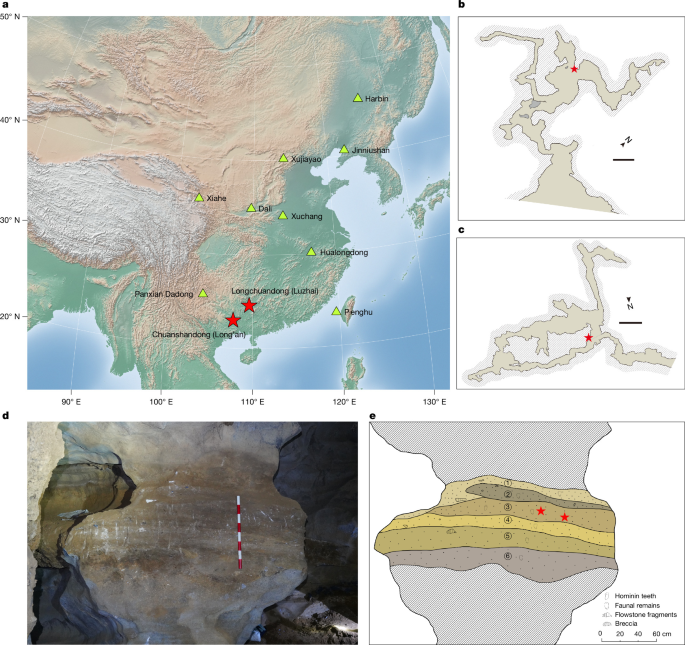
The team applied five independent dating techniques — uranium-series on teeth and flowstones, optically stimulated luminescence on sediments, electron spin resonance, and combined U-series/ESR — to the Baxian and Naxian cave deposits, which lie about 15 kilometres apart in the Chongzuo karst.
The convergent results place the human-bearing layers between 324,000 and 184,000 years ago, making them the youngest securely dated Homo erectus fossils in mainland China. Previous firm dates clustered around 400,000 years ago at sites such as Hexian (Anhui) and Nanjing.
“These findings change how we think about Homo erectus,” said palaeontologist Yingqi Zhang of the Institute of Vertebrate Palaeontology and Palaeoanthropology at the Chinese Academy of Sciences. “Finding Homo erectus evidence for the first time amongst a rainforest fauna challenges all our assumptions about their ability to adapt to environmental changes.”
Outside experts weigh implications
Ben Marwick, an archaeologist at the University of Washington who was not involved in the research, told National Geographic that rainforests were thought to be a frontier only modern humans could survive and cross. He added that the new evidence suggests the idea of Homo sapiens exceptionalism may not be the true story.

Ben Utting, an archaeologist at the University of Connecticut who was not involved, told CNN that making such journeys would have required a sophisticated understanding of the surrounding terrain, including regional land features and river networks that change with the seasons. He said the findings show Homo erectus was more behaviorally flexible than previously thought.
Authors frame the shift in understanding
The study authors wrote that Homo erectus was not ecologically excluded from rainforest environments, and Yingqi Zhang of the Chinese Academy of Sciences said the findings change how researchers think about the species.
Kira Westaway told Gizmodo that the context provides a new chapter in understanding the capabilities of this fascinating species, adding that as paleoproteomic frontiers are pushed in Asia, researchers might eventually isolate proteins of all the human family and beyond. She also said that Homo erectus survived nearly two million years — six times longer than Homo sapiens.
What remains uncertain
The rainforest adaptation rests on carbon data from only three teeth, all from one cave, and the mobility inference comes from a small number of individuals. Strontium signatures alone cannot confirm a continuous 250-kilometre journey; they show only that childhood diet incorporated resources from geologically distinct zones. Researchers also do not know whether rainforest exploitation was widespread among late Homo erectus populations or a local adaptation unique to southern China.
Keep reading

VR Mindfulness Pilot: 83% of Swedish Healthcare Staff Enjoyed Session, 93% Would Repeat
A single ten-minute virtual-reality mindfulness session left 83 percent of Swedish healthcare professionals saying they enjoyed the experience,...

Study: No Significant Difference Between TXA and Glycolic Acid for Melasma
A study in Islamabad, Pakistan, found no statistically significant difference in effectiveness between intradermal tranexamic acid injections and...

The Witcher 4 Will Be a GTA 6-Sized Leap Forward, CD Projekt Red Says
CD Projekt Red expects The Witcher 4 to deliver a technological leap comparable to the one between Grand...

Black Friday 2026 Brings Deep PS5 Game and Accessory Discounts, Console Stock Tight
Black Friday 2026 is delivering deep discounts on PlayStation games and accessories, while console deals remain scarce and...