“When we got to the point where we could actually do it, there had already been a first draft in the fiction that the science got to follow,” Abraham says.
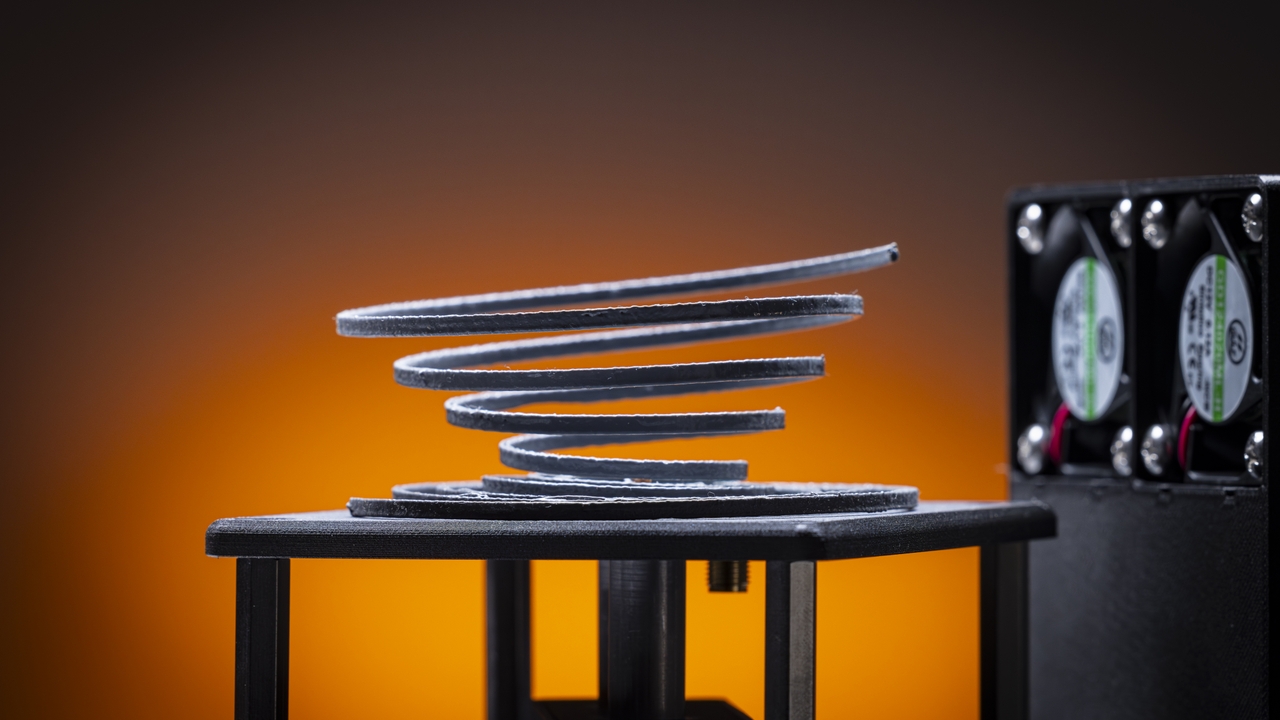
At the Johns Hopkins Applied Physics Laboratory, roughly 100 engineers and scientists have developed a shape-shifting antenna that reacts to temperature and operates across both low and high frequencies. The prototype, detailed in ACS Applied Engineering Materials in 2024, was directly inspired by the alien “protomolecule” in The Expanse, the book and television series Abraham co-writes under the pen name James S.A. Corey.
The breakthrough matters because today’s antennas are fundamentally static — locked to a narrow frequency band by their physical geometry. A satellite antenna designed for low frequencies cannot pivot to high frequencies once it is in orbit, and a soldier in the field cannot retune a rigid array without swapping hardware.
This antenna, 3D-printed from nitinol, a nickel-titanium shape-memory alloy, folds like origami or shifts along two axes when heated by an embedded wire, covering both low and high bands in one package.
“With antennas, you’re always kind of stuck with what you’ve got, so it may not work exactly the way you want it to,” Jennifer Hollenbeck, the antenna design expert and assistant group supervisor who led the project at APL, says.
“You can change the antenna, which can be incredibly inconvenient if it’s on a satellite in space and you don’t have access to it or you’re out in the field as a warfighter.”
The project traces a remarkably tight loop through the University of New Mexico. Abraham earned a biology degree there in 1994, working IT for an Albuquerque internet provider while writing fantasy novels on the side. He met co-author Ty Franck through tabletop gaming; their plan to sell a novel for “pizza money” became nine books and a six-season Amazon Prime series.
Abraham credits his biology training for the series’ rigorous take on alien biology and evolution. “The lens that I have to make sense of the world is formed in large part by the education that I got,” he says.
Decades later, Michael Sherburne entered the same orbit. He completed his Ph.D. in electrical engineering at UNM in 2022 under Edl Schamiloglu, distinguished professor and director of the UNM Directed Energy Center. “He was very supportive when I really needed the help, but he also gave me the freedom to do a lot of my own original research,” Sherburne says of his advisor.
That independence proved critical when Hollenbeck was sidelined by long COVID for six weeks in 2023. Sherburne, by then the advanced technology section supervisor for APL’s Electronic Warfare Advanced Development Group, absorbed the principal investigator’s duties and kept the program on track. “He really got thrown right into the deep end and showed us how capable he is,” Hollenbeck says.
When the team published, Sherburne discovered the UNM link to Abraham and arranged a virtual meeting between the APL researchers and the authors. In February 2025, Hollenbeck, Sherburne, and Abraham met for dinner in Albuquerque, where the engineers demonstrated the prototype using the only heat source at hand — a hot fajita plate. The researchers gifted Abraham two signed copies of the journal cover art, one for Franck.
“There’s this symbiotic thing between science fiction writers and engineers. When we met we had such an amazing exchange.”
— Jennifer Hollenbeck, antenna design expert and assistant group supervisor, Johns Hopkins Applied Physics Laboratory
Abraham and Franck released the sequel in the James S.A. Corey series, The Captive’s War, earlier this year. The APL team continues iterating on the antenna, aiming for eventual deployment on satellites and tactical platforms where a single reconfigurable aperture could replace multiple fixed antennas.
The “virtuous cycle” Abraham described — fiction drafting the future, engineering building it, new fiction dreaming farther — just ran another lap in a diner booth over fajitas.
Related reading

Virginia Senators Warner, Kaine Likely to Chair Senate Intelligence and Budget Committees
Democrats flipped both chambers of Congress on Nov. 3, handing every committee gavel to their caucus — and...

Kansas’ Tyran Stokes to Play in Players Era Title Game vs. Houston
Kansas freshman Tyran Stokes will play Thursday night in the Players Era Festival championship game against No. 8...

Owl Attacks Multiple People in Brookline; Police Notify State Wildlife Officials
Brookline police have notified state wildlife authorities after a single owl attacked at least four people in recent...

Columnist: Council Committee Bungled Festival Contract, Led to 2026 Cancellation
In a column for The Portland Press Herald, a columnist argues that the Portland City Council’s Housing and...