The Senate passed a sweeping permitting reform bill last week by a 62-33 vote, sending the nearly 500-page Bipartisan American Affordability and Jobs Act to the House with President Trump’s promise to sign it. The legislation aims to accelerate approvals for energy and infrastructure projects but faces fierce opposition from tribal nations, environmental groups and House Democrats who say it guts public input and environmental review.
The bill cleared the Senate on Thursday after leadership bypassed the committee markup process, skipping hearings and rewrites before allowing only a single amendment, The Hill reported. Just two Republicans, Sens. Mike Rounds of South Dakota and Josh Hawley of Missouri, voted against it.
Fifteen Democrats and caucus members supported the measure, including sponsors Sens. Martin Heinrich of New Mexico and Sheldon Whitehouse of Rhode Island, alongside Sens. Chris Coons, John Fetterman, Ruben Gallego, John Hickenlooper, Angus King, Amy Klobuchar, Gary Peters, Jack Reed, Jacky Rosen, Brian Schatz, Chuck Schumer, Elissa Slotkin and Mark Warner.
What the bill does
The legislation targets long-standing complaints that federal permitting takes too long, delaying power lines, pipelines, wind farms and data centers. It would let federal regulators approve transmission lines if states fail to act, prevent future presidents from revoking existing energy permits, and allow developers to sue agencies for disparate treatment of energy sources, The Hill reported. Natural gas pipeline expansions would be exempt from certain environmental reviews, and alternatives analyses would be limited to options meeting the sponsor’s project goals. Lawsuits would have to be filed within 150 days of approval, and only parties who participated in formal comment periods could sue.
Supporters argue the changes will modernize the grid, create jobs and lower electricity bills. “This isn’t just, like, a mushy, middle, moderate, do-nothing bill. Like, it’s actually a big-deal bill,” said Xan Fishman, who leads the energy program at the Bipartisan Policy Center.
“At its heart, it’s about trying to take a permitting system which has just grown out of proportion and make sure that it’s protecting the environment but getting to a yes or no answer in a reasonable amount of time,” he told NPR.
Tribal sovereignty and environmental concerns
Critics say the bill weakens bedrock laws including the National Environmental Policy Act and the National Historic Preservation Act. “From our perspective, there are no pros. There are only cons,” said Wesley Furlong, senior staff attorney with the Native American Rights Fund. He said tribes were not consulted on the bill despite its threat to their lands and sovereignty. “It will fundamentally change the federal government’s relationship with Indian tribes in a really negative way,” Furlong told NPR.
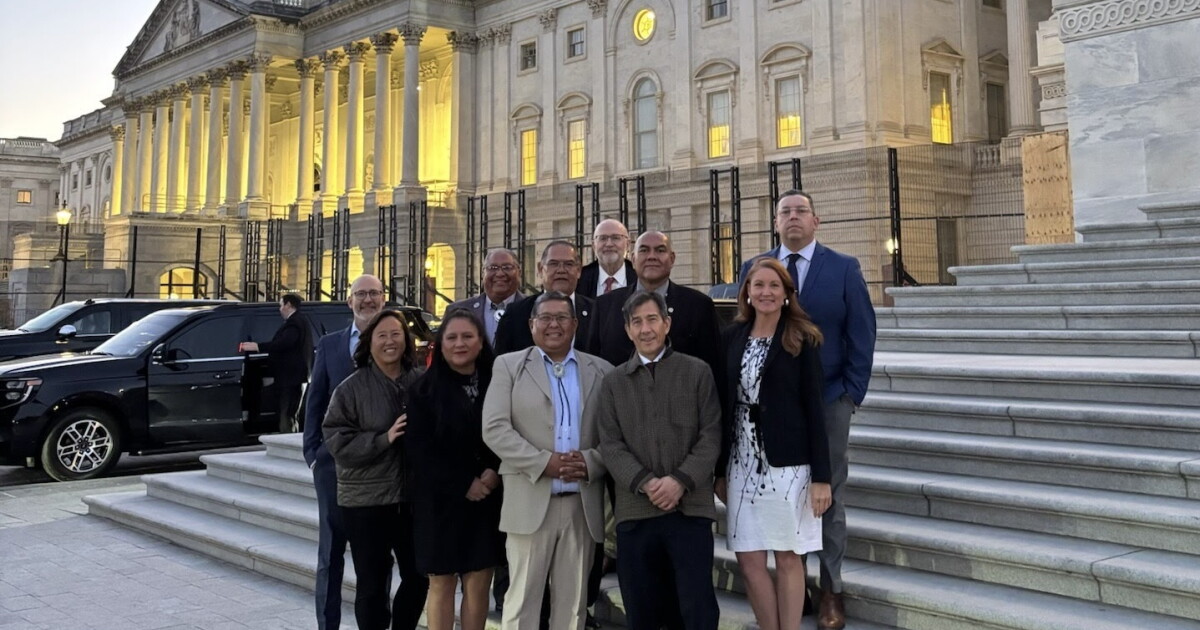
The All Pueblo Council of Governors, representing 19 New Mexico pueblos, joined Rep. Melanie Stansbury (D-N.M.) on Monday to oppose the measure. “To just break that up, that’s something that can never be replaced,” said Joey Sanchez, chairman of the council. “So we are strictly and adamantly opposed to this bill,” KSFR reported.
Stansbury called it “a bad bill at a bad time that does bad things” and urged colleagues to wait for the next Congress.
New Mexico’s other House Democrats, Reps. Teresa Leger Fernández and Gabe Vasquez, also oppose the bill, as does Sen. Ben Ray Luján, who voted against it in the Senate, KSFR reported.
Hundreds of climate, tribal, public health, historic preservation and civil rights groups have signed on in opposition.
“I think the way they’ve come up with doing it is looking at rose-colored glasses at text that, if they are wrong, has such severe consequences that it could actually make things worse,” said Sarah Gonzalez-Rothi, former senior director for water at the White House Council on Environmental Quality under President Biden, speaking to NPR.
Xan Fishman, who leads the energy program at the Bipartisan Policy Center, called the legislation “a big-deal bill” that seeks to make the permitting system deliver a decision “in a reasonable amount of time” while still protecting the environment, according to NPR.
As a Washington think tank founded by former Senate leaders, the Bipartisan Policy Center’s Energy Project has long researched permitting bottlenecks, and Fishman’s assessment signals that centrist policy experts view the measure as a substantial overhaul rather than a marginal tweak.
House timeline uncertain
Speaker Mike Johnson (R-La.) announced plans to fast-track the bill for a vote before Thanksgiving using a procedure requiring two-thirds support, KSFR reported. The House could vote in the days after Thanksgiving, but it remains unclear whether opponents have the votes or time to amend it before the current Congress adjourns on January 3.
“We’re getting very positive signals,” Sen. Shelley Moore Capito (R-W.Va.) told reporters. “I would take nothing for granted.” Sen. John Barrasso (R-Wyo.) predicted passage: “We’ll get the votes in the House and the president will sign it and it’ll be great for the American people.”
More on Senate
Related reading
Texas Democrats Win State Offices; Federal DEI Pressure Remains
Federal pressure remains Trump still controls agencies that have threatened funding cuts and lawsuits to force institutions to...

Scotty Fox Jr. Expected to Start for West Virginia vs. Utah, But Jyron Hughley Could See Action
Scotty Fox Jr. is expected to start at quarterback for West Virginia on Friday against Utah in the...

Denver DA Declines Charges in Waymo Eggings
A man in Denver has been trapping Waymo robotaxis with traffic cones and pelting them with eggs in...

Port of Seattle Commission Voted to Raise 2027 Property Tax Levy Without Voter Approval
The Port of Seattle Commission voted 5-0 on Monday to raise its 2027 property tax levy by 8.2%,...