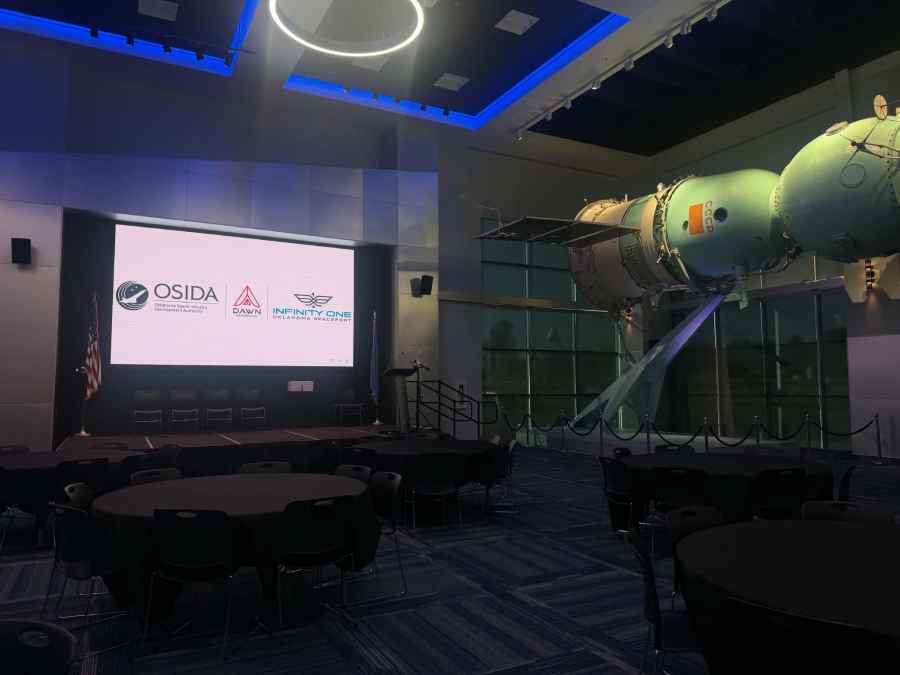
Seven research teams from universities in Oklahoma and beyond secured 25 suborbital flights valued at $5 million on Thursday after winning a first-of-its-kind competition hosted by state aerospace authorities and Dawn Aerospace.
The winning payloads will fly aboard Aurora, an uncrewed suborbital spaceplane developed by Dawn Aerospace, launching from the Infinity One Oklahoma Spaceport located at the former Clinton-Sherman Air Force Base in Burns Flat, according to announcements made at the Stafford Air and Space Museum in Weatherford.
Each winning team will receive between three and five dedicated flights to test hardware, biological samples, and materials in microgravity conditions. Commercial operations for the vehicle are scheduled to begin in late 2027.
“Oklahoma has made strategic investments in our aerospace infrastructure, workforce, and research capabilities to create opportunities exactly like this,” said Grayson Ardies, executive director of the Oklahoma Department of Aerospace and Aeronautics and CEO of the Oklahoma Space Industry Development Authority.
Ardies said that the program allows researchers to fly experiments, analyze data, and launch a second flight on the same day.

Aurora takes off from a conventional runway and climbs at an 80-degree angle to provide approximately 127 seconds of microgravity, before gliding back down to land on a runway like an aircraft, according to Aleisha Draper, lead account manager for Dawn Aerospace.
The competition drew 12 finalists before the final seven winners were selected. The chosen teams span biomedical studies, advanced materials, and spacecraft navigation.
AstroTwitch, led by Oklahoma State University with partner ETH Zurich, will study muscle tissue responses to microgravity to aid research on astronaut health and muscle-wasting conditions on Earth.
The University of Tulsa’s High Temperature Composite Materials Research Group leads the Carbon-Carbon Leading Edge project, testing thermal protection materials under real-world conditions that cannot be replicated in a standard laboratory.
Another Oklahoma State University team, working through the Oklahoma Aerospace Institute for Research and Education, leads INFLATE to test the deployment and behavior of inflatable structures in microgravity and near-vacuum.
The University of Oklahoma School of Aerospace and Mechanical Engineering leads a low-cost star tracker array project alongside the University of Colorado Springs and SEDS OU to test attitude-determination hardware above the bulk of the atmosphere.
Researchers at the University of Oklahoma Health Sciences Center lead MitoTRACER, partnering with the University of Pittsburgh and Washington University School of Medicine to investigate mitochondrial transfer in cancer cells under space-related stressors.
Oklahoma Baptist University leads a modular tank propellant management device test bed with Quantum Space to study fuel behavior in true microgravity.
Langston University leads T-GRAV, examining how human T-cells behave in reduced gravity.
Dawn Aerospace, founded in 2017 by five engineers from New Zealand, the Netherlands and Germany, builds satellite thrusters that replace toxic hydrazine with a nitrous oxide and propylene mix.
The company’s Mk-II Aurora spaceplane completed 48 jet-powered test flights in New Zealand by December 2022, then broke the sound barrier there on November 12, 2024, becoming the first New Zealand–designed and –manufactured aircraft to do so. The vehicle was jointly developed in Delft and on New Zealand’s South Island.
“What NASA and some of the others have seen over the years is that there’s an interesting correlation between what happens with these cells when they go into space and aging,” said Byron Quinn, professor at Langston University.
Worth a look

Police Scotland Recovers Missing Fishing Boat Kilda Off Orkney
Police Scotland recovered the fishing boat Kilda from the North Sea and brought it to Kirkwall on Thursday....
NOAA Forecast Predicts Light Winter With Warmer Temperatures for Michigan
Michigan is bracing for a light winter marked by well-above-average warmth and significantly lower snowfall totals, according to...
Second Chances Distributes 1,000 Backpacks, Serves Meals at 7th Annual OKC Event
OKLAHOMA CITY — Second Chances, a ministry and thrift store in Oklahoma City, is preparing to serve warm...

Stetson Falls to No. 23 Louisville 83-69 After Early Lead
The Stetson men's basketball team gave No. 23 Louisville a tough early test on Thursday evening, jumping out...