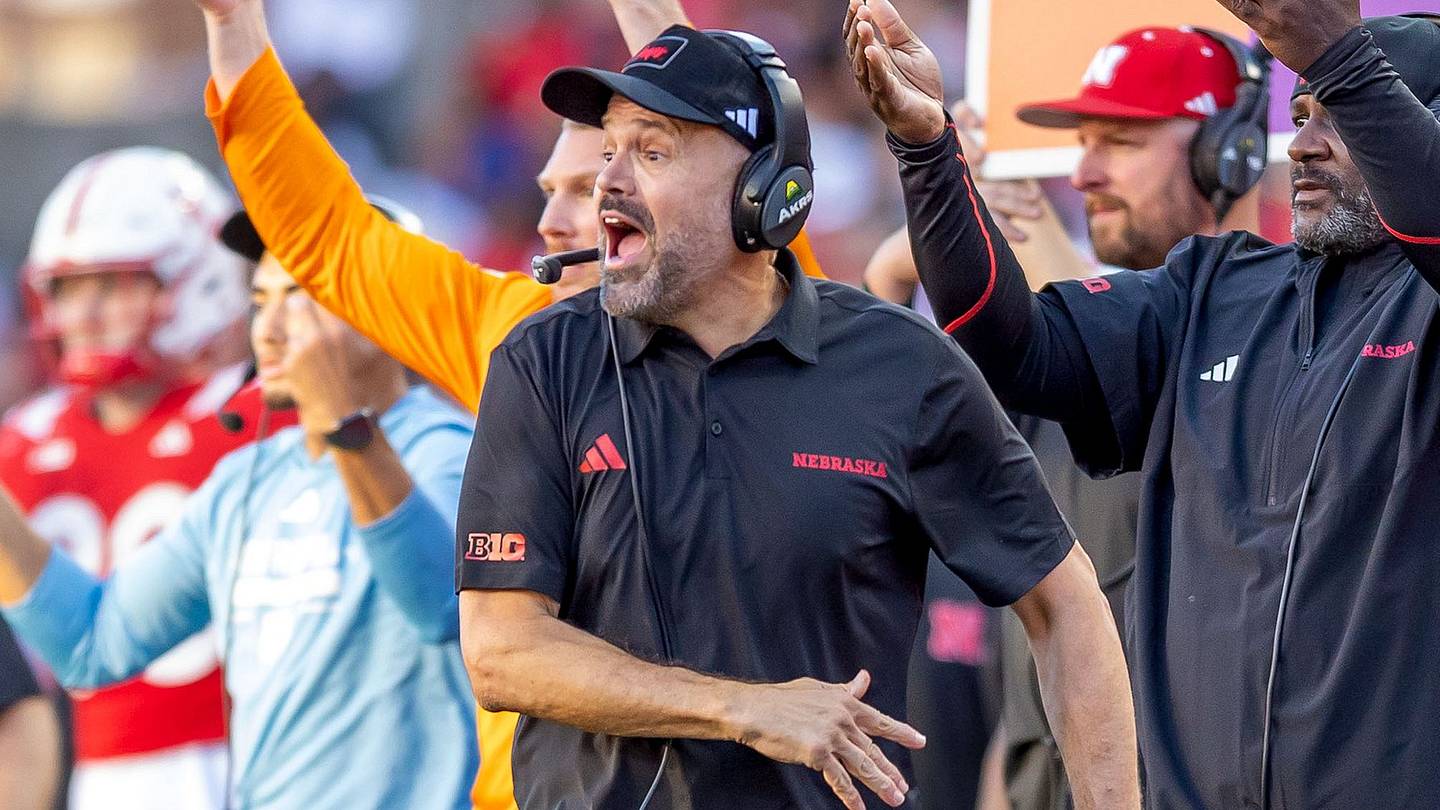
Matt Rhule seeks new direction after firing Dana Holgorsen
The Nebraska offensive landscape shifted abruptly on Saturday following head coach Matt Rhule’s decision to fire offensive coordinator Dana Holgorsen. The move leaves the Huskers searching for a new architect to lead the unit as they look toward the 2027 season. According to a report from Sports Illustrated, several high-profile candidates have emerged as potential replacements to stabilize the Lincoln offense.
Nebraska has fired offensive coordinator Dana Holgorsen. Statement from coach Matt Rhule: “Like so many of you, I am angry, I am disappointed and I am frustrated with our results this season. As the head coach, I am ultimately responsible for every aspect of our…”
For the remainder of the 2026 campaign, Glenn Thomas will maintain control of the offense. Thomas currently serves as the quarterbacks coach and co-offensive coordinator for Nebraska. His resume includes previous stints as an offensive coordinator at Arizona State, UNLV, Temple, and Baylor, where he worked alongside Rhule. While Thomas provides immediate continuity, his appointment suggests a period of transition rather than a total schematic overhaul.
The immediate stakes for Nebraska involve more than just a change in play-calling; it is a question of identity. The program must decide whether to double down on the existing system or recruit a fresh perspective to jumpstart scoring. This decision will dictate the development of the roster and the recruiting pitch for years to come.
Six candidates vying for the Lincoln coordinator role
The search for Holgorsen’s successor has produced a diverse list of coaching profiles, ranging from proven internal continuity to explosive high-scoring innovators. The following candidates represent the primary directions Rhule could take the program:
| Candidate | Current Role | Key Statistical Profile |
|---|---|---|
| Glenn Thomas | Nebraska Co-OC/QBs | Historical success at Arizona State and UNLV; familiarity with Rhule. |
| Rob Ezell | Wake Forest OC | Averaging nearly 40 points and 450 yards per game in 2026. |
| Slade Nagle | Houston OC | Leading a balanced unit averaging 470.5 yards and 36 points per game. |
| Nate Potter | Boise State OC | Specializes in the run game; Boise State averages 35.9 points per game. |
| Mitch Dahlen | Oregon State OC | Beavers average over 500 yards and 40 points per game. |
Rob Ezell of Wake Forest stands out as a high-octane option. Since taking over as offensive coordinator in 2025, Ezell has overseen a Demon Deacons offense that ranks in the top 15 nationally. His pedigree includes time as an offensive analyst at Alabama between 2015 and 2020, working under a coaching staff that included Lane Kiffin and Steve Sarkisian.
If Rhule prioritizes a physical, ground-based approach, Nate Potter of Boise State is a logical target. Potter has ascended through the ranks at Boise State, becoming the offensive coordinator in 2025. Even without the historical rushing production provided by players like Ashton Jeanty, Potter has maintained a productive unit that averages 222.8 rushing yards per game in the current season.
The choice between continuity and innovation
The decision facing the Nebraska coaching staff involves a fundamental tension in program building: the safety of the known versus the volatility of the new. Selecting Glenn Thomas would be the conservative route. Thomas has a proven track record of incremental improvement; during his time with the Bears, he helped move the offense from 404.9 total yards per game in 2017 to 421.5 in 2019.
However, Sports Illustrated notes that Thomas is unlikely to implement the level of radical change an outsider might bring. Choosing him likely means the 2027 offense will operate with a similar philosophy to the current Rhule era. Conversely, bringing in a candidate like Mitch Dahlen or Mike Bloesch could represent a total shift in offensive philosophy.
Bloesch, currently the run game coordinator at North Texas, oversees an offense that is currently among the most dominant in the country, averaging 539.6 yards per game. His history includes time at Cal, where he coached current Husker wideout Nyziah Hunter. This connection provides a bridge between the current roster and a potentially explosive new system.
The high cost of offensive stagnation
For the Nebraska fan base and the university’s athletic department, the offensive output is a primary driver of engagement and revenue. A stagnant offense does more than lose games; it impacts recruiting momentum and the overall economic health of the program. The “so what” of this coaching vacancy is clear: the winner of this search will determine the ceiling for Nebraska’s competitiveness in the Big Ten for the next several seasons.
There is, of course, a counter-argument to the pursuit of high-flying, high-risk offenses. Critics of the “spread” or “explosive” models often point to the volatility of turnover rates and the physical toll on a defense that is frequently on the field. A move toward a more disciplined, ball-control offense—similar to the style Nate Potter has cultivated at Boise State—might offer more stability, even if it lacks the highlight-reel appeal of an Ezell-led Wake Forest unit.
As the search intensifies, the focus remains on how these various schemes will mesh with the existing talent in Lincoln. Whether Rhule chooses to refine his current direction or pivot toward a new era of scoring, the decision will define the Huskers’ trajectory heading into 2027.
Worth a look
OKC Thunder host Washington Wizards with depleted roster
The Oklahoma City Thunder face a depleted roster on Saturday as they host the Washington Wizards at the...

Oregon Hammers Ohio State 41-28 to Stun Buckeyes in Columbus
Oregon overcomes early deficit to stun Ohio State in Columbus “We just kept stacking plays,” Dylan Raiola said...

New Mexico Experts Urge Winter Watering Despite Recent Rain
New Mexico homeowners face continued irrigation needs despite recent rainfall Recent rain has provided a much-needed reprieve for...

Bank Statement Cash Out Refinance in Carson City, NV: A Case Study
A Carson City homeowner tapped $110,000 in equity through a bank statement refinance A homeowner in Carson City,...