Sixty-five percent of likely Fargo voters back a local ban on flavored tobacco and nicotine sales, a poll released Thursday shows, putting the city at odds with an industry that relies on sweet flavors to hook new users.
The survey, conducted by Change Research from Sept. 23–27 and carrying a 4.6-point margin of error, found just 30% opposition. Eighty percent of respondents said protecting young people from addiction is a top priority, including 57% who said they were very concerned.
“The strongest message from Fargo voters is simply: protecting kids matters.”
said Jason McCoy, a Fargo parent and coalition member, speaking at a press conference held at West Acres Mall to coincide with the American Cancer Society’s Great American Smokeout.
The Fargo SAFE Coalition — a mix of parents, medical professionals, educators, and youth advocates — presented the findings Thursday to press city commissioners for an ordinance. They argue flavors like Blue Razz and Gummy Bear are engineered to attract children.
Fargo South High School Resource Officer Troy Nielsen called student vaping an epidemic. Vape detectors at his school trigger 45 to 60 times on an average day, he said, and children as young as third grade are getting hooked.
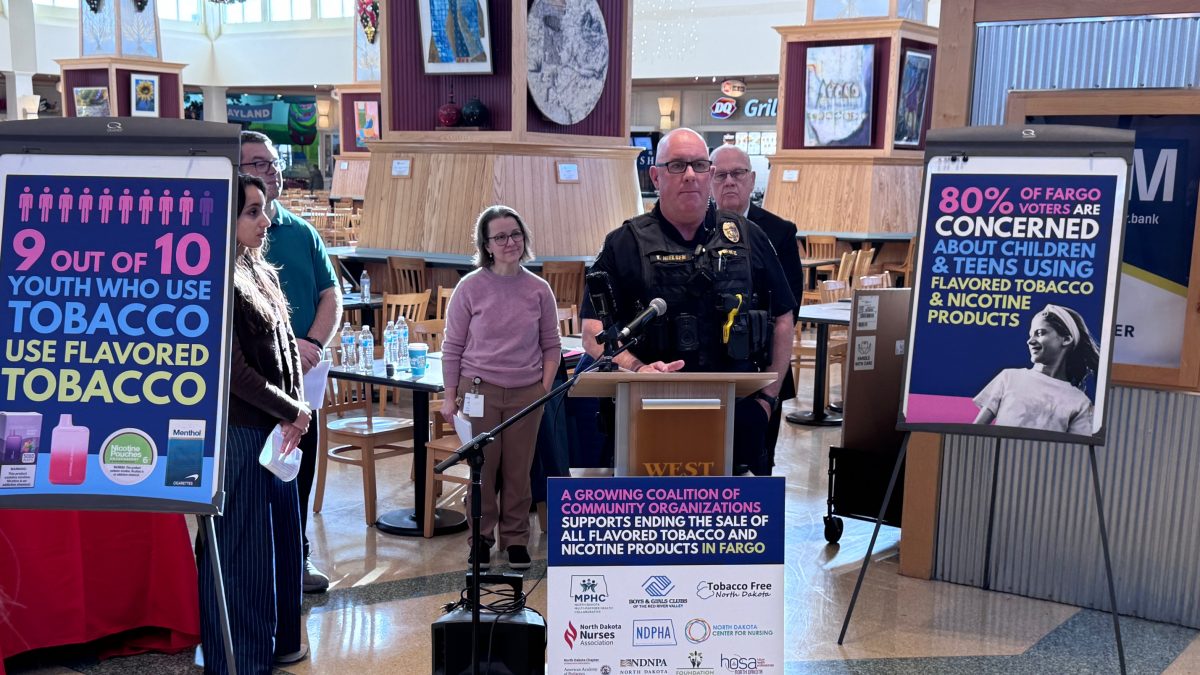
Nielsen pointed across the river to Clay County, Minnesota, where high school e-cigarette use fell from 24% to 8% over the last five years after Moorhead restricted flavored tobacco sales.
“Educators see the impact of nicotine addiction firsthand,” Nielsen said. “Students should be focused on learning, participating in activities and preparing for their futures. Flavored commercial tobacco and nicotine products make it easier for young people to start using nicotine, creating challenges not only for individual students but also for schools and families.”
Sanford Health pediatric specialist Dr. Stephanie Hanson warned that nicotine exposure during adolescence can harm cardiovascular health and disrupt brain development critical for learning, attention, and memory.
“Nicotine is highly addictive, and exposure during adolescence can interfere with critical brain development that affects learning, attention and memory,” Hanson said. “As physicians, we would much rather prevent addiction than treat its long-term health consequences. Reducing access to flavored commercial tobacco and nicotine products is an important step toward protecting the health of our children.”
Coalition co-chair Bernie Dardis, the former mayor of West Fargo, pushed back on arguments that a ban hurts local business.
“Protecting children from addiction and supporting economic vitality are not competing priorities,” Dardis said. “Communities across the country have demonstrated local action can make a difference. The real question is whether we are willing to stand up to industry practices which rely on attracting new, young customers.”
Dardis said.
Youth advocate and coalition co-chair Setiya Hamidi described watching a friend battle vaping addiction.
“What truly changed my perspective is when I watched one of my own friends battle with her vaping addiction,” Hamidi said. “Students understand exactly why flavors matter. We’ve watched classmates become addicted to products that were marketed as fun, harmless or appealing. Young people deserve adults who are willing to put their health first and protect them from products designed to hook the next generation.”
Hamidi said.
The coalition is urging residents to contact the mayor and city commissioners to advance a local flavor-ban ordinance.
Worth a look

Man Extradited From Nicaragua for Murder of Connecticut Mother; Baby Found in Bloody Blanket
Bridgeport police announced Wednesday that Douglas Jose Centeno-Vargas, 31, has been extradited from Nicaragua to face a murder...

Metropolitan Opera Premieres First Commissioned Opera by a Woman Composer
The Metropolitan Opera didn't just premiere a new work on October 19; it cracked open a door it...

North Dakota Governor Rescinds Statewide Drought Disaster Order as Rainfall Improves Conditions
Gov. Kelly Armstrong rescinded North Dakota's statewide drought disaster order Thursday, citing above-average September rainfall that lifted much...

American University Wrestling Tests 3-0 Start Against Purdue, No. 23 West Virginia
American University’s wrestling team puts its first 3-0 start since 2015 on the line Friday night against Purdue,...