
The Metropolitan Opera didn’t just premiere a new work on October 19; it cracked open a door it has kept shut for decades.
Missy Mazzoli and Royce Vavrek’s Lincoln in the Bardo became the first commissioned opera by a woman composer to reach the Met’s stage, a milestone the institution barely trumpeted even as it took the extraordinary step of livestreaming the final performance on YouTube for four days.
The move signaled something rarer than a premiere: confidence. The Met has grown stingy with its Live in HD series, excluding many new productions entirely, San Francisco Classical Voice reported. Leaving a full stream up for 96 hours suggested the company knows it has a crowd-pleaser — one that sold out houses and sparked a social-media blitz — and wants it to act as bait for first-time operagoers.
“What is opera if not a granting of that gift? It is an art form of distorted time,” wrote the New York Times, framing the adaptation of George Saunders’s 2017 novel as a natural fit for a medium where a single emotion can stretch across an act.
Saunders’s bardo — a Tibetan-inflected purgatory where spirits linger, unaware they are dead — arrives pre-scripted for the stage, its chorus of ghosts already speaking in overlapping voices that Vavrek shapes into a libretto of “artful vulgarity,” opening with the dead arguing about bodily functions.
A score built on ensemble color
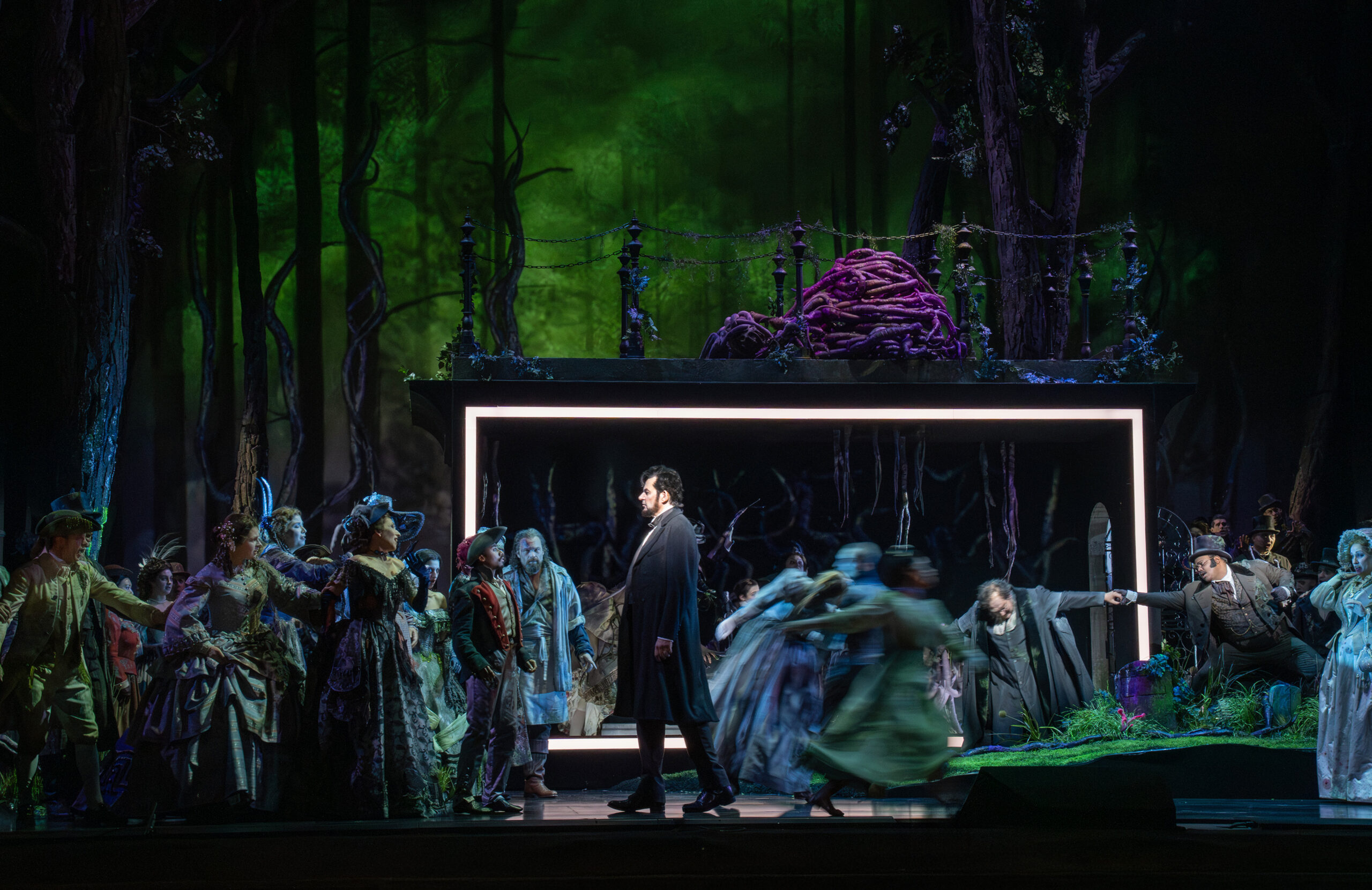
Mazzoli’s orchestration treats the Met’s massive forces like a chamber ensemble. A solo violin duels a vocalist; woodwinds echo a singer’s line like a halo; the ghost chorus sighs into kazoos. OperaWire noted the production dispensed with ceremony entirely — no overture, no house-light ritual — letting electronic sounds and a blue curtain set the mood before a note was sung. The effect, the outlet wrote, was “far more spiritual” than formal.
Peter Mattei’s Lincoln sings only in monologues, unable to perceive the spirits swarming around him. His baritone carries the opera’s emotional weight through long, soft orchestral phrases that circle and build. Everett Sobers matches him as Willie, the frightened son pleading across the veil.
But the work’s engine is its ensembles: Vollman and Bevins trade comic banter; the Reverend (Christine Goerke, relishing a pants role) delivers a crisis of faith; the monsters harmonize in eerie angelic chords; the villains sharpen into Thenardier-like grotesques.
Where the libretto stumbles
Vavrek condenses Saunders’s 166 ghosts to a dozen, a necessary surgery that keeps the two-plus hours propulsive. Yet both acts swerve late toward Black characters unconnected to the main action: Mrs. Francis Hodge (Janai Brugger), seeking vengeance for stolen children, and Thomas Havens (Joshua Blue), a formerly enslaved man who enters Lincoln’s consciousness to plead for the enslaved.
Their scenes carry affective musical weight — Mazzoli’s scoring turns eerily spectral — but the thematic stitching feels convenient. The “kinship” the two men sing of resolves a national trauma in a duet, and the dim, foggy staging renders it more fantasy than reckoning.
The second act, significantly shorter, loses momentum once father and son reach closure. The remainder is a prolonged farewell carried by choral singing. Willie’s final revelation to the spirits — that they are dead — lands flat, a libretto problem rather than a performance one.
An American partnership hitting its stride
Mazzoli and Vavrek have been forging a distinct operatic Americana since Proving Up in 2018: searchers and strivers undone by forces beyond their control — prairie monsters, cult leaders, predatory doctors, death itself. The Met premiere was originally slated for Los Angeles Opera; when that fell through, the composer found herself making history and her house debut on the same night. The company has commissioned women before, but never premiered one.
The Metropolitan Opera, founded in 1883 by industrialists excluded from the Academy of Music, is the largest classical music organization in North America. It presents about 18 operas each season in a rotating repertory, with up to four different works staged weekly. The company moved to its Lincoln Center home in 1966 and has been led by music director Yannick Nézet-Séguin since 2018.
The production, directed by Lileana Blain-Cruz, proves the Met’s stage can still serve grand opera’s original brief: lavish sets, huge casts, special effects, serious themes. Lincoln in the Bardo wears that mantle comfortably. Its misfires — the awkward racial pivot, the sagging second act — are forgivable because the foundation holds: a score that breathes, characters who matter, and a company willing, for once, to let the world watch for free.
Worth a look

Santa Fe Balances Ancient Roots With Modern Economic Pressure at 7,199 Feet
Santa Fe sits at 7,199 feet in the Sangre de Cristo Mountains, the oldest state capital in the...
ADOT, Phoenix, MAG Plan $240M Elevated Intersection at 35th, Indian School, Grand
Arizona transportation agencies are planning a $240 million elevated intersection at 35th Avenue, Indian School Road and Grand...
Hendrix Mock Trial Opens Season With Awards in Houston and Record Finish in Atlanta
Hendrix College Mock Trial Association began its 2026–2027 campaign by sweeping individual honors and a team sportsmanship award...

Wyoming County commissioners approved technology and infrastructure upgrades Tuesday
Wyoming County commissioners approved technology and infrastructure upgrades Tuesday, targeting aging 911 systems and county networks that officials...