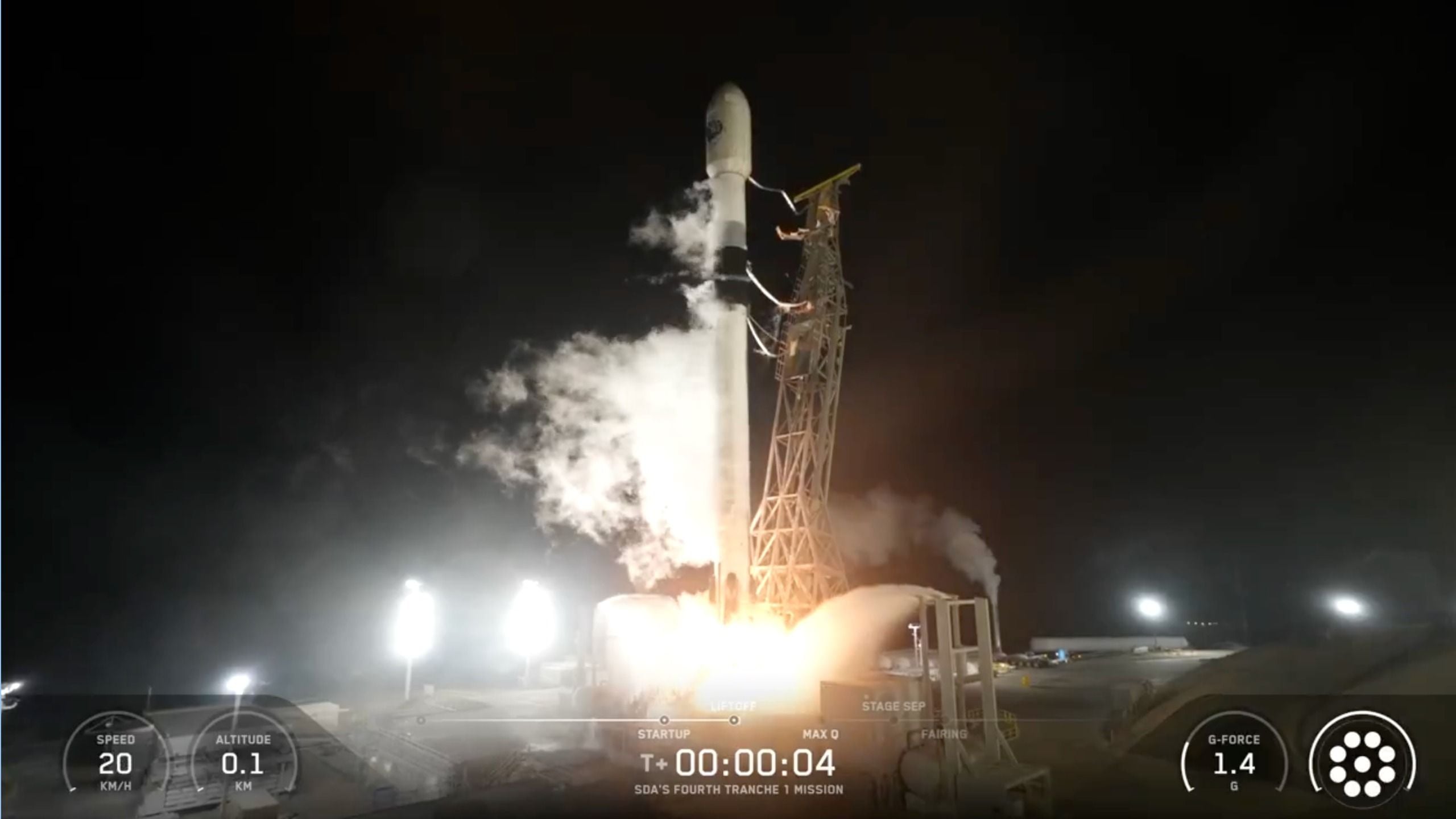
Following a five-day delay from an earlier countdown abort, a SpaceX Falcon 9 rocket successfully launched 21 data transport satellites for the U.S. Space Force’s Space Development Agency from California early Saturday morning.
SpaceX Launches 21 Data Transport Satellites After Five-Day Delay
Hauling a fresh batch of spacecraft for the military’s Space Development Agency (SDA), a Falcon 9 rocket lifted off from Space Launch Complex 4E at Vandenberg Space Force Base at 12:39 a.m. PDT. An auto-abort had halted the countdown with just 58 seconds remaining on October 5.
Booster 1103 returned to Vandenberg’s Landing Zone-4 just over seven minutes after launch, marking its sixth flight. Residents across Santa Barbara, Ventura, and San Luis Obispo counties experienced sonic booms during the descent of the booster, which previously flew the SDA’s July Tranche 1 mission alongside national security and commercial payloads.
Northrop Grumman Joins Tranche 1 With New Transport Layer Mission
Marking Northrop Grumman’s inaugural Tranche 1 launch, the 21 spacecraft aboard the rocket represent the Transport Layer A mission for Tranche 1, serving as the fourth installment in a constellation designed to support regional military communications, advanced missile warning, and beyond-line-of-sight targeting.
The Proliferated Warfighter Space Architecture relies on a mesh network of optically connected satellites in low Earth orbit. SDA Director Gurpartap Sandhoo emphasized the operational reality of scaling up production during a recent media briefing.
“It’s one thing to go through launch and early ops of one, two, maybe even three or four satellites. Twenty-one is a completely different ball of wax.”
Gurpartap Sandhoo, Director of the Space Development Agency
Three prior successful Tranche 1 launches have already placed 63 satellites into orbit.

Space Force Targets Late Spring 2027 for Complete Constellation
Tranche 1 will eventually comprise 154 operational spacecraft in low Earth orbit, split among 126 data-transport vehicles, 28 missile-tracking satellites, and four dedicated missile-defense test satellites equipped with high-fidelity infrared sensors, with agency leadership anticipating all Tranche 1 satellites in orbit by late spring 2027.
In May, the Department of Defense awarded SpaceX a $2.3 billion contract to build an operational prototype for the Space Data Network backbone by the end of next year.
More on Gurpartap Sandhoo
- Queen Camilla Recalls Secret Teenage Reading of Lady Chatterley’s Lover
- US Military to Execute Nidal Malik Hasan; Livestreaming Still Being Determined
- South Korea Foreign Ministry Says Jeong Cheong-rae Visa Delay Not Linked to South Korea-U.S. Relations (archyde.com)
- Up to 7 MHz Twice: What SpaceX's Reported $8 Billion Actually Buys (daybreakwire.com)

Queen Camilla Recalls Secret Teenage Reading of Lady Chatterley’s Lover
Queen Camilla has revealed she secretly read Lady Chatterley's Lover under her pillow by torchlight as a teenager...

US Military to Execute Nidal Malik Hasan; Livestreaming Still Being Determined
Defense officials confirmed Thursday that the United States military will livestream the upcoming firing squad execution of former...

Alex Pereira Questions UFC 334 Main Event Decision on Instagram
Alex Pereira has questioned the UFC 334 main event decision, arguing that a women's bantamweight title fight between...

President Cyril Ramaphosa Confirms Jacob Zuma is Hospitalized
President Cyril Ramaphosa confirmed on Friday, October 9, 2026, that former South African president Jacob Zuma is receiving...