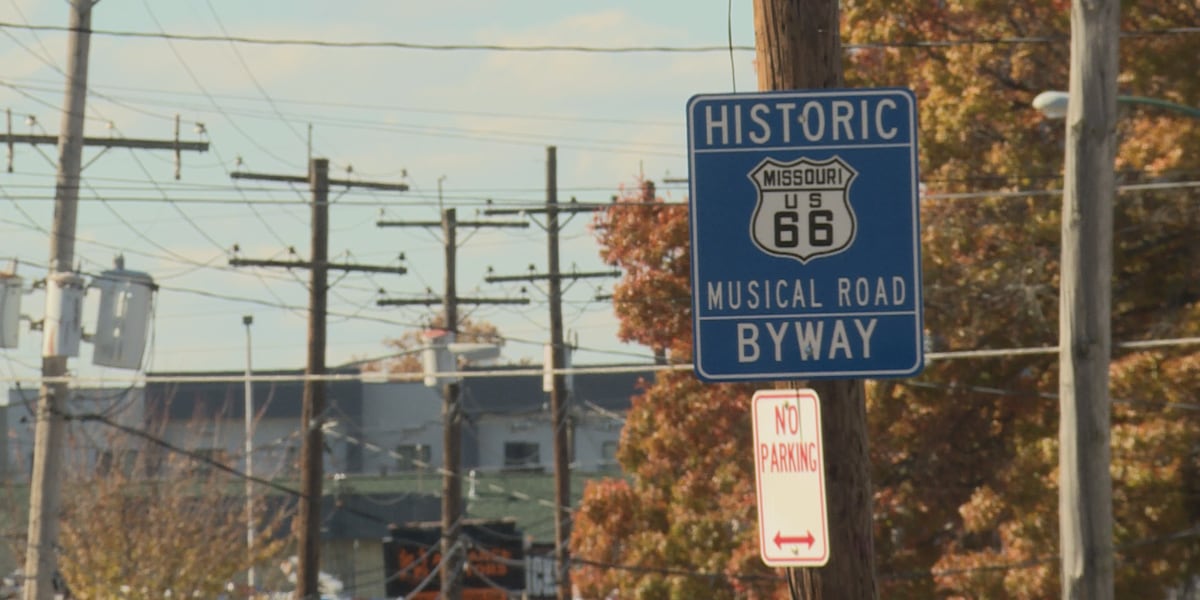
Springfield will pull up its musical rumble strips on Monday, ending a months-long experiment that turned a stretch of St. Louis Street into a giant phonograph for Route 66’s centennial.
City crews planned to remove the grooves near Queen’s Gate after the November 11 anniversary of the highway’s 1926 designation, KY3 reported. The strips were engineered to play “America the Beautiful” when drivers hit 45 mph, but the pavement cuts cannot survive a Missouri winter.
“It’s just very loud. Almost like a mosquito constantly buzzing around your ears. Or like a housefly you can’t get rid of,” said Blair Engemann-Bates, who owns Lagon Spa on the block. She runs brown-noise machines and her own soundtrack to mask the drone, and she worries the novelty encourages speeding rather than the slower, mindful driving the city hoped for.
“I think it’s encouraged people to drive even faster just to see what the song will sound like with that,” she told KY3. “I see bicycles on the street all the time, and it’s right next to the bike lane.”

Other neighbors have simply tuned it out. Staff at Latino Market and Nick Venute Law Offices say they barely notice the tune anymore. At Mother Road Motorcycles and Cantrell-Barnes Printing, the sound has faded into the background of daily work.
The musical road was always meant to be temporary, used to celebrate both the highway’s 100th birthday and America’s 250th.
City of Springfield officials
Springfield bills itself as the birthplace of Route 66, the name having been formally proposed in a 1926 telegram sent from the city’s Colonial Hotel. The centennial brought parades, festivals, and a surge of heritage tourism to the Mother Road’s midpoint. The musical strip — one of only a handful in the United States — was installed this spring as a marquee attraction.
Rumble-strip songs rely on precise groove spacing; freeze-thaw cycles widen the cuts and destroy the pitch. Transportation departments in New Mexico, California, and Arizona have all scrapped similar pilots after a single winter. Springfield’s contract with the installer specified removal before the first hard freeze.
Route 66 was designated on November 11, 1926, and eventually stretched 2,448 miles from Chicago, Illinois, to Santa Monica, California, crossing Missouri and six other states. It became the first U.S. highway to be fully paved in 1938 and served as a primary corridor for westward migration during the Dust Bowl of the 1930s.
The highway was formally decommissioned in 1985 after being largely supplanted by the Interstate Highway System, though many segments survive as Historic Route 66, a National Scenic Byway.
Monday’s work will mill the top layer of asphalt and repave the segment, restoring standard lane markings and the adjacent bike lane. The city has not announced a replacement centennial feature.

Pennsylvania Farmers Call for Visa Reform, End to Aggressive ICE Tactics
More than 30 Pennsylvania farmers, agribusinesses and organizations endorsed a letter to U.S. Agriculture Secretary Brooke Rollins and...

Franciscan Health Runs Free Lactation Clinics, Phone Support in Indiana
Franciscan Health runs outpatient lactation clinics staffed by registered nurses who hold international board certification, offering Indianapolis-area families...

UAlbany Study: Google AI Hurricane Model Outperforms NOAA Model at 1-5 Days, Matches Human Forecasters After Day 1
Google DeepMind's WeatherNext Cyclone model predicted Hurricane Melissa's track and Category 5 strength a week before landfall in...

Former Moorhead Truck Driver Gets Probation in Crash That Killed Adam Amin, 9
Victor Port, the 65-year-old former Moorhead city truck driver, pleaded guilty Thursday to a single misdemeanor charge tied...