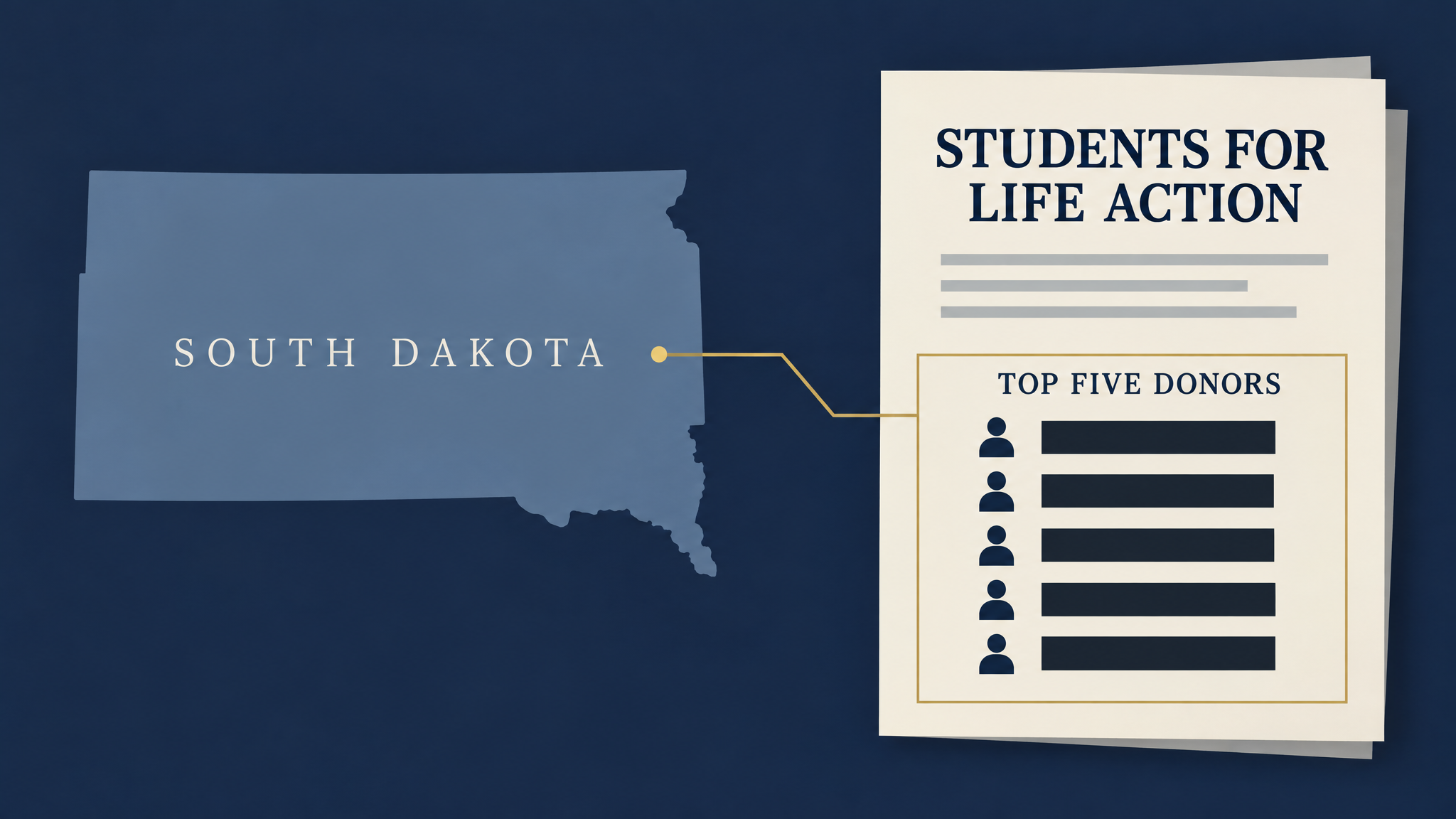
A student-led anti-abortion organization asked a federal appeals court on Wednesday to strike down a South Dakota law that mandates the disclosure of top donors on political communications.
The case, heard before a three-judge panel of the U.S. Court of Appeals for the Eighth Circuit, centers on whether the state’s donor disclosure requirements impose an unconstitutional burden on free speech and association.
Students for Life Action, a nonprofit that mobilizes supporters to influence public policy, initiated the legal challenge in 2023. The group argues that South Dakota’s statute—which requires any entity spending more than $100 on independent political communications to list their five largest donors—effectively forces them to carry government-mandated speech.
The organization contends that this requirement lacks an opt-out mechanism for donors who may not intend for their contributions to fund election-related activities.
Jeffrey M. Schwab, director of litigation for the Liberty Justice Center, represented the nonprofit during the 30-minute hearing. He argued that the law’s broad application, coupled with its lack of a temporal limit or a mechanism for donors to earmark funds away from political spending, creates a chilling effect on civic participation.
According to Courthouse News Service, Schwab emphasized that no federal court has upheld a disclosure statute with such a combination of features, including a minimal $100 trigger and the threat of criminal penalties for noncompliance.

“No federal court has upheld a disclosure statute with its combination of features, requiring organizations to list their five top largest general donor on every covered message, with no off-ramp for donors, a negligible $100 trigger, no temporal time limit to any election, and criminal penalties,” said Jeffrey M. Schwab, director of litigation at the Liberty Justice Center, as reported by Khanlist.com.
The Standing Dispute and State Defense
The state of South Dakota maintains that the challenge is procedurally flawed. Assistant Attorney General Grant M. Flynn argued that the lower court correctly determined the group lacked standing to sue because the law does not actually apply to their specific activities.
The state asserts that the disclosure requirements are triggered only by “express advocacy”—communications that clearly support or oppose a candidate—rather than the “issue advocacy” that the nonprofit claims to perform.
Flynn said that because the organization has disavowed any intent to engage in express advocacy, they are under no obligation to list donors, as they do not receive what the statute defines as a “contribution.”
He pushed back against the nonprofit’s characterization of the law’s complexity, arguing that the group failed to point to specific precedents where courts struck down similar statutes for lacking the exact features they now contest.
The tension in the courtroom highlighted a fundamental disagreement over how to interpret donor intent. Schwab told the panel that the government’s reliance on the term “contribution” creates a vague standard, forcing organizations to guess a donor’s intent to comply with the law. Without a clear way to know if a donor intended to influence an election, the group remains at risk of potential criminal penalties.
Legal Stakes for Nonprofits
The panel of judges, comprised of U.S. Circuit Judges Steven M. Colloton and Bobby E. Shepherd, both appointees of George W. Bush, and Jane Kelly, an appointee of Barack Obama, took the case under advisement. There is currently no set timetable for a ruling.
As it stands, the court must decide whether the state’s interest in transparency overrides the concerns of an organization that argues its members deserve the right to support policy advocacy without being forced into the public eye. The legal battle remains active, with the Liberty Justice Center continuing its push to protect private association rights as a foundational element of the nonprofit’s mission.
Worth a look
Sanders Backs Van Hollen for Leader; Welch Undecided
Bernie Sanders endorsed Chris Van Hollen for Senate majority leader, breaking with Vermont's junior senator Peter Welch, who...
Wake Forest, Texas, Utah, Indiana Surge in College Football Playoff Odds
That means teams that were in a good spot to make the CFP have solidified their position. Georgia...

Sam Houston WBB Travels to ULM; Justice One Win Shy of Milestone
Sam Houston sits at 2-2 after a 72-58 loss at Northern Colorado, and the Bearkats have yet to...
MSU Basketball Crashes to 61-46 Loss at Tennessee on 18% Shooting
Michigan State basketball fell 61-46 to Tennessee on Tuesday, Nov. 17, after shooting just 18% from the floor...