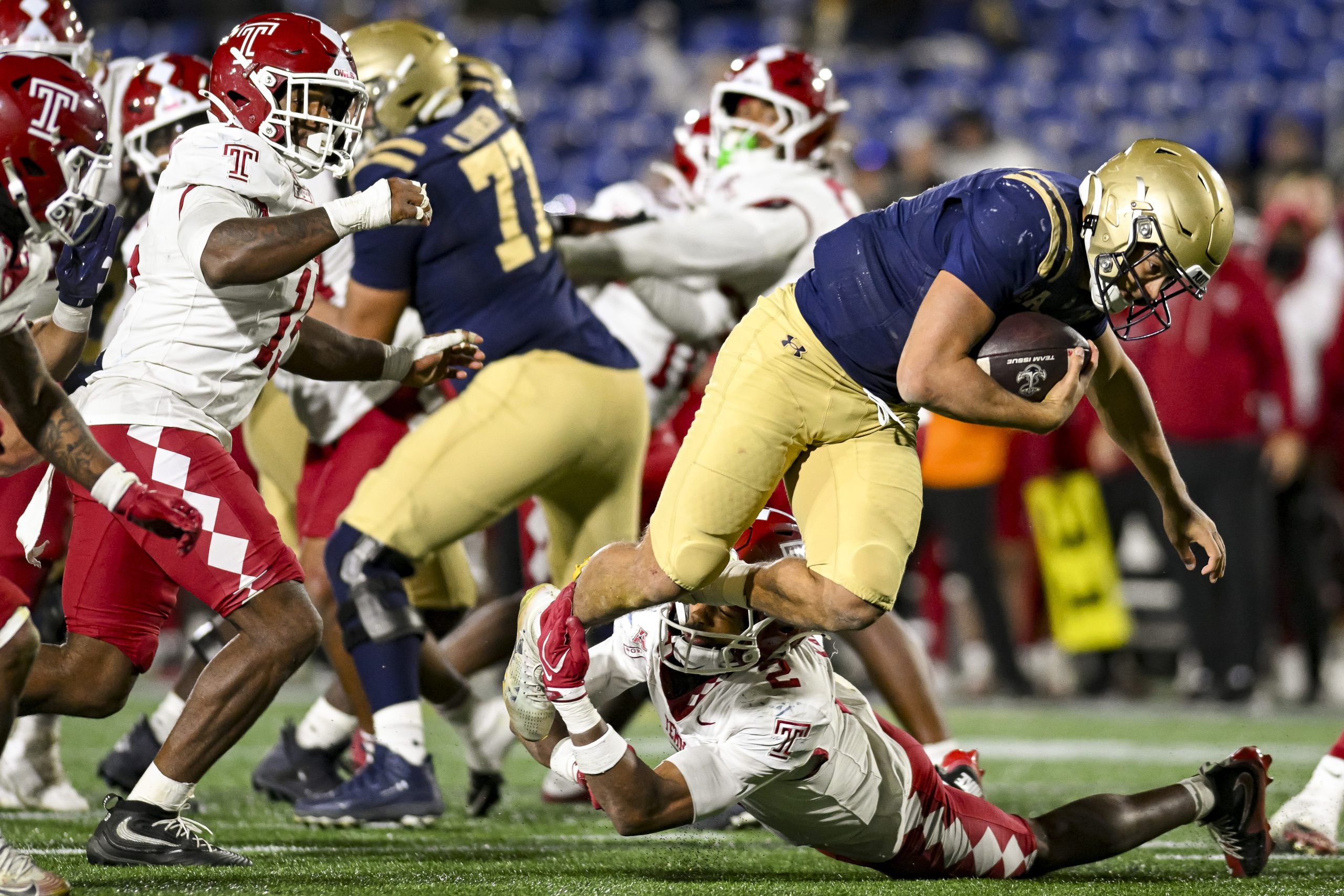
A Lesson in Annapolis: Football, History, and the Temple Owls
Driving down Route 301, the world seems to quiet down.
The stretch through Delaware and Maryland offers a rare, rhythmic peace for anyone heading toward the Chesapeake. Last Saturday, that drive led to Annapolis, where the atmosphere at the Navy-Marine Corps Memorial Stadium provided a stark contrast to the lopsided scoreline on the field.
As reported by Crossing Broad, the Temple Owls found themselves in a 28-0 hole by halftime, eventually falling 42-35 in a desperate, late-stage comeback attempt that left the 2-7 Owls searching for answers.
The experience of visiting Annapolis is, in a word, compelling. The town itself feels like a deliberate blend of Boston’s colonial charm, Baltimore’s maritime grit, and the familiar pulse of a college town. Yet, the presence of the United States Naval Academy creates a distinct gravity.
Walking through streets lined with brick and docking areas packed with locals and visitors, the distinction between a standard university and a military institution blurs. It is a place where 20-something Gen Z culture meets the rigid, disciplined history of the armed forces.

The Weight of History on the Sidelines
The stadium, originally constructed in 1959 and updated two decades ago, lacks the modern gloss of newer facilities. It feels utilitarian, grounded in concrete and purpose. What truly sets it apart, however, is the lack of player names adorning the stadium’s perimeter.
Instead, the walls are inscribed with the names of battles—Iwo Jima, Mekong Delta, Midway. When the cadets march in and military aircraft break the silence overhead, the football game itself feels secondary. It is an air of reverence that persists even when the actual play on the field struggles to meet the intensity of the surroundings.
For the Temple program, the reality of the 2026 season has been defined by narrow margins and missed opportunities. The team has recorded five one-score losses this year, suggesting coaching and late-game execution are problematic. K.C. Keeler, who arrived with a formidable reputation, is now in his third losing season at the FBS level.
Following a 3-9 start at Sam Houston and a 5-7 campaign at Temple last year, the current 2-7 record marks a troubling trend. Despite a favorable conference schedule that excluded North Texas and UTSA, the team is officially out of bowl contention.
Navy 42, Temple 35. Seven points in it, and @Temple_FB hands over six marbles in Annapolis. The Owls leave with 26, and @NavyFB is up to 39.#GoNavy #TempleTUFF #ForAllTheMarbles Presented by @gamedayhue pic.twitter.com/nN4kJhMsur
The Search for a Playmaker
The first half of the Navy game was, frankly, an indictment of the Owls’ current offensive identity. Quarterback Jaxon Smolik struggled to find his rhythm, finishing 12 for 26 with 173 yards.
While he improved in the second half, his performance did little to silence the debate over whether he should be the starter over an injury-plagued Ajani Sheppard. The offensive line remains a point of concern, with injuries further complicating pass protection and the team’s ability to establish a consistent running game.
The most glaring issue, however, was the usage of JoJo Bermudez. He was unequivocally the best player on the field, housing a punt before halftime and snagging a 41-yard screen pass for a touchdown. Yet, he finished the day with only two receptions.
Seeing him absent from the formation during key stretches in the third quarter was baffling. For a team struggling to generate offense, failing to keep your primary playmaker in the mix is a tactical error that the coaching staff must address.
A Program at a Crossroads
The question of “coaching” is one that haunts programs like Temple. While Keeler made defensive adjustments following the loss to Charlotte, the offense remained stagnant against ECU and for the first half of the Annapolis trip.
The decision to call a timeout just before the half to force a punt—thereby giving Bermudez a chance to make a play—was the smartest bit of strategy seen all day. It was a flash of competence in an otherwise grim performance.
Ultimately, a trip to Annapolis is a bucket-list item for any college football fan. It is accessible, historic, and offers a perspective on the sport that is rarely found in the polished, commercialized environments of bigger programs.
But for Temple, the visit was a reminder of the gap between potential and execution. As the season winds down, the Owls are left with more questions than answers, and a program that seems to be searching for its own identity in a league that waits for no one.

Related reading

University of Wyoming Earns 2026 CPN Seal of Prevention for Student Well-Being Excellence
The University of Wyoming has earned the 2026 Campus Prevention Network (CPN) Seal of Prevention, a distinction held...

Northeast Wisconsin Snowfall Thresholds Remain Unmet for 2026 Season
Green Bay and the Fox Valley have yet to record their first measurable snowfall for the 2026 season....
Sanda and Jerry Lambert lead new Lambert Institute at Mount Vernon
The Lambert Institute for Digital History and Innovation George Washington's Mount Vernon is expanding its scope of historical...
Tax Payment Deadline November 13 at 4:00 PM
Montgomery residents have until 4:00 p.m. this Friday, November 13, to pay their tax bills in full, according...