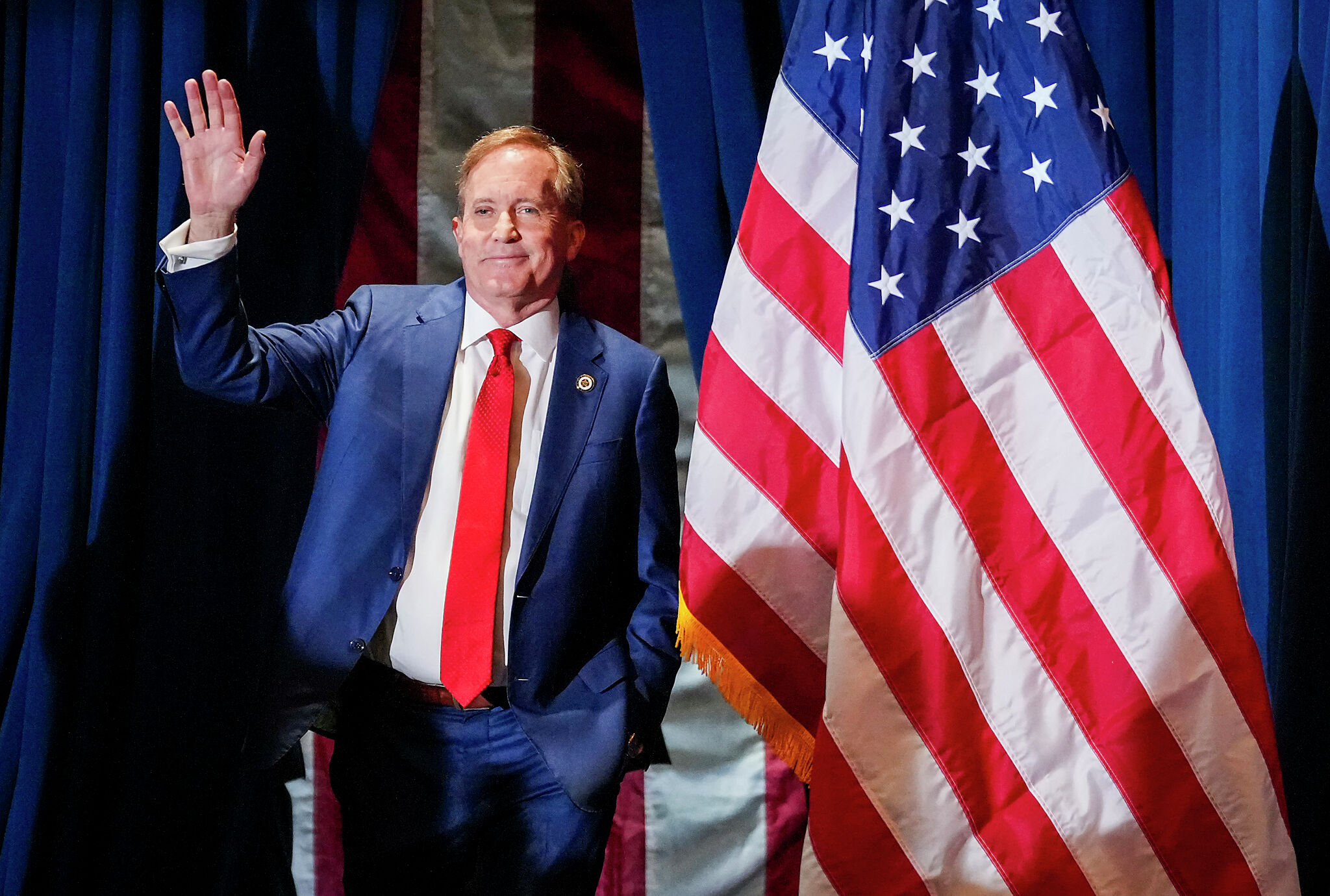
Texas Attorney General Ken Paxton dropped his lawsuit against the Democratic fundraising platform ActBlue on Friday, effectively ending a federal case that a judge had already ruled was likely filed in retaliation for the platform’s support of his Senate opponent.
The dismissal, filed in the U.S. Court of Appeals for the First Circuit, came with prejudice — meaning Texas cannot refile the same claims — and was paired with the withdrawal of a companion suit in state court the same day. Dallas News reported that the move is the latest in a string of abandoned lawsuits since Nathan Johnson won the attorney general’s race.
“The dismissal of the ActBlue case marks an important end to one of the clearest examples of political retaliation challenged in federal court,” said Sam Robles, director of the Texas Nonprofit Protection Network and a leader of the coalition that opposed the suit. “The incoming administration and the Texas Legislature must confront this abuse of government power and put safeguards in place to ensure it never happens again.”
Johnson, who beat Republican state Sen. Mayes Middleton of Galveston in the attorney general’s election, applauded the dismissals “irrespective of the likely political motivation,” calling them “the first tangible and important result of the election.” Paxton’s office did not respond to requests for comment Friday.

The lawsuit and the injunction that stopped it
Paxton filed the original lawsuit on April 20 in Tarrant County District Court, alleging ActBlue violated the Texas Deceptive Trade Practices Act by misrepresenting its safeguards against fraudulent donations. The complaint centered on the platform’s acceptance of prepaid gift cards, which Paxton argued could conceal donor identities and facilitate illegal foreign contributions or donations exceeding federal limits.
ActBlue denied knowingly facilitating illegal donations and countersued in federal court on May 1, arguing the investigation violated its First Amendment rights. The Massachusetts-based company said the enforcement action was politically motivated to undermine fundraising for James Talarico, who defeated Paxton in the November 3 U.S. Senate race.
On June 11, U.S. District Judge Richard G. Stearns issued a preliminary injunction halting the state lawsuit. In his written decision, Stearns concluded the evidence supported ActBlue’s retaliation claim. “The truth is plain and captured in Paxton’s own declarations: The lawsuit was filed in retaliation for (and in an attempt to suppress) ActBlue’s efforts to fund Talarico’s campaign,” Stearns wrote.

The judge examined the timing closely. Talarico reported raising $2.5 million in a single day in February, with approximately $2.2 million processed through ActBlue. Investigators from Paxton’s office began conducting test transactions using gift cards shortly after that fundraising surge became public, court records show. Investigators successfully completed three small donations, while additional attempts were rejected by ActBlue’s payment system.
A pattern of abandoned cases
The ActBlue dismissal is not an isolated event. Since losing election, Paxton’s office has moved to drop or end involvement in multiple lawsuits critics describe as partisan lawfare. These actions involve halting legal proceedings against Houston and El Paso immigration advocacy groups, withdrawing a lawsuit regarding transgender athletes and the NCAA, and stopping an attempt to prevent a Muslim civil rights group from functioning in Texas.
Robles said the litigation forced dozens of community organizations to spend time and money defending themselves. “This pattern of intimidation was designed to silence organizations, discourage civic participation, and make nonprofit leaders think twice about doing their work,” she said.
Republican allegations and ActBlue’s defense
Republicans in Congress have long criticized ActBlue for allegedly allowing foreign donations through loopholes in federal campaign finance law, which permits only U.S. citizens and alien permanent residents with “Green Cards” to donate to candidates.
U.S. House Speaker Mike Johnson (R-La.) wrote in 2024 that “illicit overseas donors are using the corrupt Democrat donor platform ActBlue to exploit campaign finance loopholes and make donations in the names of people without their knowledge.”
ActBlue, founded in 2004, has been central to Democratic fundraising, notably enabling Bernie Sanders to eschew super PAC money in his 2016 and 2020 primary campaigns. During the 2020 Democratic Party presidential primaries, all candidates utilized the platform. Furthermore, in the 2005–2006 campaign alone, the site raised $17 million for 1500 Democratic candidates.
Regina Wallace-Jones testified before the House Administration Committee on June 10, denying illegal activity. She repeatedly invoked her Fifth Amendment rights against self-incrimination during the hearing, drawing criticism from Republican lawmakers. “President Trump and his allies are abusing their power to target ActBlue,” Wallace-Jones said in a statement about the hearing. “Invoking the Fifth Amendment is not an admission, or even an insinuation, of guilt.”
Worth a look

Woman Banging Head Against NH Home Before Break-in, Assault, Police Say
"We're just pretty shook up," the homeowner told NBC10 Boston. "It feels traumatic, especially when you try and...

NJ Son Confessed to Killing Mother After Months of Planning, Prosecutors Say
Marcus Toth, 26, walked into the Clark Police Department on Thursday afternoon and told an officer he had...

Independent Audit Suggests Changes to Wisconsin School District Report Cards
Wisconsin school report cards face scrutiny as an independent audit suggests changes are needed for statutory performance reporting...

Maryland Reparations Commission Holds First Meeting After Roadblocks
"This is very important work that is long overdue," said Stephanie Franklin, a civil rights attorney and one...