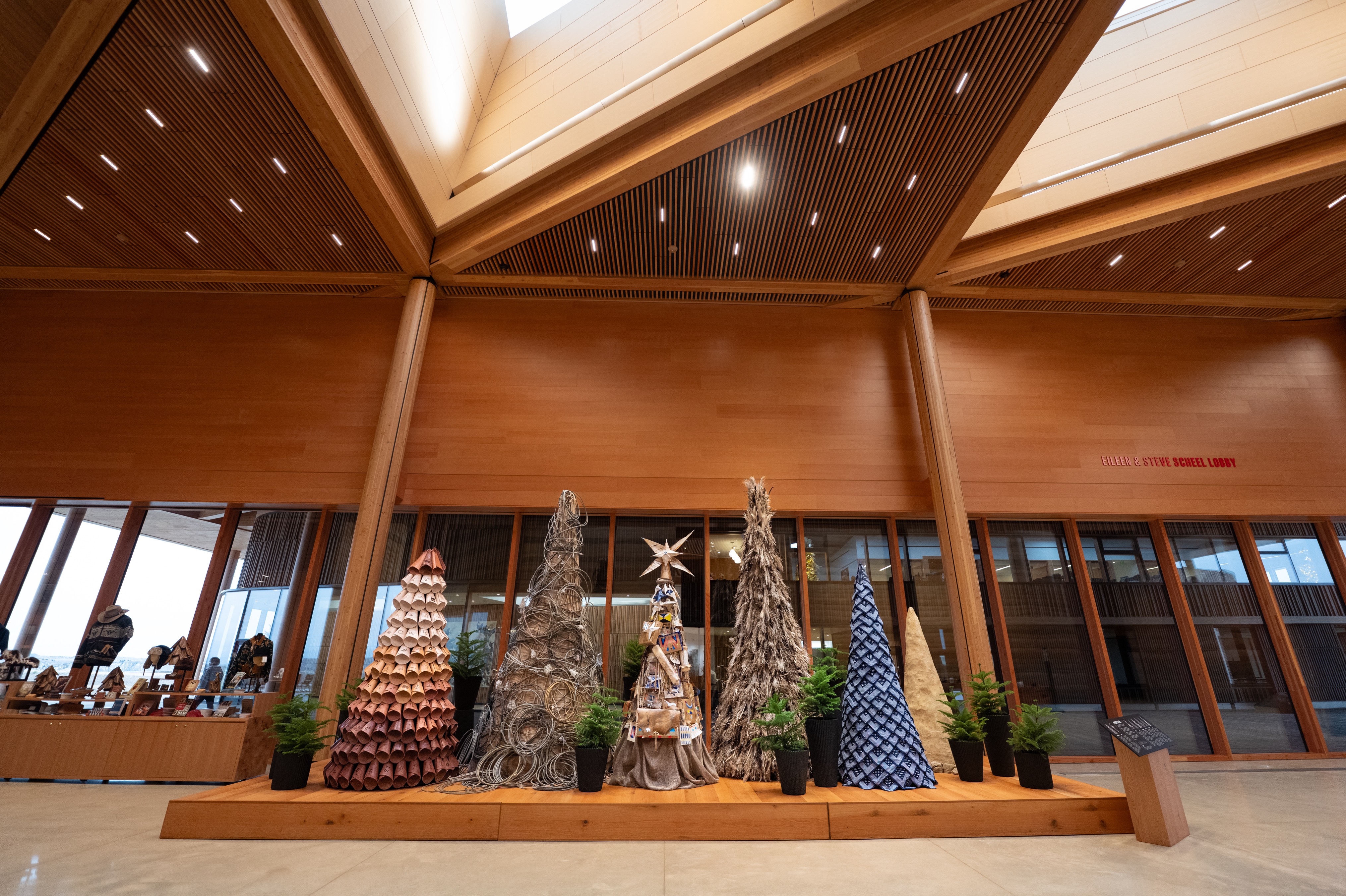
The Theodore Roosevelt Presidential Library unveiled its first holiday installation Friday night, lighting six artisan trees built entirely from the raw materials of North Dakota life — ranch leather, working lariats, native grasses, parfleche, bandanas and Badlands clay.
The exhibit, titled Spirit of the Land, serves as the centerpiece of Christmas at the Elkhorn, the library’s inaugural holiday season since opening on July 4, 2026. The trees were illuminated for the first time at a free Holiday Open House on November 20, according to a release distributed by GlobeNewswire.
“The materials came from across the state,” the library said in its announcement. “Ranchers and ropers sent lariats. Families shared the brands that carry their histories. Volunteers gathered grasses from landscapes they know by heart.”

The painted parfleche packages on the tree, created by artist Prairie Rose Seminole, an enrolled citizen of the Mandan, Hidatsa and Arikara Nation, honor the rawhide containers Plains Indigenous peoples used to carry and protect belongings, and celebrate generosity and sharing.
Each of the six trees represents a distinct thread of the region’s identity. The leather tree bears 64 brands from North Dakota ranching families, historic ranches and institutions — among them Theodore Roosevelt’s own Maltese Cross and Elkhorn brands and the Connolly family brand, first recorded in 1890, the year the territory began registering brands. Rick Buchholz and Wade Benson alone contributed more than thirty well‑worn latigos.
The lariat tree cascades with donated rope that has worked cattle in the same country Roosevelt ranched in the 1880s. The parfleche tree, crafted by Prairie Rose Seminole, honors the rawhide containers Plains Indigenous peoples used to carry and protect belongings. Five native grasses — western wheatgrass, green needlegrass, needle‑and‑thread, blue grama and prairie Junegrass — form the grass tree, gathered by volunteers from the mixed‑grass prairie.
Blue polka‑dot bandanas, long associated with Roosevelt’s Rough Riders, make up the bandana tree. The clay tree pays tribute to the layered geology of the Badlands and to Hebron Brick Company, which has fired brick from North Dakota claystone since 1904.
The installation was designed by JLG Architects under the creative direction of Matthew Dunham, with fabrication by Ashley Rieck of Tinker Experiential Design. Traditional illuminated trees and living Norfolk Island pines extend the display through the 96,000‑square‑foot building, trimmed with willow and boxelder branches and gold ornaments recalling the Northern Pacific’s 1883 Golden Spike celebration — the year Roosevelt first arrived in the Badlands by rail.
Ceramic vessels by Thomas Christnagel and Giulio Angotti of North Dakota State University, shaped from Hebron clay and pressed with bur oak leaves and prairie grass patterns, accompany the exhibit. A Seek & Find game hides six animal constellations among the branches for younger visitors.
The library sits on a 93‑acre butte above Medora at the edge of Theodore Roosevelt National Park.
Programming runs through April. Museum Store Sunday opens the season November 29 with gifts from regional makers. The Midwinter Table on December 4 seats 75 for a $150 dinner by Executive Chef Candace Stock of Salt + Scoria, with producers at the table.
Elkhorn Evenings on December 10 and 17 keep the library open until 8 p.m. for an outdoor Branding Market and charcuterie building. Family crafting sessions drop in December 13, 19, 20 and 23. Santa visits December 17 at 6 p.m. and December 19 at 1 p.m. A butchery workshop on January 24, 2027, limited to eight participants, costs $225 or $275 with a branded cutting board.
The complete list of brands on the leather tree, full credits and short films on how the trees were made are available at trlibrary.com/holidaytrees.
Worth a look

Spartz Asks EPA to Review Alexandria Water After Resident Complaints
Outgoing Indiana Congresswoman Victoria Spartz has asked the U.S. Environmental Protection Agency to step into a drinking-water dispute...

New Jersey Extreme Risk Protective Orders: Civil Gun Seizure Standard and Process
New Jersey residents can lose their firearms through a civil court order that requires only a preponderance of...

Oklahoma First State to Review Special Education Textbooks for Students With Significant Cognitive Disabilities
Oklahoma's State Textbook Committee voted Friday to create a "special education alternate" category for its 2027-28 adoption cycle,...
University of Montana Uses Steppingblocks Data to Connect Students With Alumni Careers
Fifteen years ago, as an environmental science major, Justin Gay felt daunted by the task of choosing a...